Skip to main content
Macroeconomics
My Course
Learn
Exam Prep
AI Tutor
Study Guides
Flashcards
Explore
Try the app
My Course
Learn
Exam Prep
AI Tutor
Study Guides
Flashcards
Explore
Try the app
Back
Dynamic AD-AS Model: Fiscal Policy definitions
You can tap to flip the card.
Dynamic ADAS Model
You can tap to flip the card.
👆
Dynamic ADAS Model
A framework where aggregate supply and demand curves shift rightward annually, reflecting ongoing economic growth.
Track progress
Control buttons has been changed to "navigation" mode.
1/14
Related flashcards
Related practice
Recommended videos
Dynamic AD-AS Model: Fiscal Policy quiz
Dynamic AD-AS Model: Fiscal Policy
15 Terms
Dynamic AD-AS Model: Fiscal Policy
23. Dynamic AD/AS Model
10 problems
Topic
Dynamic AD-AS Model: Monetary Policy
23. Dynamic AD/AS Model
10 problems
Topic
25. Dynamic AD/AS Model
4 topics
15 problems
Chapter
Guided course
05:25
Dynamic AD-AS Model: Expansionary Fiscal Policy
1146
views
8
rank
Guided course
03:59
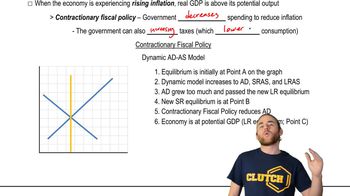
Dynamic AD-AS Model: Contractionary Fiscal Policy
838
views
5
rank
Terms in this set (14)
Hide definitions
Dynamic ADAS Model
A framework where aggregate supply and demand curves shift rightward annually, reflecting ongoing economic growth.
Long Run Aggregate Supply
A curve representing the economy's maximum sustainable output, increasing each year in the dynamic model.
Short Run Aggregate Supply
A curve showing total production at current prices, shifting rightward over time due to economic growth.
Aggregate Demand
A curve reflecting total spending on goods and services, influenced by government actions and shifting annually.
Expansionary Fiscal Policy
A government approach involving increased spending or tax cuts to boost aggregate demand during a recession.
Contractionary Fiscal Policy
A government strategy using reduced spending or higher taxes to decrease aggregate demand and control inflation.
Potential GDP
The level of output an economy can achieve when operating at full capacity, serving as a target for equilibrium.
Long Run Equilibrium
A state where aggregate demand, short run, and long run aggregate supply intersect, indicating economic stability.
Short Run Equilibrium
A temporary point where aggregate demand and short run aggregate supply meet, possibly away from potential GDP.
Government Spending
Expenditures by the public sector, directly affecting aggregate demand and used as a fiscal policy tool.
Taxation
A fiscal lever involving adjustments to taxes, impacting consumption and aggregate demand.
Recession
A period when real GDP falls below potential, prompting policies to stimulate aggregate demand.
Inflation
A situation with rising price levels, often resulting from aggregate demand exceeding potential GDP.
Price Level
An index reflecting the average prices of goods and services, used to track inflation or deflation.
 BackBack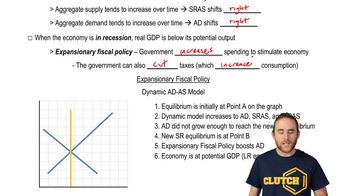
 05:25
05:25