Back

Economic Surplus and Efficiency definitions

Control buttons has been changed to "navigation" mode.
1/15
  • Economic Surplus

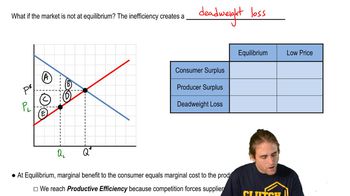
    Sum of gains to buyers and sellers, representing total net benefit from market transactions at a given price and quantity.
  • Consumer Surplus

    Area between the demand curve and market price, showing extra value buyers receive over what they pay.
  • Producer Surplus

    Area between market price and supply curve, reflecting extra earnings sellers receive above their minimum acceptable price.
  • Market Equilibrium

    Point where supply and demand intersect, ensuring no unexploited gains from trade and maximum total surplus.
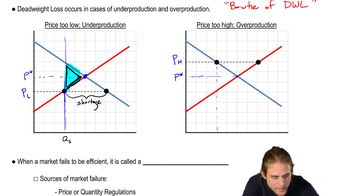
  • Deadweight Loss

    Lost potential surplus from trades that do not occur due to market inefficiency, often visualized as the 'bowtie' area.
  • Shortage

    Situation where quantity demanded exceeds quantity supplied, typically resulting from prices set below equilibrium.
  • Surplus

    Condition where quantity supplied exceeds quantity demanded, usually caused by prices above equilibrium.
  • Allocative Efficiency

    State where resources are distributed to match consumer preferences, achieved when the right amount of goods is produced.
  • Productive Efficiency

    Condition where goods are produced at the lowest possible cost, driven by competition among suppliers.
  • Marginal Benefit

    Additional value a consumer places on one more unit of a good, represented by the demand curve.
  • Marginal Cost

    Extra cost to producers for making one more unit, depicted by the supply curve.
  • Market Failure

    Breakdown in market efficiency, often due to regulations, externalities, monopoly power, or high transaction costs.
  • Externality

    Unintended cost or benefit affecting those not directly involved in a market transaction, such as pollution.
  • Monopoly

    Market structure with a single seller, allowing control over price and often leading to inefficiency.
  • Transaction Costs

    Expenses incurred in making an exchange, which can prevent beneficial trades if excessively high.