Back

Economic Surplus and Efficiency quiz

Control buttons has been changed to "navigation" mode.
1/15
  • What is economic surplus in a market?

    Economic surplus is the sum of consumer surplus and producer surplus, representing the total surplus in a market.
  • At what point is economic surplus maximized?

    Economic surplus is maximized at market equilibrium, where supply and demand intersect.
  • How is consumer surplus represented on a supply and demand graph?

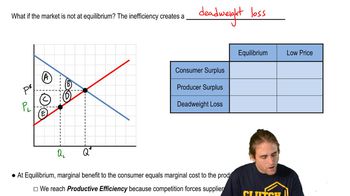
    Consumer surplus is the area below the demand curve and above the market price.
  • How is producer surplus represented on a supply and demand graph?

    Producer surplus is the area above the supply curve and below the market price.
  • What happens to economic surplus when the market is not at equilibrium?

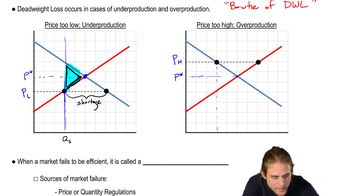
    When the market is not at equilibrium, economic surplus is reduced and deadweight loss occurs.
  • What is deadweight loss?

    Deadweight loss is the loss of potential economic surplus due to inefficiency, such as underproduction or overproduction.
  • What causes deadweight loss in the case of underproduction?

    Underproduction causes deadweight loss because trades that would have benefited society do not occur, resulting in a shortage.
  • What causes deadweight loss in the case of overproduction?

    Overproduction causes deadweight loss because resources are wasted producing goods beyond the equilibrium quantity, resulting in excess supply.
  • Where does deadweight loss appear on the supply and demand graph?

    Deadweight loss appears in the 'bowtie' area between the supply and demand curves, either on the left for underproduction or right for overproduction.
  • What is the key formula for efficiency in a market?

    Efficiency is achieved when marginal benefit equals marginal cost, which occurs at market equilibrium.
  • What is productive efficiency?

    Productive efficiency means suppliers produce goods at the lowest possible cost, often due to competition at equilibrium.
  • What is allocative efficiency?

    Allocative efficiency occurs when the correct amount of goods is produced to satisfy consumer preferences at equilibrium.
  • What is a market failure?

    A market failure occurs when the market does not operate efficiently, failing to reach equilibrium and maximize surplus.
  • Name two causes of market failure.

    Market failure can be caused by price or quantity regulations, externalities, monopolies, or high transaction costs.
  • What is an externality and how can it cause market failure?

    An externality is a cost or benefit affecting people outside a transaction, such as pollution, which can prevent the market from reaching equilibrium.