Skip to main content
Macroeconomics
My Course
Learn
Exam Prep
AI Tutor
Study Guides
Flashcards
Explore
Try the app
My Course
Learn
Exam Prep
AI Tutor
Study Guides
Flashcards
Explore
Try the app
Back
Exchange Rates: Fixed, Flexible, and Managed Float definitions
You can tap to flip the card.
Exchange Rate
You can tap to flip the card.
👆
Exchange Rate
The value at which one nation's currency can be traded for another's, often fluctuating due to market forces or policy.
Track progress
Control buttons has been changed to "navigation" mode.
1/15
Related flashcards
Related practice
Recommended videos
Exchange Rates: Fixed, Flexible, and Managed Float quiz
Exchange Rates: Fixed, Flexible, and Managed Float
15 Terms
Exchange Rates: Fixed, Flexible, and Managed Float
Exchange Rates
9 problems
Topic
Exchange Rates: Purchasing Power Parity
Exchange Rates
9 problems
Topic
23. Exchange Rates
9 topics
15 problems
Chapter
Guided course
05:16
Exchange Rates: Fixed, Flexible, and Managed Float
Terms in this set (15)
Hide definitions
Exchange Rate
The value at which one nation's currency can be traded for another's, often fluctuating due to market forces or policy.
Floating Exchange Rate
A system where currency values are set by supply and demand in the foreign exchange market, causing frequent changes.
Flexible Exchange Rate
A synonym for a floating system, where currency values adjust freely based on market conditions.
Fixed Exchange Rate
A system where governments agree to keep their currency values constant relative to another currency or commodity.
Gold Standard
A historical system where currency values were determined by the amount of gold a country possessed.
Pegging
A practice where a country ties its currency's value to another, maintaining a set exchange rate.
Managed Float
A system where currency values mostly float but governments intervene to prevent extreme fluctuations.
Supply and Demand
The main forces in the foreign exchange market that determine currency values in a floating system.
Equilibrium Exchange Rate
The rate at which the quantity of currency supplied equals the quantity demanded in the market.
Intervention
Government actions in the currency market, such as buying or selling currency, to influence exchange rates.
Currency Fluctuation
Frequent changes in the value of a currency relative to others, common in floating systems.
Great Depression
A historical period during which many countries abandoned the gold standard, leading to more flexible exchange systems.
Yuan
The official currency of China, notable for being pegged to the US dollar for many years.
US Dollar
A major global currency often used as a reference point for pegging and exchange rate comparisons.
Foreign Exchange Market
The marketplace where currencies are traded and exchange rates are determined.
 BackBack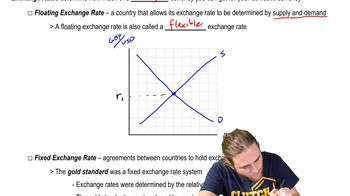
 05:16
05:16