Skip to main content
Macroeconomics
My Course
Learn
Exam Prep
AI Tutor
Study Guides
Flashcards
Explore
Try the app
My Course
Learn
Exam Prep
AI Tutor
Study Guides
Flashcards
Explore
Try the app
Back
Exchange Rates: Fixed, Flexible, and Managed Float quiz
You can tap to flip the card.
What determines the value of a currency in a floating exchange rate system?
You can tap to flip the card.
👆
What determines the value of a currency in a floating exchange rate system?
The value is determined by supply and demand in the foreign exchange market.
Track progress
Control buttons has been changed to "navigation" mode.
1/15
Related flashcards
Related practice
Recommended videos
Exchange Rates: Fixed, Flexible, and Managed Float definitions
Exchange Rates: Fixed, Flexible, and Managed Float
15 Terms
Exchange Rates: Fixed, Flexible, and Managed Float
Exchange Rates
9 problems
Topic
Exchange Rates: Purchasing Power Parity
Exchange Rates
9 problems
Topic
23. Exchange Rates
9 topics
15 problems
Chapter
Guided course
05:16
Exchange Rates: Fixed, Flexible, and Managed Float
Terms in this set (15)
Hide definitions
What determines the value of a currency in a floating exchange rate system?
The value is determined by supply and demand in the foreign exchange market.
What is another name for a floating exchange rate system?
It is also called a flexible exchange rate system.
How do exchange rates behave in a floating system?
Exchange rates change frequently based on shifts in supply and demand.
What is the equilibrium exchange rate?
It is the rate at which the quantity of currency demanded equals the quantity supplied.
What happens to the equilibrium exchange rate if demand for a currency increases?
The equilibrium exchange rate rises, meaning the currency becomes stronger.
What is a fixed exchange rate system?
It is an agreement between countries to hold exchange rates constant.
What was the gold standard?
The gold standard was a fixed exchange rate system where currency values were determined by the amount of gold each country had.
Why was the gold standard abandoned?
It was abandoned during the Great Depression as countries allowed their currencies to fluctuate based on current conditions.
What does it mean to 'peg' a currency?
Pegging means fixing a currency's value to another currency, typically the US dollar.
Which country is a famous example of pegging its currency to the US dollar?
China is a well-known example, having pegged its currency to the US dollar for many years.
What is a managed float exchange rate system?
It is a system where the government intervenes occasionally to stabilize the currency, while supply and demand still play a role.
How do governments intervene in a managed float system?
They buy or sell their own currency to influence supply and demand and stabilize exchange rates.
What is the main goal of government intervention in a managed float system?
The goal is to prevent large irregularities and maintain a stable currency.
Which exchange rate system is most commonly used by countries today?
Most countries use a managed float system.
How does a managed float differ from a purely floating system?
A managed float allows for government intervention, while a purely floating system relies solely on market forces.
 BackBack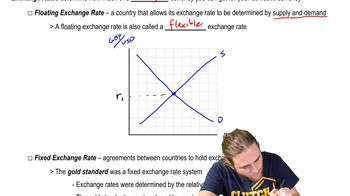
 05:16
05:16