Skip to main content
Macroeconomics
My Course
Learn
Exam Prep
AI Tutor
Study Guides
Flashcards
Explore
Try the app
My Course
Learn
Exam Prep
AI Tutor
Study Guides
Flashcards
Explore
Try the app
Back
Exchange Rates: Introduction definitions
You can tap to flip the card.
Exchange Rate
You can tap to flip the card.
👆
Exchange Rate
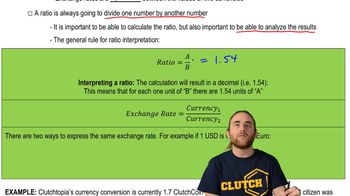
A ratio showing how much foreign currency can be obtained for one unit of domestic currency, crucial for international transactions.
Track progress
Control buttons has been changed to "navigation" mode.
1/14
Related flashcards
Related practice
Recommended videos
Exchange Rates: Introduction quiz
Exchange Rates: Introduction
15 Terms
22. Balance of Payments
5 topics
15 problems
Chapter
Guided course
06:12
Exchange Rates
207
views
2
rank
Guided course
05:25
Exchange Rates: Introduction
242
views
1
rank
Terms in this set (14)
Hide definitions
Exchange Rate
A ratio showing how much foreign currency can be obtained for one unit of domestic currency, crucial for international transactions.
Currency
A system of money in general use in a particular country, such as the US dollar or euro, exchanged in global markets.
Ratio
A mathematical comparison of two quantities, often used to express the value relationship between two currencies.
Denominator
The bottom value in a ratio or fraction, representing the reference currency in exchange rate calculations.
Numerator
The top value in a ratio or fraction, indicating the amount of foreign currency in exchange rate calculations.
Appreciation
An increase in the value of a currency relative to another, making foreign goods cheaper for domestic consumers.
Depreciation
A decrease in the value of a currency relative to another, making foreign goods more expensive for domestic consumers.
International Trade
The exchange of goods and services across national borders, influenced by changes in currency values.
Balance of Payments
A record of all economic transactions between residents of a country and the rest of the world, affected by exchange rates.
Open Economy
An economic system that engages in international trade and financial exchanges with other countries.
Unit
A single quantity of currency used as a standard measure in exchange rate calculations.
Division
A mathematical operation used to calculate ratios, essential for determining exchange rates between currencies.
Foreign Currency
Money issued by a country other than one's own, obtained through exchange based on current rates.
Domestic Currency
The official money of a home country, used as the base in exchange rate comparisons.
 BackBack
 06:12
06:12