Skip to main content
Macroeconomics
My Course
Learn
Exam Prep
AI Tutor
Study Guides
Flashcards
Explore
Try the app
My Course
Learn
Exam Prep
AI Tutor
Study Guides
Flashcards
Explore
Try the app
Back
Exchange Rates: Nominal and Real definitions
You can tap to flip the card.
Nominal Exchange Rate
You can tap to flip the card.
👆
Nominal Exchange Rate
The current market value at which one currency can be traded for another, typically quoted by banks or currency exchanges.
Track progress
Control buttons has been changed to "navigation" mode.
1/13
Related flashcards
Related practice
Recommended videos
Exchange Rates: Nominal and Real quiz
Exchange Rates: Nominal and Real
15 Terms
22. Balance of Payments
5 topics
15 problems
Chapter
Guided course
09:46
Nominal and Real Exchange Rates
286
views
5
rank
Terms in this set (13)
Hide definitions
Nominal Exchange Rate
The current market value at which one currency can be traded for another, typically quoted by banks or currency exchanges.
Real Exchange Rate
A measure comparing the purchasing power of two currencies by adjusting for price levels of goods in each country.
Currency Appreciation
A situation where a currency can buy more of a foreign currency than before, indicating increased strength.
Currency Depreciation
A situation where a currency buys less of a foreign currency than before, indicating decreased strength.
Purchasing Power
The amount of goods or services that can be bought with a unit of currency in different countries.
Price Level
The average of current prices for goods and services in a country, used to compare costs internationally.
Foreign Currency
Monetary units used in countries other than one's own, exchanged based on prevailing rates.
Domestic Goods
Products or services produced and sold within a country's own economy.
International Trade
The exchange of goods and services across national borders, influenced by currency values.
Economic Equilibrium
A state where supply and demand in an economy are balanced, often affected by exchange rate movements.
Vice Versa Effect
The phenomenon where appreciation of one currency results in depreciation of the other in an exchange rate pair.
Sandwich Index
An illustrative method using the price of a common good, like a sandwich, to compare purchasing power between countries.
Unit Cancellation
A calculation process where currency and price units are arranged to eliminate each other, leaving a comparison in terms of goods.
 BackBack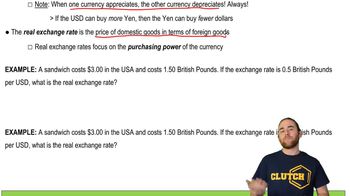
 09:46
09:46