Expansionary and Contractionary Fiscal Policy quiz #1 Flashcards

Expansionary and Contractionary Fiscal Policy quiz #1
Control buttons has been changed to "navigation" mode.
1/10
  • What is expansionary fiscal policy and how does it affect aggregate demand?
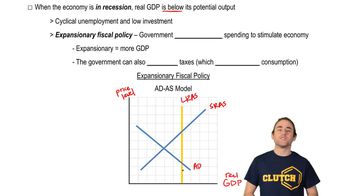
    Expansionary fiscal policy involves the government increasing spending or lowering taxes to stimulate the economy during a recession. This raises aggregate demand, shifting it to the right, which helps move the economy toward its long-run potential GDP, though it may also result in a higher price level.
  • What is a potential negative effect of expansionary fiscal policy?
    A potential negative effect of expansionary fiscal policy is an increase in the price level, which can lead to higher inflation.
  • What happens to real GDP during a recession, and how does this relate to the use of expansionary fiscal policy?
    During a recession, real GDP is below its potential output, prompting the government to use expansionary fiscal policy to increase aggregate demand and move GDP back toward its long-run potential.
  • How does lowering taxes impact disposable income and consumption?
    Lowering taxes increases disposable income, which in turn boosts consumption and helps shift aggregate demand to the right.
  • What is meant by 'overemployment' in the context of contractionary fiscal policy?
    Overemployment refers to a situation where more people are working than usual, including those who typically wouldn't work or are working overtime, due to an unsustainably booming economy.
  • How does contractionary fiscal policy affect aggregate demand and price levels?
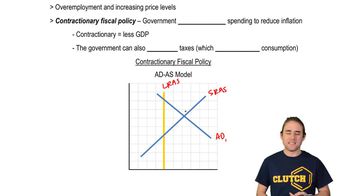
    Contractionary fiscal policy reduces aggregate demand by decreasing government spending or increasing taxes, which lowers price levels and brings GDP back to its sustainable long-run potential.
  • Which components of the GDP equation are directly affected by fiscal policy changes?
    Fiscal policy directly affects government spending and, through tax changes, influences consumption, both of which are components of the GDP equation.
  • What is the goal of contractionary fiscal policy when the economy is experiencing high inflation?
    The goal is to reduce aggregate demand and bring GDP back to its long-run potential, thereby lowering inflation and price levels.
  • How does increasing taxes serve as a contractionary fiscal policy tool?
    Increasing taxes reduces disposable income, which decreases consumption and shifts aggregate demand to the left.
  • What visual change occurs on the ADAS model graph when the government enacts contractionary fiscal policy?
    The aggregate demand curve shifts to the left, moving the economy from a short-run equilibrium above potential GDP back to long-run equilibrium at a lower price level.