Skip to main content
Macroeconomics
My Course
Learn
Exam Prep
AI Tutor
Study Guides
Flashcards
Explore
Try the app
My Course
Learn
Exam Prep
AI Tutor
Study Guides
Flashcards
Explore
Try the app
Back
Long-Run Economic Growth definitions
You can tap to flip the card.
Long-Run Economic Growth
You can tap to flip the card.
👆
Long-Run Economic Growth
Sustained rise in average living standards over time, reflected by persistent increases in real output per person.
Track progress
Control buttons has been changed to "navigation" mode.
1/14
Related flashcards
Related practice
Recommended videos
Long-Run Economic Growth quiz
Long-Run Economic Growth
15 Terms
Productivity and the Per-Worker Production Function
12. Productivity and Economic Growth
10 problems
Topic
13. Productivity and Economic Growth
6 topics
14 problems
Chapter
Guided course
02:07
Economic Growth
871
views
70
rank
Terms in this set (14)
Hide definitions
Long-Run Economic Growth
Sustained rise in average living standards over time, reflected by persistent increases in real output per person.
Real GDP
Total value of goods and services produced, adjusted for inflation, showing true changes in economic output.
Per Capita
A measurement expressed for each individual in a population, allowing fair comparisons across different group sizes.
Standard of Living
Overall quality of life, including access to essentials like healthcare, education, and leisure, improved by economic expansion.
Inflation
General increase in prices over time, which real GDP calculations remove to reveal actual growth.
Healthcare
Services and infrastructure such as hospitals and plans, whose availability expands with economic progress.
Sanitation
Access to clean water, toilets, and hygiene facilities, which improves as economies develop.
Education
Opportunities for learning and skill development, often subsidized by government revenue from economic growth.
Leisure
Time and resources for non-work activities, which increase as societies become wealthier.
Business Cycle
Short-term fluctuations in economic activity, seen as temporary deviations from the long-term growth trend.
Aggregate Demand
Total spending on goods and services in an economy, influencing overall output and growth.
Aggregate Supply
Total productive capacity of an economy, determining how much can be produced at various price levels.
Human Capital
Skills, knowledge, and experience possessed by individuals, enhanced through education and health improvements.
Productivity
Efficiency in producing goods and services, crucial for raising output per worker and living standards.
 BackBack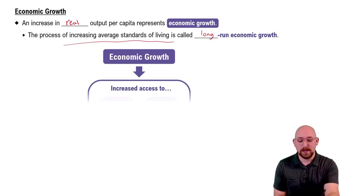
 02:07
02:07