Skip to main content
Macroeconomics
My Course
Learn
Exam Prep
AI Tutor
Study Guides
Flashcards
Explore
Try the app
My Course
Learn
Exam Prep
AI Tutor
Study Guides
Flashcards
Explore
Try the app
Back
Lorenz Curve and Gini Coefficient definitions
You can tap to flip the card.
Lorenz Curve
You can tap to flip the card.
👆
Lorenz Curve
A graphical tool plotting cumulative household percentages against cumulative income to visualize income inequality.
Track progress
Control buttons has been changed to "navigation" mode.
1/12
Related flashcards
Recommended videos
Lorenz Curve and Gini Coefficient quiz
Lorenz Curve and Gini Coefficient
15 Terms
Guided course
11:30
Lorenz Curve and the Gini Coefficient
5
views
Terms in this set (12)
Hide definitions
Lorenz Curve
A graphical tool plotting cumulative household percentages against cumulative income to visualize income inequality.
Gini Coefficient
A numerical measure from 0 to 1 quantifying income inequality, calculated using areas between curves on the Lorenz graph.
Income Inequality
The unequal distribution of income among households, often illustrated by deviations from perfect equality on a graph.
Cumulative Percentage
A running total expressed as a percentage, adding each group’s value to those before it, used on both axes of the Lorenz curve.
Quintile
A segment representing 20% of a population, used to break down income groups for analysis on the Lorenz curve.
Line of Perfect Equality
A diagonal reference line on the Lorenz graph where each population segment receives an equal share of income.
Line of Unequal Distribution
A graphical extreme where all income is concentrated in one household, showing maximum possible inequality.
Area A
The region between the Lorenz curve and the line of perfect equality, used in calculating the Gini coefficient.
Area B
The region under the Lorenz curve but above the horizontal axis, combined with Area A for Gini coefficient calculation.
Aggregate Demand
The total demand for goods and services in an economy, influenced by the distribution of income among households.
Fiscal Policy
Government actions regarding taxation and spending, often shaped by concerns about income distribution and inequality.
Economic Stability
A condition where an economy experiences steady growth and low volatility, potentially affected by income inequality.
 BackBack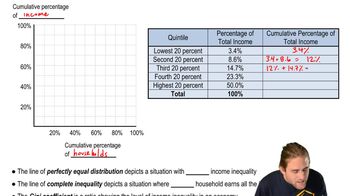
 11:30
11:30