The Lorenz curve represents income inequality by plotting the cumulative percentage of households against the cumulative percentage of income.
On a Lorenz curve graph, what is shown on the horizontal (x) axis?
The horizontal axis shows the cumulative percentage of households.
What is plotted on the vertical (y) axis of a Lorenz curve?
The vertical axis shows the cumulative percentage of income.
How is the population divided when constructing a Lorenz curve?
The population is divided into quintiles, with each quintile representing 20% of households.
What does the line of perfect equality represent on a Lorenz curve graph?
It represents a situation where income is distributed equally, so each percentage of households earns the same percentage of income.
How do you calculate the cumulative percentage of income for each quintile?
You add the income percentages of each quintile up to that point to get the cumulative percentage.
What does it mean if the Lorenz curve is farther from the line of perfect equality?
It means there is greater income inequality in the distribution.
What is the Gini coefficient and what does it measure?
The Gini coefficient is a ratio that quantifies income inequality, ranging from 0 (perfect equality) to 1 (complete inequality).
How is the Gini coefficient calculated using areas on the Lorenz curve graph?
It is calculated as A divided by (A + B), where A is the area between the Lorenz curve and the line of equality, and B is the area under the Lorenz curve.
What does a Gini coefficient of 0 indicate?
A Gini coefficient of 0 indicates perfect equality in income distribution.
What does a Gini coefficient of 1 indicate?
A Gini coefficient of 1 indicates complete income inequality, where one household earns all the income.
In the context of the Lorenz curve, what does 'cumulative' mean?
'Cumulative' means adding up the values from each group or quintile as you move along the axis.
What would the Lorenz curve look like in a society with complete income equality?
It would be a straight diagonal line from the origin to the top right corner, matching the line of perfect equality.
What would the Lorenz curve look like in a society with complete income inequality?
It would hug the bottom and right edges of the graph, showing that all income goes to one household.
Why are the Lorenz curve and Gini coefficient useful in economics?
They help analyze and compare income distribution, economic inequality, and their effects on aggregate demand, fiscal policy, and economic stability.
 Back
Back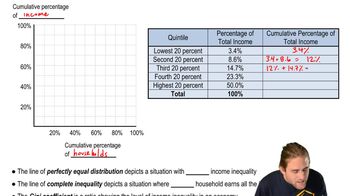
 11:30
11:30