Skip to main content
Macroeconomics
My Course
Learn
Exam Prep
AI Tutor
Study Guides
Flashcards
Explore
Try the app
My Course
Learn
Exam Prep
AI Tutor
Study Guides
Flashcards
Explore
Try the app
Back
Marginal Cost definitions
You can tap to flip the card.
Marginal Cost
You can tap to flip the card.
👆
Marginal Cost
The extra expense incurred from producing one additional unit, calculated by dividing the change in total cost by the change in output.
Track progress
Control buttons has been changed to "navigation" mode.
1/13
Related flashcards
Recommended videos
Marginal Cost quiz
Marginal Cost
15 Terms
Guided course
10:48
Marginal Cost
3
views
Terms in this set (13)
Hide definitions
Marginal Cost
The extra expense incurred from producing one additional unit, calculated by dividing the change in total cost by the change in output.
Total Cost
The sum of all expenses, including both fixed and variable, required to produce a given quantity of goods.
Variable Cost
The portion of total expenses that changes directly with the level of output, such as wages for additional workers.
Fixed Cost
The portion of total expenses that remains unchanged regardless of output, like the daily cost of pizza ovens.
Marginal Product of Labor
The increase in output resulting from hiring one more worker, reflecting the productivity of additional labor.
Diminishing Marginal Productivity
The phenomenon where adding more workers eventually leads to smaller increases in output, raising extra production costs.
U-Shaped Curve
A graphical pattern where a cost measure first declines, reaches a minimum, and then rises as output increases.
Quantity
The total number of units produced within a given period, used to measure changes in output.
Output
The total amount of goods produced by a firm, often measured in units like pizzas in examples.
Aggregate Supply
The total quantity of goods and services that producers in an economy are willing to supply at a given overall price level.
Aggregate Demand
The total quantity of goods and services demanded across all levels of an economy at a given overall price level.
Wage
The payment made to workers for their labor, often a key component of variable expenses in production.
Cost Behavior
The way in which total expenses change as output levels vary, crucial for production and employment decisions.
 BackBack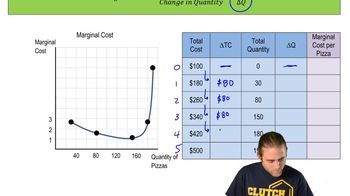
 10:48
10:48