Skip to main content
Macroeconomics
My Course
Learn
Exam Prep
AI Tutor
Study Guides
Flashcards
Explore
Try the app
My Course
Learn
Exam Prep
AI Tutor
Study Guides
Flashcards
Explore
Try the app
Back
Monetarist Model definitions
You can tap to flip the card.
Monetarist Model
You can tap to flip the card.
👆
Monetarist Model
An economic framework emphasizing the role of money supply in determining price levels and output, advocating minimal government intervention.
Track progress
Control buttons has been changed to "navigation" mode.
1/14
Related flashcards
Related practice
Recommended videos
Monetarist Model quiz
Monetarist Model
15 Terms
Monetarist Model
22. Macroeconomic Schools of Thought
10 problems
Topic
New Classical Model
22. Macroeconomic Schools of Thought
9 problems
Topic
24. Macroeconomic Schools of Thought
7 topics
15 problems
Chapter
Guided course
04:06
Monetarist Model
1128
views
16
rank
Terms in this set (14)
Hide definitions
Monetarist Model
An economic framework emphasizing the role of money supply in determining price levels and output, advocating minimal government intervention.
Keynesian Economics
A theory highlighting economic instability and advocating active government intervention to manage inflation and recessions.
Money Supply
The total amount of currency available in an economy, primarily regulated by the central bank to influence economic activity.
Federal Reserve
The central banking system of the United States, responsible for controlling the nation's money supply and monetary policy.
Quantity Theory of Money
A theory linking the amount of money in circulation to the overall price level and economic output using a specific formula.
Velocity of Money
The frequency with which a unit of currency is spent on goods and services within a given period.
Price Level
A measure reflecting the average prices of goods and services in an economy at a given time.
Real GDP
The total value of all goods and services produced in an economy, adjusted for inflation, indicating actual economic output.
Competitive Markets
Economic environments where numerous buyers and sellers interact, leading to efficient allocation of resources and stability.
Inflation
A sustained increase in the general price level of goods and services, reducing purchasing power over time.
Monetary Policy
Strategies and actions by a central bank to manage the money supply and interest rates to influence economic conditions.
Sticky Wages
A situation where employee compensation does not adjust quickly to changes in economic conditions, affecting labor markets.
Milton Friedman
A Nobel Prize-winning economist who developed the Monetarist Model, emphasizing the importance of money supply.
Government Intervention
Actions by public authorities to influence or regulate economic activity, often to stabilize the economy.
 BackBack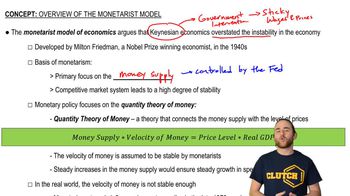
 04:06
04:06