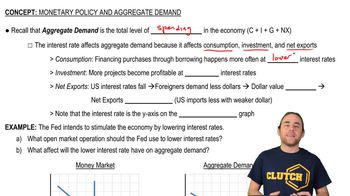
Total spending in an economy, including consumption, investment, government purchases, and net exports, represented as a curve relating GDP and price level.
Interest Rate
Cost of borrowing money, influencing consumption, investment, and net exports, and serving as the y-axis in the money market graph.
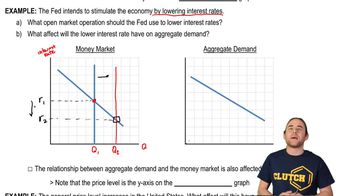
Money Market
Graphical representation of the supply and demand for money, where equilibrium determines the prevailing interest rate.
Open Market Operations
Federal Reserve actions involving the purchase or sale of securities to adjust the money supply and influence interest rates.
Money Supply
Total quantity of money available in the economy, fixed by the central bank and altered through policy tools.
Money Demand
Desire to hold cash balances, influenced by price level and real GDP, and depicted as a curve in the money market.
Equilibrium Interest Rate
Rate at which money supply equals money demand, determining the cost of borrowing in the economy.
Net Exports
Difference between a country's exports and imports, affected by currency value and interest rates.
Consumption
Household spending on goods and services, sensitive to changes in borrowing costs and savings incentives.
Investment
Business expenditures on capital goods, driven by the cost of financing through loans.
Price Level
Average of current prices across the entire economy, serving as the y-axis on the aggregate demand graph.
Rightward Shift
Movement of the aggregate demand curve indicating increased total spending at every price level.
Federal Reserve
Central bank of the United States, responsible for regulating the money supply and conducting monetary policy.
Recession
Period of declining economic activity, often addressed by stimulating aggregate demand through monetary policy.
Currency Value
Relative worth of a nation's money, influencing import and export levels through exchange rates.
 Back
Back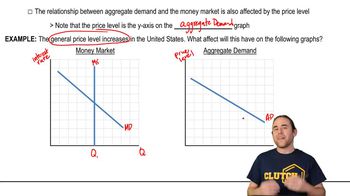
 06:24
06:24