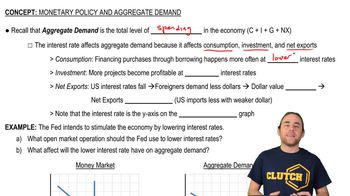
How do lower interest rates affect consumption, investment, and net exports?
Lower interest rates increase consumption, investment, and net exports by making borrowing cheaper and reducing the incentive to save.
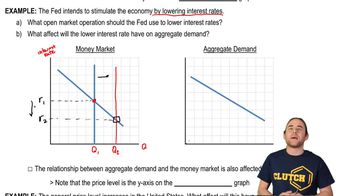
What action does the Federal Reserve take in open market operations to lower interest rates?
The Fed purchases securities from the public to increase the money supply, which lowers equilibrium interest rates.
What happens to the aggregate demand curve when interest rates decrease?
The aggregate demand curve shifts to the right, indicating an increase in total spending in the economy.
Why does a lower interest rate lead to higher investment by firms?
Lower interest rates reduce the cost of borrowing, encouraging firms to take out loans for new equipment and buildings.
How does a decrease in U.S. interest rates affect the value of the dollar and net exports?
A decrease in interest rates weakens the dollar, making imports more expensive and increasing net exports.
What is the y-axis variable on the money market graph?
The y-axis on the money market graph represents the interest rate, which is the price of money.
What is the effect of an increase in the money supply on equilibrium interest rates?
An increase in the money supply lowers equilibrium interest rates in the money market.
How does the Fed’s purchase of securities affect the public’s money holdings?
The Fed’s purchase of securities gives more money to the public, increasing the money supply.
What happens to GDP demanded when the price level increases, according to the aggregate demand curve?
When the price level increases, GDP demanded decreases, resulting in movement along the aggregate demand curve.
How does an increase in the price level affect the money demand curve?
An increase in the price level shifts the money demand curve to the right, indicating higher demand for money.
What happens to equilibrium interest rates when money demand increases but money supply stays the same?
Equilibrium interest rates rise because the higher demand for money is not matched by an increase in supply.
When does a change in the price level cause a shift versus a movement along the aggregate demand curve?
A change in the price level causes movement along the aggregate demand curve, not a shift; shifts occur due to changes in underlying factors like interest rates.
Why does the Fed increase the money supply during a recession?
The Fed increases the money supply to lower interest rates, which stimulates spending and helps counteract the recession.
Which components of aggregate demand are directly affected by changes in interest rates?
Consumption, investment, and net exports are directly affected by changes in interest rates.
What is the relationship between the money market and aggregate demand in the context of monetary policy?
Changes in the money market, such as adjustments to the money supply and interest rates, significantly influence aggregate demand and overall economic activity.
 Back
Back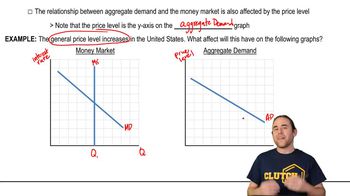
 06:24
06:24