What is productive efficiency in a perfectly competitive market?
Productive efficiency occurs when firms produce at the minimum average total cost (ATC), ensuring the lowest possible cost of production.
At what point do perfectly competitive firms achieve productive efficiency?
They achieve productive efficiency at the minimum point of their average total cost (ATC) curve.
What is the condition for productive efficiency in perfect competition?
The condition is that price equals the minimum average total cost (P = min ATC).
How does perfect competition force firms to be efficient?
It forces firms to lower their costs as much as possible to remain profitable, leading to production at the lowest possible cost.
What is allocative efficiency?
Allocative efficiency is achieved when the marginal benefit to consumers equals the marginal cost to producers.
What is the equilibrium condition for allocative efficiency in perfect competition?
The equilibrium condition is when price equals marginal cost (P = MC).
How does the price in a perfectly competitive market relate to consumer benefit?
The price represents the marginal benefit to the last consumer who purchases the good.
Why does the last unit sold in perfect competition reflect allocative efficiency?
Because the marginal benefit to the consumer equals the price, which also equals the marginal cost to the producer.
How do firms in perfect competition decide how much to produce?
They produce where marginal revenue equals marginal cost (MR = MC), which in perfect competition is also where price equals marginal cost.
What is the relationship between price, marginal benefit, and marginal cost in perfect competition?
In perfect competition, price equals both marginal benefit to consumers and marginal cost to producers (P = MB = MC).
Why is perfect competition considered the most efficient market structure?
Because it uniquely achieves both productive and allocative efficiency, maximizing economic welfare.
Do other market structures achieve both productive and allocative efficiency?
No, other market structures generally do not achieve both types of efficiency.
What does the downward sloping demand curve represent in terms of consumer willingness to pay?
It shows that some consumers are willing to pay more than the equilibrium price, but the last unit sold is to the consumer whose willingness to pay equals the market price.
In the long run, where do perfectly competitive firms operate on their ATC curve?
They operate at the minimum point of their ATC curve, ensuring productive efficiency.
What is the key takeaway about efficiency in perfect competition?
Perfect competition achieves both productive and allocative efficiency, unlike other market structures.
 Back
Back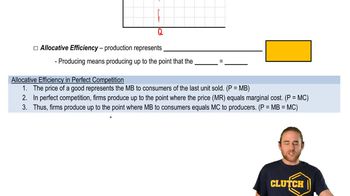
 06:46
06:46