What economic condition occurs when high inflation is combined with high unemployment, often as a result of a negative supply shock?
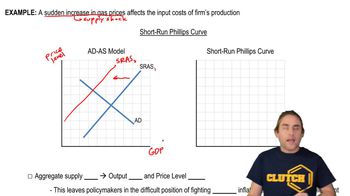
Stagflation occurs when high inflation is combined with high unemployment, typically due to a negative supply shock that shifts the short run aggregate supply curve to the left, resulting in higher prices and lower output.
What typically causes a leftward shift in the short run aggregate supply (SRAS) curve?
A leftward shift in the SRAS curve is typically caused by a supply shock, such as an unexpected increase in input prices like gasoline. This makes production more expensive for firms.
How does a sudden increase in gasoline prices affect firms' production costs?
A sudden increase in gasoline prices raises firms' input costs, making it more expensive to produce goods. This can lead to reduced output and higher prices in the economy.
What happens to GDP and the price level when the SRAS curve shifts to the left?
When the SRAS curve shifts to the left, GDP decreases and the price level increases. This reflects lower economic output and higher inflation.
Why does higher unemployment result from a decrease in GDP after a supply shock?
Higher unemployment results because fewer workers are needed to produce the reduced level of output. As GDP falls, firms require less labor.
How does a supply shock influence the position of the short run Phillips curve?
A supply shock shifts the short run Phillips curve to the right. This means that at every level of economic activity, both inflation and unemployment are higher.
What challenge do policymakers face when both inflation and unemployment rise due to a supply shock?
Policymakers face the challenge of addressing both high inflation and high unemployment simultaneously. Efforts to reduce one often worsen the other.
What is the typical trade-off policymakers encounter when responding to a supply shock?
The typical trade-off is that reducing unemployment may increase inflation, while reducing inflation may worsen unemployment. This makes policy decisions more complex.
In the context of the Phillips curve, what does a rightward shift indicate about the economy?
A rightward shift in the Phillips curve indicates that both inflation and unemployment are higher at every level of output. This reflects a worsening economic situation.
Why is a supply shock that shifts aggregate supply to the left considered 'doubly bad' for the economy?
It is considered 'doubly bad' because it causes both higher inflation and higher unemployment. This combination makes economic conditions more difficult to manage.