What is productivity in the context of macroeconomics?
Productivity is the goods and services produced from each unit of labor. It measures how efficiently labor is used in producing output.
Name three main factors that determine productivity.
The three main factors are physical capital per worker, human capital, and levels of technology.
How does physical capital per worker affect productivity?
More physical capital per worker, such as tools and machinery, increases productivity by allowing workers to produce more output.
What is unique about physical capital in terms of productivity?
Physical capital can be used to create more physical capital, which further increases productivity.
Define human capital.
Human capital refers to the knowledge and skills of the workforce, which are improved through education and training.
How does investing in human capital affect future productivity?
Investing in human capital increases future productivity by making workers more knowledgeable and skilled.
What role does technology play in productivity?
Technology improves the processes of turning inputs into outputs, generally leading to increased productivity over time.
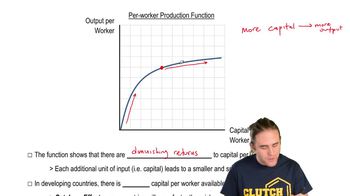
What does the per worker production function show?
It shows the relationship between physical capital per worker and output per worker, illustrating how output changes as capital increases.
What are diminishing returns to capital?
Diminishing returns mean that as more capital is added, the additional output gained from each extra unit of capital decreases.
Explain the catch-up effect.
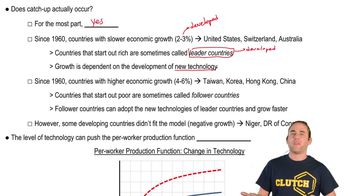
The catch-up effect is when developing countries grow faster than developed countries because they gain more output from small increases in capital.
Why do developed countries rely on new technology for growth?
Developed countries already have high levels of capital, so further growth mainly comes from technological advancements rather than just adding more capital.
How can developing countries 'leapfrog' stages of development?
Developing countries can adopt existing technologies from developed countries, sometimes skipping intermediate steps and infrastructure.
What happens to the per worker production function when technology improves?
The production function shifts outward, meaning the same amount of capital produces more output due to better technology.
What is the typical GDP growth rate for developed countries compared to developing countries?
Developed countries typically grow at 2-3% per year, while developing countries can grow at 4-6% per year.
Why might some countries not experience the catch-up effect?
Countries with political instability, corruption, or conflict may not experience economic growth even with investments in capital.
 Back
Back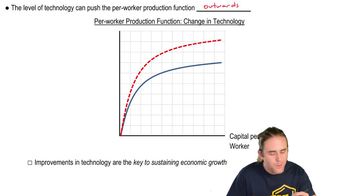
 02:27
02:27