Skip to main content
Macroeconomics
My Course
Learn
Exam Prep
AI Tutor
Study Guides
Flashcards
Explore
Try the app
My Course
Learn
Exam Prep
AI Tutor
Study Guides
Flashcards
Explore
Try the app
Back
Risk and Diversification quiz
You can tap to flip the card.
What is diversification in investment?
You can tap to flip the card.
👆
What is diversification in investment?
Diversification is spreading investments across multiple assets to reduce risk by avoiding concentration in a single investment.
Track progress
Control buttons has been changed to "navigation" mode.
1/15
Related flashcards
Related practice
Recommended videos
Risk and Diversification definitions
Risk and Diversification
15 Terms
Risk and Diversification
13. The Financial System
9 problems
Topic
Time Value of Money Calculations
13. The Financial System
9 problems
Topic
14. The Financial System - Part 1 of 2
8 topics
15 problems
Chapter
13. The Financial System - Part 2 of 2
1 topic
3 problems
Chapter
Guided course
04:01
Efficient Markets Theory, Random Walk, and Irrational Behavior
829
views
6
rank
Guided course
05:40
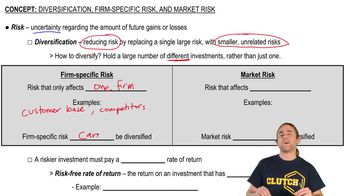
Market Risk and Firm-specific Risk
959
views
8
rank
Terms in this set (15)
Hide definitions
What is diversification in investment?
Diversification is spreading investments across multiple assets to reduce risk by avoiding concentration in a single investment.
What type of risk can diversification help reduce?
Diversification can reduce firm-specific risk, which affects individual companies.
Can diversification eliminate market risk?
No, diversification cannot eliminate market risk, which affects the entire market.
Give an example of a firm-specific risk.
Firm-specific risks include issues with a company's customer base or competition that only affect that particular firm.
What is an example of a market risk?
Market risks include events like recessions or wars that impact all companies in the market.
Why do investors choose riskier investments like stocks over risk-free options?
Investors choose riskier investments for the potential of higher returns compared to risk-free options like Treasury Bills.
What is considered a risk-free investment?
US Treasury bills or notes are generally considered risk-free investments.
How is the rate of return on an investment calculated?
The rate of return is calculated as the income earned (such as dividends or interest) divided by the price paid for the investment.
What does the Efficient Market Hypothesis state about stock prices?
The Efficient Market Hypothesis states that stock prices reflect all publicly available information and are informationally efficient.
Why are stock prices unpredictable according to the Efficient Market Hypothesis?
Stock prices are unpredictable because they change based on new, unforeseeable information.
What is meant by the 'random walk' of stock prices?
The 'random walk' means stock prices move unpredictably, making it impossible to forecast future prices based on past data.
Why can't historical stock price data reliably predict future prices?
Because stock prices are influenced by unpredictable new information, past data does not reliably indicate future movements.
What is a market bubble and how does it relate to risk?
A market bubble occurs when prices are driven up by speculation and irrational behavior, eventually leading to a market correction and losses.
How can irrational behavior affect market efficiency?
Irrational behavior, such as speculation and fear of missing out, can cause market inefficiencies and price bubbles.
What risks does an investor face if they only invest in one company?
An investor faces both firm-specific risk and market risk, increasing the chance of significant losses if either affects their investment.
 BackBack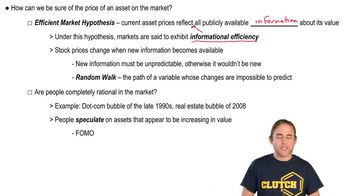
 04:01
04:01