Skip to main content
Macroeconomics
My Course
Learn
Exam Prep
AI Tutor
Study Guides
Flashcards
Explore
Try the app
My Course
Learn
Exam Prep
AI Tutor
Study Guides
Flashcards
Explore
Try the app
Back
Risk and Insurance definitions
You can tap to flip the card.
Risk
You can tap to flip the card.
👆
Risk
Uncertainty about future financial outcomes, where gains or losses are unpredictable and can impact decision-making.
Track progress
Control buttons has been changed to "navigation" mode.
1/14
Related flashcards
Related practice
Recommended videos
Risk and Insurance quiz #1
Risk and Insurance
10 Terms
Risk and Insurance
13. The Financial System
10 problems
Topic
Risk and Diversification
13. The Financial System
9 problems
Topic
14. The Financial System - Part 1 of 2
8 topics
15 problems
Chapter
13. The Financial System - Part 2 of 2
1 topic
3 problems
Chapter
Guided course
07:25
Risk and Insurance
1034
views
8
rank
Terms in this set (14)
Hide definitions
Risk
Uncertainty about future financial outcomes, where gains or losses are unpredictable and can impact decision-making.
Risk Aversion
Preference for avoiding uncertainty, where potential losses cause more dissatisfaction than equivalent gains provide satisfaction.
Utility
Quantitative measure of satisfaction or happiness derived from consuming goods or experiencing events.
Marginal Utility
Additional satisfaction gained from consuming one more unit of a good, typically less than the previous unit.
Law of Diminishing Returns
Principle stating that each additional unit consumed provides less satisfaction than the one before.
Utility Graph
Visual representation showing how satisfaction changes with increases or decreases in wealth or goods.
Insurance
Mechanism for reducing the impact of large, unpredictable losses by paying smaller, predictable premiums.
Premium
Regular payment made to transfer the risk of significant financial loss to an insurer.
Catastrophic Loss
Rare but severe financial setback, such as from a fire, that can drastically reduce satisfaction or well-being.
Satisfaction
Level of happiness or contentment achieved from consuming goods, services, or avoiding negative outcomes.
Uncertainty
Condition where future events or outcomes are unpredictable, leading to potential gains or losses.
Insurance Market
System where individuals or entities transfer risk of large losses to insurers in exchange for regular payments.
Financial Gain
Increase in wealth or resources, which contributes to higher satisfaction but with diminishing impact as wealth grows.
Financial Loss
Decrease in wealth or resources, often causing a greater reduction in satisfaction than an equivalent gain increases it.
 BackBack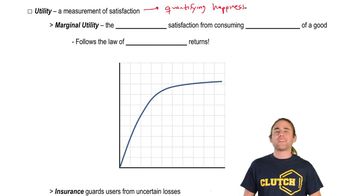
 07:25
07:25