Skip to main content
Macroeconomics
My Course
Learn
Exam Prep
AI Tutor
Study Guides
Flashcards
Explore
Try the app
My Course
Learn
Exam Prep
AI Tutor
Study Guides
Flashcards
Explore
Try the app
Back
The Bretton Woods System definitions
You can tap to flip the card.
Bretton Woods System
You can tap to flip the card.
👆
Bretton Woods System
A post-WWII arrangement where currencies were fixed to the US dollar, which was convertible to gold by central banks only.
Track progress
Control buttons has been changed to "navigation" mode.
1/15
Related flashcards
Related practice
Recommended videos
The Bretton Woods System quiz
The Bretton Woods System
15 Terms
The Bretton Woods System
Exchange Rates
10 problems
Topic
The Gold Standard
Exchange Rates
10 problems
Topic
23. Exchange Rates
9 topics
15 problems
Chapter
Guided course
04:04
Bretton Woods System:Introduction
716
views
2
rank
Guided course
02:53
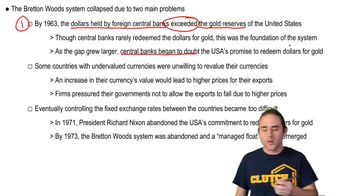
Bretton Woods System:Collapse
591
views
3
rank
Terms in this set (15)
Hide definitions
Bretton Woods System
A post-WWII arrangement where currencies were fixed to the US dollar, which was convertible to gold by central banks only.
Fixed Exchange Rate
A regime where a currency's value is tied to another currency or commodity, preventing market-driven fluctuations.
Gold Standard
A monetary system where currency value is directly linked to a specific amount of gold, allowing redemption for gold.
Central Bank
A national authority responsible for managing currency, reserves, and monetary policy, including gold and dollar holdings.
Dollar Reserves
Holdings of US currency by foreign monetary authorities, used to maintain exchange rate stability under the system.
International Monetary Fund
An institution created to provide financial support to countries facing reserve shortages, helping maintain currency pegs.
Surplus
A situation where the supply of a currency exceeds demand at the fixed exchange rate, often requiring adjustment.
Shortage
A condition where demand for a currency surpasses supply at the fixed rate, leading to pressure for revaluation.
Overvaluation
A state where a currency's fixed rate is set above its market equilibrium, making exports less competitive.
Undervaluation
A scenario where a currency's fixed rate is below its market equilibrium, boosting exports but risking shortages.
Revaluation
An official increase in a currency's fixed value relative to others, often resisted due to export concerns.
Inflation
A general rise in prices, which can result from excessive money creation when fixed rates are not adjusted.
Managed Float System
A post-1973 regime where exchange rates are mostly market-determined, but governments may intervene occasionally.
Equilibrium Exchange Rate
The rate at which currency supply equals demand, absent government intervention or fixed pegs.
Currency Peg
A policy of fixing a currency's value to another currency or commodity, central to the Bretton Woods arrangement.
 BackBack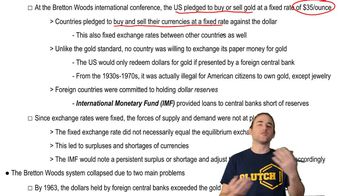
 04:04
04:04