Pearson+ LogoPearson+ Logo

Using CPI to Adjust for Inflation quiz #1 Flashcards

Back
Using CPI to Adjust for Inflation quiz #1
Control buttons has been changed to "navigation" mode.
1/10
  • How do you calculate the GDP deflator, and how does it differ from the Consumer Price Index (CPI) when adjusting for inflation?

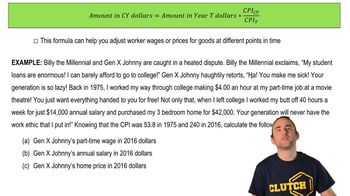
    The GDP deflator is calculated as (Nominal GDP / Real GDP) × 100. It measures the overall change in prices for all goods and services produced in an economy, not just a fixed basket. In contrast, the CPI measures the cost of a fixed basket of goods over time and is used to adjust past prices or wages to current dollars using the formula: Amount in current dollars = Amount in year T × (CPI in current year / CPI in year T). The GDP deflator reflects price changes for all domestically produced goods and services, while the CPI focuses on consumer goods and services.
  • What does the CPI allow us to compare when looking at prices or wages from different years?

    The CPI allows us to compare the purchasing power of money across different years by adjusting for inflation. This helps us see what a past price or wage is equivalent to in today's dollars.
  • How do you use the CPI to convert a past wage into its equivalent value in current dollars?

    Multiply the past wage by the ratio of the current year's CPI to the past year's CPI. This calculation adjusts the wage for inflation to reflect its value today.
  • Why is it important to use the same basket of goods when calculating the CPI over time?

    Using the same basket of goods ensures that changes in the CPI reflect only price changes, not changes in the types or quantities of goods purchased. This consistency allows for accurate measurement of inflation.
  • In the example given, what was Gen X Johnny's part-time wage in 1975 equivalent to in 2016 dollars?

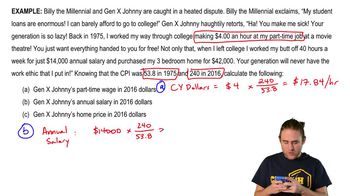
    Gen X Johnny's $4 per hour wage in 1975 was equivalent to $17.84 per hour in 2016 dollars. This was calculated using the CPI adjustment formula.
  • What information do you need to convert a historical price to its present-day equivalent using the CPI?

    You need the original price, the CPI for the year of the original price, and the CPI for the current year. These values are used in the conversion formula.
  • What does it mean if two different amounts of money from different years buy the same basket of goods after adjusting for CPI?

    It means the two amounts have the same purchasing power after accounting for inflation. This shows that the real value of money is maintained despite nominal differences.
  • How does adjusting for inflation with the CPI help in comparing wages across generations?

    Adjusting for inflation allows us to see the real value of wages from different time periods in today's terms. This makes it possible to fairly compare earnings across generations.
  • What is the formula for converting an amount from year T to current year dollars using the CPI?

    The formula is: Amount in current dollars = Amount in year T × (CPI in current year / CPI in year T). This formula adjusts for inflation using the CPI.
  • Why might a wage from decades ago seem low in nominal terms but high when adjusted to current dollars?

    Inflation causes prices and wages to rise over time, so a low nominal wage from the past can have significant purchasing power when adjusted to today's dollars. This reveals the real value of historical earnings.