 Back
BackMacroeconomics Final Topics Flashcards
 02:31
02:31
Terms in this set (29)
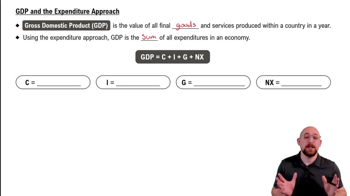
GDP is the total market value of all final goods and services produced within a country in a given period. Components include consumption, investment, government purchases, and net exports.
Nominal GDP is measured using current prices; Real GDP is adjusted for inflation using base year prices to reflect true output changes.
Growth rate = \(\frac{Real\ GDP_2 - Real\ GDP_1}{Real\ GDP_1} \times 100\) percent.
Unemployment rate = \(\frac{Unemployed}{Labor\ Force} \times 100\) percent; measures the percentage of the labor force that is unemployed.
Labor force participation rate = \(\frac{Labor\ Force}{Working\text{-}age\ Population} \times 100\) percent; shows the share of working-age population in the labor force.
Frictional: short-term job search; Structural: mismatch of skills; Cyclical: due to economic downturns.
The unemployment rate when the economy is at full employment, including frictional and structural unemployment but no cyclical unemployment.
GDP deflator = \(\frac{Nominal\ GDP}{Real\ GDP} \times 100\); measures the overall price level of goods and services included in GDP.
CPI measures the cost of a fixed basket of goods and services relative to a base year; used to calculate inflation and adjust for cost of living changes.
Inflation rate = \(\frac{CPI_2 - CPI_1}{CPI_1} \times 100\) percent; shows the percentage change in price level between two periods.
Real interest rate = Nominal interest rate – Inflation rate; reflects the true cost of borrowing after adjusting for inflation.
Number of years to double = \(\frac{70}{Growth\ Rate}\); estimates how long it takes for a variable to double at a constant growth rate.
Labor productivity depends on capital per hour worked, technological change, and human capital.
Market where savers supply funds and borrowers demand funds; equilibrium determines the real interest rate and investment level.
When government borrowing raises interest rates, reducing private investment.
Expansion (GDP and inflation rise, unemployment falls) and contraction/recession (GDP and inflation fall, unemployment rises).
Downward sloping due to wealth effect, interest-rate effect, and international-trade effect.
Vertical at potential GDP; shifts with changes in labor force, capital stock, and technology.
Upward sloping; shifts due to changes in input prices, expectations, supply shocks, and technology.
Money serves as a medium of exchange, unit of account, store of value, and standard of deferred payment.
Banks keep a fraction of deposits as reserves and loan out the rest, creating money through the money multiplier.
The central bank of the U.S., responsible for monetary policy, regulating banks, and maintaining financial stability.
Buying and selling government securities by the Fed to influence the money supply and interest rates.
Equation: \(PY=MV\); predicts inflation as the difference between money supply growth and real output growth.
Price stability, high employment, financial market stability, and economic growth.
Fed lowers interest rates to increase consumption and investment, shifting aggregate demand right.
Government changes in spending and taxes to influence aggregate demand and stabilize the economy.
Initial change in spending leads to a larger change in real GDP; calculated as \(\frac{Change\ in\ GDP}{Change\ in\ Spending}\).
Increased government spending raises interest rates, reducing private investment and partially offsetting fiscal stimulus.