 Back
BackAdding Government and Trade to the Simple Macro Model: Chapter 7 Study Notes
Study Guide - Smart Notes
 Tailored notes based on your materials, expanded with key definitions, examples, and context.
Adding Government and Trade to the Simple Macro Model
Government Spending and Aggregate Expenditure
Government spending is a key component of aggregate expenditure (AE) in the macroeconomic model. It is considered autonomous, meaning it does not directly depend on the level of national income.
Government Purchases (G): Expenditures by the government on goods and services.
Aggregate Expenditure (AE): The total planned spending in the economy, now including government and trade:
Autonomous Expenditure: Expenditure that does not vary with income.
Net Tax Revenues and Disposable Income
Net tax revenues (T) are the total taxes collected minus transfer payments. Disposable income (YD) is the income households have available after taxes.
Net Tax Revenues (T): where t is the net tax rate and Y is GDP.
Disposable Income (YD):
The Budget Balance
The budget balance is the difference between net tax revenues and government spending.
Budget Balance:
Surplus: When
Deficit: When
Balanced Budget: When
Introducing Foreign Trade
Foreign trade introduces exports (X) and imports (IM) into the macro model, affecting aggregate expenditure and national income.
Exports (X): Autonomous expenditure from foreign demand for domestic goods.
Imports (IM): where m is the marginal propensity to import.
Net Exports (NX):
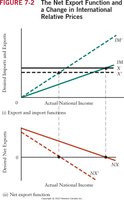
The Net Export Function
The net export function shows how net exports change with national income and other factors.
Shifts in NX Function: Caused by changes in foreign income and international relative prices.
Increase in Foreign Income: Raises exports, shifting NX upward.
Changes in International Prices: Affect both imports and exports, shifting the NX curve.
Depreciation: Makes imports more expensive and exports cheaper, increasing NX.
The Aggregate Expenditure Function
The aggregate expenditure function incorporates consumption, investment, government spending, and net exports. It is used to determine equilibrium national income.
AE Function:
Terms with Y: Consumption (C), Imports (IM), and sometimes Net Exports (NX) depend on Y.
Equilibrium: Occurs when
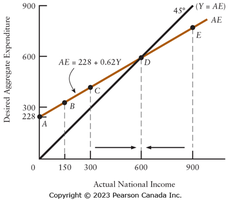
Worked Example: Calculating AE
Consider the following example to illustrate the calculation of AE:
Taxes:
Disposable Income:
Consumption:
Aggregate Expenditure:
Multiplier Effect with Taxes and Imports
The multiplier measures the change in equilibrium national income resulting from a change in autonomous expenditure. Taxes and imports reduce the marginal propensity to spend, lowering the multiplier.
Simple Multiplier:
Where:
MPC: Marginal Propensity to Consume
t: Net tax rate
m: Marginal Propensity to Import
Fiscal Policy and Stabilization
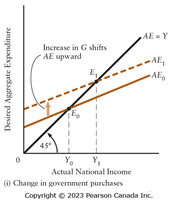
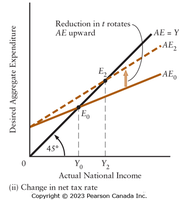
Fiscal policy uses government purchases and net tax rates to stabilize the economy. Changes in these variables have multiplied impacts on national income due to the multiplier effect.
Increase in G: Shifts AE upward, raising equilibrium income.
Reduction in t: Rotates AE upward, increasing equilibrium income.
Demand-Determined Output and Equilibrium National Income
Equilibrium national income is determined where desired aggregate expenditure equals actual national income. Deviations from equilibrium lead to changes in production and income.
If : Inventories are depleted, production increases, and national income rises.
If : Inventories accumulate, production decreases, and national income falls.
Summary Table: Key Formulas and Relationships
Concept | Formula | Description |
|---|---|---|
Net Tax Revenues | Net taxes as a function of income | |
Disposable Income | Income after taxes | |
Imports | Imports as a function of income | |
Net Exports | Exports minus imports | |
Aggregate Expenditure | Total planned spending | |
Multiplier | Effect of autonomous expenditure on income | |
z (open economy) | Marginal propensity to spend |
Additional info:
In an open economy with government, the multiplier is smaller than in a closed economy due to leakages from taxes and imports.
Fiscal policy is a primary tool for stabilization, with government spending and tax rates influencing aggregate demand.
