 Back
BackAggregate Demand and Aggregate Supply Analysis: Macroeconomics Study Guide
Study Guide - Smart Notes
 Tailored notes based on your materials, expanded with key definitions, examples, and context.
Chapter 13: Aggregate Demand and Aggregate Supply Analysis
Aggregate Demand
The aggregate demand (AD) curve represents the relationship between the price level and the quantity of real GDP demanded by households, firms, and the government. Understanding the determinants of aggregate demand and the distinction between movements along the curve and shifts of the curve is essential for macroeconomic analysis.
Components of Real GDP: Consumption (C), Investment (I), Government Purchases (G), Net Exports (NX). The sum of these components gives real GDP.
Government Purchases: Generally determined by policymakers and independent of the price level.
Consumption, Investment, and Net Exports: These are affected by changes in the price level.
Aggregate Demand and Aggregate Supply Model: This model explains short-run fluctuations in real GDP, employment, and the price level.
Aggregate Demand (AD) Curve: Shows the relationship between the price level and the quantity of real GDP demanded.
Short-Run Aggregate Supply (SRAS) Curve: Shows the relationship in the short run between the price level and the quantity of real GDP supplied by firms.
Determinants of Aggregate Demand
Wealth Effect: As price levels rise, the real value of household wealth declines, leading to lower consumption.
Interest-Rate Effect: Higher price levels increase the demand for money, raising interest rates and discouraging investment.
International-Trade Effect: Higher U.S. price levels make exports more expensive and imports cheaper, reducing net exports.
These effects explain why the aggregate demand curve slopes downward.
Movements vs. Shifts of the Aggregate Demand Curve
Movement Along the Curve: Occurs when the price level changes, holding other factors constant.
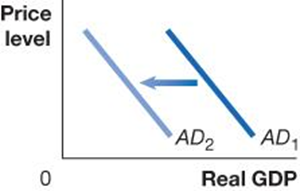
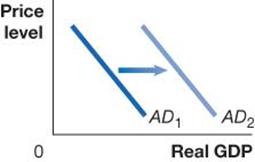
Shift of the Curve: Occurs when a component of real GDP changes (e.g., government purchases, consumer confidence).
Variables That Shift the Aggregate Demand Curve
Government policy changes, household and firm expectations, and foreign variables can shift the AD curve.
Monetary Policy: Actions by the Federal Reserve to manage money supply and interest rates. Higher interest rates decrease investment spending; lower rates increase it.
Fiscal Policy: Changes in federal taxes and purchases. Higher taxes reduce disposable income and consumption; increased government purchases raise AD.
Expectations: Optimism increases consumption and investment; pessimism decreases them.
Foreign Income and Exchange Rates: Higher foreign incomes increase exports; a stronger dollar reduces exports and increases imports.
Variable | Effect on AD |
|---|---|
Monetary Policy (Interest Rate) | Higher rates shift AD left; lower rates shift AD right |
Fiscal Policy (Taxes, Purchases) | Higher taxes shift AD left; higher purchases shift AD right |
Expectations | Optimism shifts AD right; pessimism shifts AD left |
Foreign Income | Higher foreign income shifts AD right |
Exchange Rate | Stronger dollar shifts AD left |
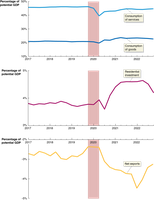
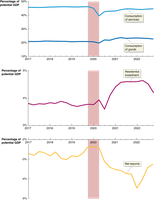
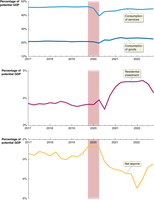
Aggregate Demand During the 2020 Recession
Consumption spending fell, especially on services. Residential investment increased due to low interest rates and stimulus checks. Net exports decreased as the dollar strengthened and U.S. GDP fell less than trading partners.
Aggregate Supply
Aggregate supply is the total quantity of goods and services firms are willing and able to supply. The relationship between quantity supplied and price level differs in the short and long run.
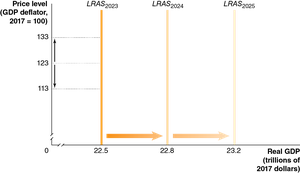
Long-Run Aggregate Supply (LRAS) Curve: Shows the relationship in the long run between the price level and real GDP supplied. LRAS is vertical because real GDP is determined by labor, capital, and technology, not the price level.
Short-Run Aggregate Supply (SRAS) Curve: Upward sloping because input prices (wages, resources) adjust more slowly than output prices, and some prices are sticky due to contracts, slow wage adjustments, and menu costs.
Why Is the SRAS Curve Upward Sloping?
Sticky Wages and Prices: Contracts and slow wage adjustments make prices sticky.
Menu Costs: Firms may avoid changing prices due to associated costs.
Movements vs. Shifts of the SRAS Curve
Movement Along SRAS: Caused by changes in the price level, holding other factors constant.
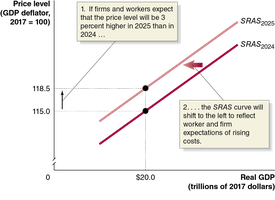
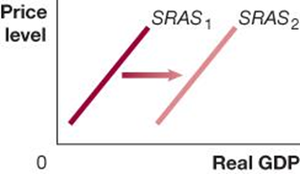
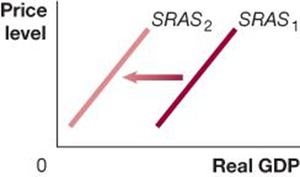
Shift of SRAS: Caused by changes in factors such as labor, capital, technology, expected future prices, and supply shocks.
Variables That Shift the SRAS Curve
Labor and Capital: Increased availability shifts SRAS right; decreased availability shifts it left.
Technology: Improvements shift SRAS right.
Expected Future Price Level: Higher expected prices shift SRAS left.
Supply Shocks: Unexpected events (e.g., oil price increases, pandemics) shift SRAS left.
Variable | Effect on SRAS |
|---|---|
Labor/Capital | More shifts SRAS right; less shifts SRAS left |
Technology | Improvement shifts SRAS right |
Expected Price Level | Higher shifts SRAS left |
Supply Shock | Negative shock shifts SRAS left |
Macroeconomic Equilibrium in the Long Run and the Short Run
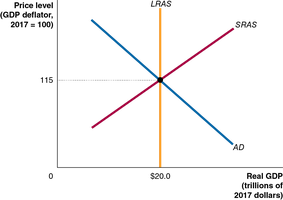
Macroeconomic equilibrium occurs when AD and SRAS intersect at the LRAS level, meaning the economy is at full employment. Short-run and long-run equilibria differ based on the intersection of these curves.
Effects of Changes in Aggregate Demand and Supply
Decrease in AD: Causes recession; SRAS eventually shifts right, restoring equilibrium at a lower price level.
Increase in AD: Causes expansion; SRAS eventually shifts left, restoring equilibrium at a higher price level.
Supply Shock: SRAS shifts left, causing stagflation (inflation and recession); SRAS may shift right over time, or policy may increase AD.
Dynamic Aggregate Demand and Aggregate Supply Model
This model incorporates continual increases in real GDP, shifting LRAS and AD to the right, and SRAS shifting right except when inflation expectations are high. Inflation occurs when AD increases faster than LRAS.
Macroeconomic Schools of Thought
Macroeconomics includes several schools of thought, each with different views on the causes of business cycles and the role of government policy.
Keynesian: Emphasizes sticky wages and prices; government intervention can stabilize the economy.
Monetarist: Focuses on money supply; advocates a constant monetary growth rule.
New Classical: Rational expectations; fluctuations minimized by correct expectations and monetary rules.
Real Business Cycle: Productivity shocks are main source of fluctuations; supply is vertical even in the short run.
Austrian: Market system superior; business cycles caused by central bank-induced low interest rates.
Marxist: Critiques capitalism; labor theory of value; predicts eventual transition to communism.
Key Equations
Real GDP:
Aggregate Demand:
Long-Run Aggregate Supply: (where is potential GDP)
Additional info: The notes include expanded explanations, examples, and tables to ensure completeness and academic quality. Images are included only when directly relevant to the explanation of the paragraph.
