 Back
BackAggregate Demand and Supply: Gaps, Adjustments, and Fiscal Policy
Study Guide - Smart Notes
 Tailored notes based on your materials, expanded with key definitions, examples, and context.
Aggregate Demand and Aggregate Supply Model
Overview of the AD-AS Model
The Aggregate Demand (AD) and Aggregate Supply (AS) model is a central framework in macroeconomics for analyzing fluctuations in real GDP, employment, and the price level. It helps explain short-run economic cycles and long-run growth.
Aggregate Demand (AD): Represents the total demand for goods and services in an economy at different price levels.
Aggregate Supply (AS): Shows the total output firms are willing to produce at various price levels.
Short-Run vs. Long-Run: In the short run, prices and wages may be sticky, while in the long run, they adjust fully.
Example: A sudden increase in consumer confidence can shift the AD curve to the right, increasing output and price level in the short run.
Macroeconomic Gaps: Recessionary and Inflationary
Recessionary Gap
A recessionary gap occurs when actual real GDP is below potential GDP (Y*), indicating underutilized resources and higher unemployment.
Causes: Decline in aggregate demand due to reduced consumption, investment, government spending, or net exports.
Adjustment Mechanisms:
Falling wages and factor prices shift the short-run aggregate supply (SRAS) curve to the right, restoring equilibrium at potential GDP.
Expansionary fiscal policy (increased government spending or tax cuts) shifts the AD curve to the right.
Example: During a recession, governments may increase spending to boost aggregate demand. 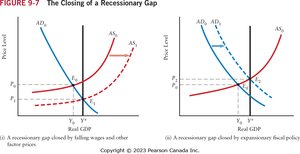
Inflationary Gap
An inflationary gap arises when actual real GDP exceeds potential GDP, leading to upward pressure on prices and lower unemployment.
Causes: Excessive aggregate demand from high consumption, investment, or government spending.
Adjustment Mechanisms:
Rising wages and factor prices shift the SRAS curve to the left, reducing output to potential GDP.
Contractionary fiscal policy (decreased government spending or increased taxes) shifts the AD curve to the left.
Example: If the economy overheats, the government may raise taxes to cool demand. 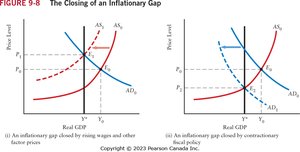
Shifts and Movements in Aggregate Demand and Supply
Shifts of the AD Curve
The AD curve shifts due to changes in its components:
Consumption (C)
Investment (I)
Government Spending (G)
Net Exports (NX)
Formula:
An increase in any component shifts AD right; a decrease shifts it left.
Why the AD Curve is Downward Sloping
Wealth Effect: Higher price levels reduce real wealth, lowering consumption.
Interest Rate Effect: Higher prices increase interest rates, reducing investment.
Net Export Effect: Higher domestic prices make exports less competitive, reducing net exports.
Shifts of the SRAS Curve
The SRAS curve shifts due to changes in input costs, productivity, and expectations.
Increase in Labour Force: Shifts SRAS right.
Improved Productivity: Shifts SRAS right.
Supply Shocks: Negative shocks (e.g., oil price spike) shift SRAS left.
Why the SRAS Curve is Upward Sloping
Sticky Wages and Prices: Contracts and menu costs prevent immediate adjustment.
Slow Wage Adjustment: Firms are slow to change wages in response to economic conditions.
Difficulty Predicting Prices: Uncertainty leads to gradual adjustments.
Long-Run Macroeconomic Equilibrium
Adjustment to Full Potential
In the long run, the economy returns to potential GDP (Y*) as wages and prices fully adjust.
Self-Correcting Mechanism: Recessionary gaps close as wages fall; inflationary gaps close as wages rise.
Role of Expectations: If workers expect higher future prices, they demand higher wages, shifting SRAS left.
Fiscal Policy and Economic Stabilization
Automatic Stabilizers
Automatic stabilizers are fiscal mechanisms that counteract economic fluctuations without new government action.
Progressive Taxation: Taxes rise with income, dampening booms.
Transfers: Unemployment benefits rise during recessions, supporting demand.
Multiplier Effect: Taxes and transfers reduce the size of the multiplier, moderating swings.
Discretionary Fiscal Policy
Discretionary fiscal policy involves deliberate changes in government spending or taxation to close output gaps.
Closing a Recessionary Gap: Increase spending or cut taxes.
Closing an Inflationary Gap: Decrease spending or raise taxes.
Phillips Curve and Tradeoffs
Unemployment and Inflation
The Phillips Curve illustrates the short-run tradeoff between unemployment and inflation.
Lower Unemployment: Often associated with higher inflation.
Higher Unemployment: Often associated with lower inflation.
Supply Side and Economic Growth
Factors Driving Growth
Labour Force Growth: Increases productive capacity.
Technological Progress: Shifts LRAS right, raising potential GDP.
Static vs. Dynamic AD-AS Models
Dynamic Model Features
Increasing Real GDP: LRAS shifts right over time.
AD Shifts: Typically rightward due to population and productivity growth.
SRAS Shifts: Rightward except when inflation expectations are high.
Saving Paradox
Short-Run vs. Long-Run Effects
Short Run: Increased saving reduces consumption and GDP.
Long Run: Higher saving boosts investment and future GDP.
Example: If households suddenly save more, the economy may slow initially but grow faster in the future. Additional info: These notes expand on brief points with academic context, definitions, and examples for clarity.
