 Back
BackAggregate Expenditure and Equilibrium Output: ch 8
Study Guide - Smart Notes
 Tailored notes based on your materials, expanded with key definitions, examples, and context.
Aggregate Expenditure and Equilibrium Output
Introduction to Aggregate Expenditure
Aggregate expenditure (AE) is a foundational concept in macroeconomics, representing the total planned spending in an economy during a specific period. It is the sum of consumption, planned investment, government expenditure, and net exports. The equilibrium output is achieved when aggregate output (income) equals aggregate planned expenditure.
Aggregate Planned Expenditure (AE):
Aggregate Output (Y): The total value of goods and services produced, equivalent to aggregate income.
Equilibrium Condition:
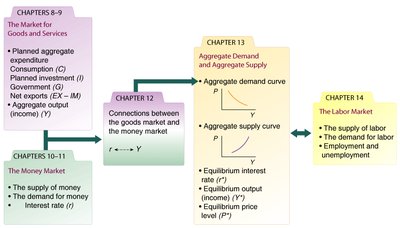
Income, Consumption, and Saving
Definitions and Relationships
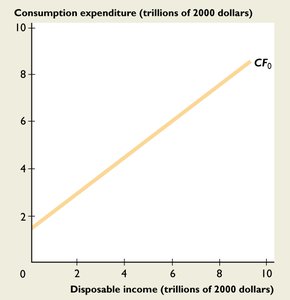
Household income can be either consumed or saved. The consumption function describes the relationship between consumption and income, while the saving function captures the portion of income not spent.
Consumption Function: where is autonomous consumption and is the marginal propensity to consume (MPC).
Saving Function:
Marginal Propensity to Consume (MPC): The fraction of additional income spent on consumption.
Marginal Propensity to Save (MPS): The fraction of additional income saved.
Identity:
Shifts in the Consumption Function
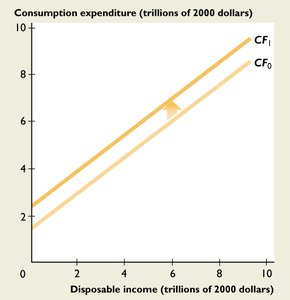
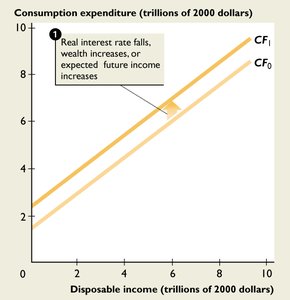
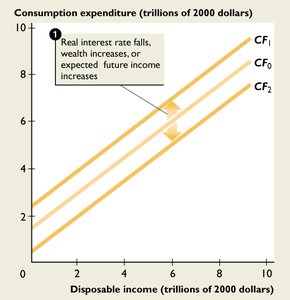
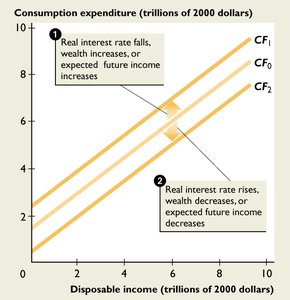
The consumption function can shift due to changes in factors other than income, such as the real interest rate, wealth, and expected future income. An upward shift indicates increased consumption at every income level.
Factors Influencing Consumption:
Income
Real interest rate
Wealth
Expected future income
The U.S. Consumption Function: Historical Perspective
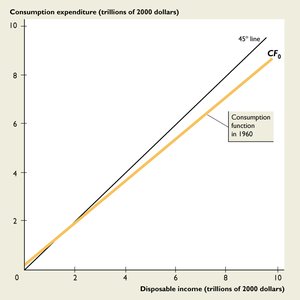
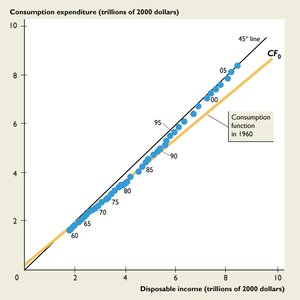
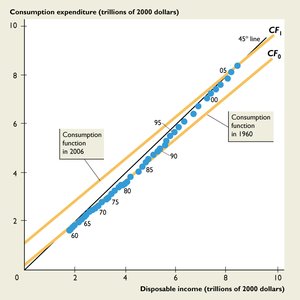
Empirical data from the United States demonstrates how the consumption function has shifted over time, reflecting changes in economic conditions and consumer behavior.
CF0: Consumption function estimate for the 1960s
CF1: Consumption function estimate for the 2000s
Slope (MPC): For the U.S., the MPC has been estimated at 0.87 in recent decades.
Planned Investment and Actual Investment
Definitions
Investment in macroeconomics refers to purchases by firms of new capital goods and additions to inventories. Planned investment is what firms intend to invest, while actual investment includes unplanned changes in inventories.
Planned Investment (I): Additions to capital stock and inventory that are planned by firms.
Actual Investment: The actual amount of investment, including unplanned inventory changes.
Change in Inventory: Production minus sales.
Equilibrium Aggregate Output (Income)
Determining Equilibrium
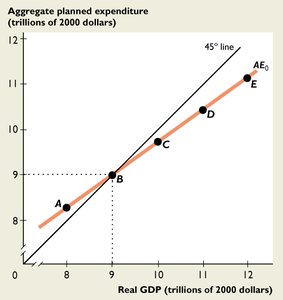
Equilibrium occurs when planned aggregate expenditure equals aggregate output (income). At this point, there is no tendency for change, and unplanned inventory changes are zero.
Equilibrium Condition:
Alternative Approach: Equilibrium also occurs when planned saving equals planned investment ().
Aggregate Output (Y) | Aggregate Consumption (C) | Planned Investment (I) | Planned Aggregate Expenditure (AE) | Unplanned Inventory Change | Equilibrium? |
|---|---|---|---|---|---|
100 | 175 | 25 | 200 | -100 | No |
200 | 250 | 25 | 275 | -75 | No |
400 | 400 | 25 | 425 | -25 | No |
500 | 475 | 25 | 500 | 0 | Yes |
600 | 550 | 25 | 575 | +25 | No |
800 | 700 | 25 | 725 | +75 | No |
1,000 | 850 | 25 | 875 | +125 | No |
The Multiplier Effect
Concept and Calculation
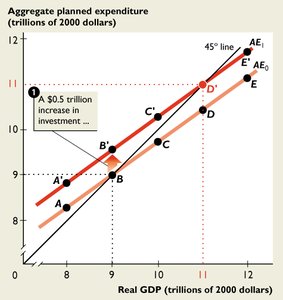
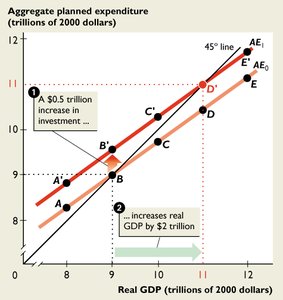
The multiplier measures how a change in autonomous expenditure (such as investment) leads to a larger change in equilibrium output. The size of the multiplier depends on the marginal propensity to consume (MPC).
Multiplier Formula:
Change in Output:
Example: If , then
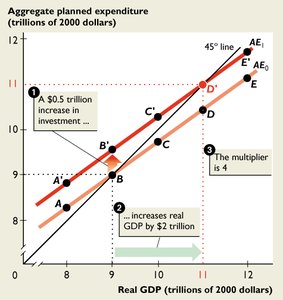
Multiplier in the Real World
In practice, the multiplier is often smaller than the theoretical value due to leakages such as taxes, imports, and savings. In the U.S., a sustained increase in autonomous spending of $10 billion typically raises real GDP by about $20 billion, implying a multiplier of about 2.
Practice Questions
Assume a consumption function of the form . Derive the saving function and write out the algebraic representation.
Assume a two-sector economy where and . Calculate the equilibrium level of output for this hypothetical economy. What would the level of consumption be if the economy were operating at 1400? What would be the amount of unplanned investment at this level? In which direction would you expect the economy to move to at $1400$ and why?
