 Back
BackAggregate Expenditure Multiplier: Concepts, Mechanisms, and Applications
Study Guide - Smart Notes
 Tailored notes based on your materials, expanded with key definitions, examples, and context.
Chapter 14: Aggregate Expenditure Multiplier
14.1 Expenditure Plans and Real GDP
The aggregate expenditure model analyzes how total spending in the economy determines the level of real GDP. Aggregate expenditure is the sum of consumption, investment, government spending, and net exports.
Aggregate Expenditure (AE):
Aggregate Planned Expenditure: The sum of planned spending by households, firms, and government, including planned exports minus planned imports.
Autonomous Expenditure: Components of AE that do not change with real GDP (e.g., investment, government spending, exports, and the autonomous parts of consumption and imports).
Induced Expenditure: Components of AE that change with real GDP (mainly consumption and imports that vary with income).
Consumption Function: Shows the relationship between consumption expenditure and disposable income (income after taxes and transfers).
Disposable Income (Yd):
Net Taxes: Taxes paid minus transfer payments received.
Key Points:
When the consumption function is above the 45° line, saving is negative (dissaving).
When below the 45° line, saving is positive.
At the intersection, all disposable income is spent (saving is zero).
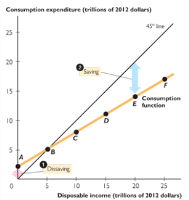
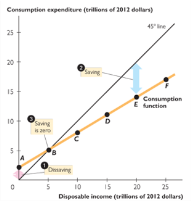
Marginal Propensity to Consume (MPC)
The MPC is the fraction of a change in disposable income that is spent on consumption.
Formula:
For example, if disposable income increases by MPC = 3/5 = 0.6$.
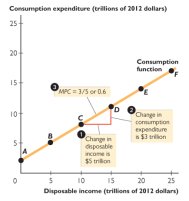
Other Influences on Consumption Expenditure
Real Interest Rate: Lower rates increase consumption and decrease saving; higher rates do the opposite.
Wealth: Increases in wealth raise consumption; decreases lower it.
Expected Future Income: Higher expected income increases consumption today.
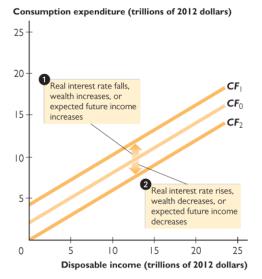
Imports and Real GDP
Imports are another major component of induced expenditure.
Marginal Propensity to Import (MPI): The fraction of an increase in real GDP spent on imports:
14.2 Equilibrium Expenditure
Equilibrium expenditure occurs when aggregate planned expenditure equals real GDP. At this point, there are no unplanned changes in inventories, and the economy is in short-run equilibrium.
Aggregate Planned Expenditure (APE):
As real GDP increases, disposable income and consumption rise, affecting equilibrium.
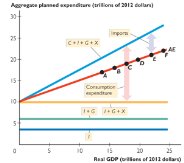
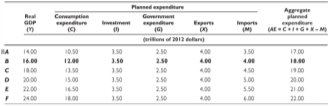
Equilibrium Condition
Equilibrium occurs where the AE curve intersects the 45° line:
If AE > Y, inventories fall (unplanned decrease), prompting firms to increase production.
If AE < Y, inventories rise (unplanned increase), prompting firms to cut production.
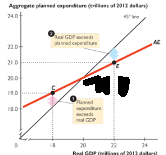
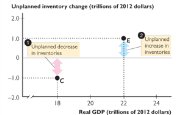
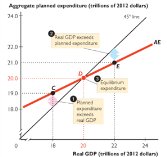
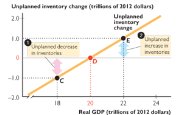
Adjustment to Equilibrium
When not at equilibrium, real GDP adjusts through changes in production until AE = Y.
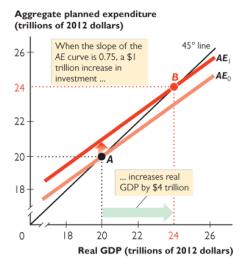
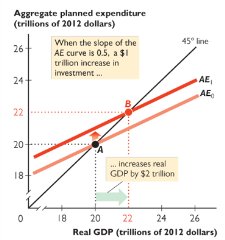
Autonomous expenditure increases shift the AE curve upward, raising equilibrium GDP by more than the initial change (the multiplier effect).
14.3 Expenditure Multipliers
The multiplier quantifies how a change in autonomous expenditure leads to a larger change in equilibrium real GDP.
Multiplier Formula:
The multiplier is greater than 1 because increased spending induces further rounds of consumption.
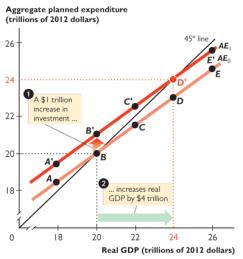
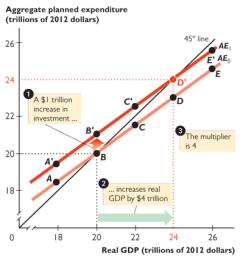
Multiplier and the Marginal Propensity to Consume
The higher the MPC, the larger the multiplier.
Ignoring imports and taxes: and
Solving for the multiplier:
For , multiplier
Multiplier with Imports and Taxes
Imports and income taxes reduce the multiplier because they leak spending out of the domestic economy.
The general formula:
The slope of the AE curve is reduced by the marginal propensity to import and the marginal tax rate.
Business-Cycle Turning Points
Swings in autonomous expenditure (e.g., investment, exports) trigger expansions or recessions.
The multiplier amplifies these swings, giving momentum to the business cycle.
14.4 The AD Curve and Equilibrium Expenditure
The Aggregate Demand (AD) curve shows the relationship between the quantity of real GDP demanded and the price level, holding other factors constant. It is derived from the equilibrium expenditure model.
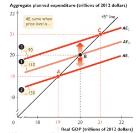
A movement along the AE curve is caused by changes in real GDP; a movement along the AD curve is caused by changes in the price level.
When the price level changes, the AE curve shifts, changing equilibrium expenditure and thus the quantity of real GDP demanded.
Eye on the Multiplier: Real-World Estimates
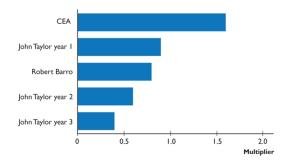
Economists debate the size of the government expenditure multiplier. Estimates vary based on economic conditions and assumptions about crowding out and slack in the economy.
Christina Romer (CEA): Multiplier ≈ 1.6
Robert Barro: Multiplier ≈ 0.8 (due to crowding out of private investment)
John Taylor: Multiplier less than 1, declining over time as crowding out increases
A large multiplier is more likely when there is substantial slack (large recessionary gap).
Summary Table: Key Formulas and Concepts
Concept | Formula | Description |
|---|---|---|
Aggregate Expenditure (AE) | Total planned spending in the economy | |
Marginal Propensity to Consume (MPC) | Fraction of additional income spent on consumption | |
Marginal Propensity to Import (MPI) | Fraction of additional income spent on imports | |
Multiplier (no taxes/imports) | Effect of autonomous expenditure on GDP | |
Multiplier (general) | Includes effects of taxes and imports |
