 Back
BackChapter 1: Foundations of Economics – Key Concepts and Applications
Study Guide - Smart Notes
 Tailored notes based on your materials, expanded with key definitions, examples, and context.
What is Economics?
Definition and Scope of Economics
Economics is the social science that studies the choices individuals, businesses, governments, and societies make as they cope wlith scarcity and the incentives that influence and reconcile those choices. Scarcity arises because human wants exceed the resources available, necessitating choices and tradeoffs. Economics is divided into two main branches:
Microeconomics: Focuses on the choices of individuals and businesses, market interactions, and government influence.
Macroeconomics: Examines the performance of national and global economies, including issues like unemployment and inflation.
Example: A microeconomic question might be "Why are people buying more e-books and fewer hard copy books?" while a macroeconomic question could be "Why does the unemployment rate in Canada fluctuate?"
Two Big Economic Questions
What, How, and For Whom?
Economics seeks to answer two fundamental questions:
What, how, and for whom are goods and services produced?
When do choices made in self-interest also promote the social interest?
Goods and services are produced using factors of production:
Land: Natural resources
Labour: Human effort, influenced by human capital (education, skills)
Capital: Tools, machines, buildings
Entrepreneurship: Organization and innovation
Distribution of goods and services depends on income earned from these factors:
Land earns rent
Labour earns wages
Capital earns interest
Entrepreneurship earns profit
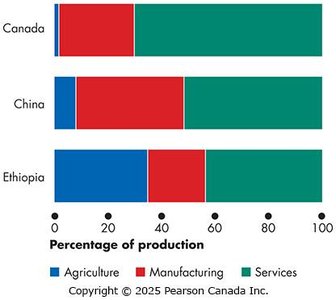
Example: The composition of production varies by country. In Canada, services dominate production, while agriculture is more significant in Ethiopia.
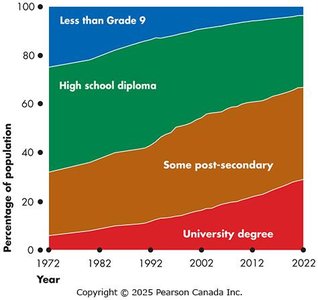
Growth of Human Capital
Human capital, measured by educational attainment, has grown significantly in Canada over the past century. This trend influences the quality of labour and overall economic productivity.
Self-Interest vs. Social Interest
Choices made in self-interest may or may not align with the social interest. Social interest is defined by two dimensions:
Efficiency: Resource use is efficient if it is impossible to make someone better off without making someone else worse off.
Equity: Fairness in the distribution of resources and outcomes.
Major topics illustrating the tension between self-interest and social interest include globalization, information-age monopolies, climate change, and economic instability.
The Economic Way of Thinking
Six Key Ideas
Economists use a structured approach to analyze choices:
A choice is a tradeoff: Scarcity forces individuals to give up one thing to obtain another.
Rational choices: People compare benefits and costs to maximize their net gain.
Benefit: The gain or pleasure derived from an action, determined by preferences.
Cost: The opportunity cost, or the highest-valued alternative forgone.
Marginal analysis: Most choices are "how-much" decisions made at the margin, weighing marginal benefit against marginal cost.
Incentives: Rewards or penalties that influence choices.
Example: Deciding how much time to allocate between studying and leisure involves comparing the marginal benefit of extra study time to its marginal cost.
Formula: Opportunity cost can be expressed as:
Economics as a Social Science and Policy Tool
Positive vs. Normative Statements
Economists distinguish between:
Positive statements: Descriptions of what is, testable by facts.
Normative statements: Opinions about what ought to be, not testable.
Economic models are simplified representations of reality, used to predict and analyze outcomes. Models are tested using natural experiments, statistical investigations, and economic experiments.
Policy Advice
Economics provides tools for evaluating policy alternatives by comparing marginal benefits and costs, though it cannot determine normative goals.
Economists in the Economy
Career Opportunities and Skills
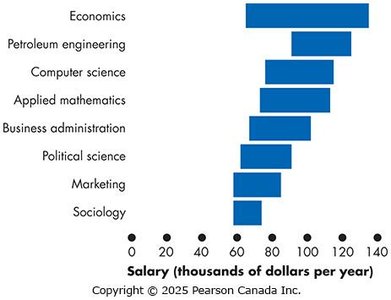
Economics majors pursue careers as economists, market research analysts, financial analysts, and budget analysts in private firms, government, and international organizations. The field offers competitive salaries and growth prospects.
Key skills sought by employers include:
Critical-thinking skills: Problem-solving using logic
Analytical skills: Using economic tools to analyze data
Math skills: Applying mathematics and statistics
Writing skills: Communicating ideas in written reports
Oral communication skills: Explaining concepts to non-economists
Diversity, Equity, and Inclusion in Economics
There is underrepresentation of women and minorities in economics compared to their share in the population. Efforts to improve diversity are ongoing, as a more inclusive profession is seen as both fairer and more efficient, enhancing research quality and economic policy.
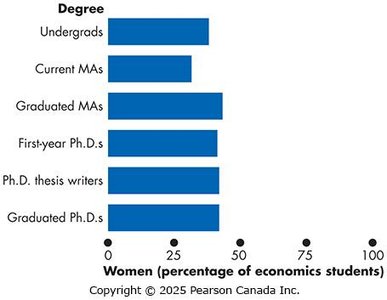
Degree | Women (% of economics students) |
|---|---|
Undergrads | ~42% |
Current MAs | Similar to undergrads |
Graduated MAs | Similar to undergrads |
First-year Ph.D.s | Similar to undergrads |
Ph.D. thesis writers | Similar to undergrads |
Graduated Ph.D.s | Similar to undergrads |
Additional info: Diversity and inclusion are essential for attracting the best talent and making the economics profession—and the economy—more prosperous.
