 Back
BackChapter 15: Monetary Policy – Study Notes for Macroeconomics
Study Guide - Smart Notes
 Tailored notes based on your materials, expanded with key definitions, examples, and context.
Monetary Policy: Concepts and Tools
What Is Monetary Policy?
Monetary policy refers to the actions undertaken by a nation's central bank—in the United States, the Federal Reserve (the Fed)—to manage the money supply and interest rates in pursuit of macroeconomic goals. These goals include price stability, high employment, stability of financial markets and institutions, and economic growth.
Monetary Policy: The process by which the central bank controls the supply of money, often targeting an inflation rate or interest rate to ensure price stability and general trust in the currency.
Federal Reserve's Role: Established in 1913, the Fed's responsibilities expanded after the Great Depression to include promoting maximum employment, stable prices, and moderate long-term interest rates.
Dual Mandate: The Fed is tasked with achieving both price stability and high employment.
The Goals of Monetary Policy
Price Stability: Maintaining low and stable inflation is crucial because rising prices erode the value of money.
High Employment: Ensuring that those willing and able to work can find employment supports economic growth and stability.
Stability of Financial Markets and Institutions: The Fed acts as a lender of last resort to prevent bank failures and maintain confidence in the financial system.
Economic Growth: Stable economic growth encourages investment and long-term prosperity.
The Money Market and the Fed’s Monetary Policy Targets
Monetary Policy Tools
The Fed uses three main tools to influence the money supply and interest rates:
Open Market Operations: Buying and selling U.S. Treasury securities to adjust the money supply.
Discount Policy: Changing the interest rate charged to commercial banks for borrowing funds from the Fed.
Reserve Requirements: Setting the minimum reserves each bank must hold to back deposits.
Monetary Policy Targets
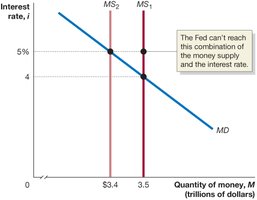
The Fed typically targets the short-term nominal interest rate, specifically the federal funds rate, which is the rate banks charge each other for overnight loans. The money supply and interest rate are closely linked through the money market.
The Demand for Money
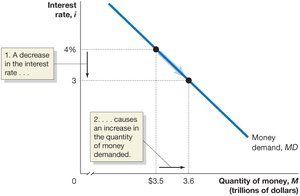
As the interest rate decreases, the quantity of money demanded increases because the opportunity cost of holding money falls.
Shifts in the Money Demand Curve
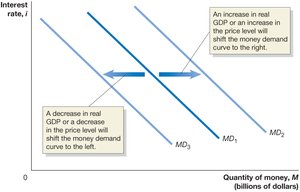
Increases in real GDP or the price level shift the money demand curve to the right.
Decreases in real GDP or the price level shift the money demand curve to the left.
Managing the Money Supply
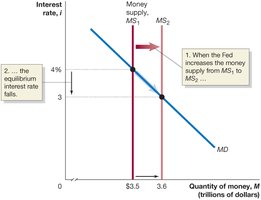
To increase the money supply, the Fed buys Treasury securities, which injects money into the banking system and lowers interest rates.
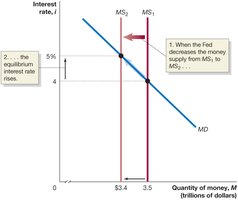
To decrease the money supply, the Fed sells Treasury securities, which withdraws money from the system and raises interest rates.
The Federal Funds Rate
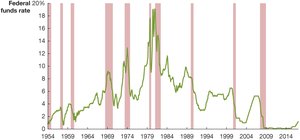
The Fed influences the federal funds rate through open market operations, pushing it down during recessions and up during expansions.
Monetary Policy and Economic Activity
Interest Rates and Aggregate Demand
Monetary policy affects aggregate demand through its impact on interest rates:
Consumption: Lower interest rates encourage borrowing and spending, especially on durable goods.
Investment: Lower rates make borrowing cheaper for firms and households, stimulating investment in capital and housing.
Net Exports: Lower U.S. interest rates can weaken the dollar, making exports more competitive.
Expansionary and Contractionary Monetary Policy
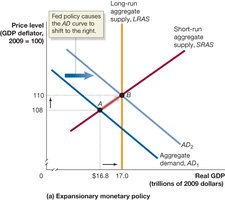
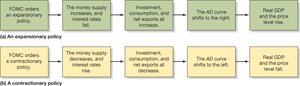
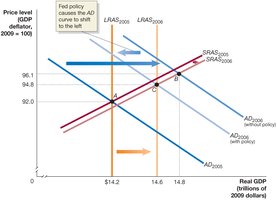
Expansionary Policy: The Fed decreases interest rates to stimulate real GDP when the economy is below potential output.
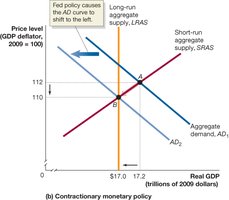
Contractionary Policy: The Fed increases interest rates to reduce inflation when the economy is above potential output.
Limitations of Monetary Policy
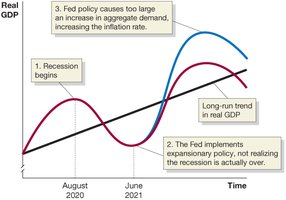
Monetary policy is subject to information lags and forecasting errors, making it difficult to perfectly offset recessions or inflation.
Poorly timed policy can exacerbate economic fluctuations.
Expansionary vs. Contractionary Policy: Summary Table
Policy | Money Supply | Interest Rates | Investment, Consumption, Net Exports | AD Curve | Real GDP & Price Level |
|---|---|---|---|---|---|
Expansionary | Increases | Falls | Increase | Shifts right | Rise |
Contractionary | Decreases | Rises | Decrease | Shifts left | Fall |
Dynamic Aggregate Demand and Aggregate Supply Model
Monetary Policy in a Dynamic Context
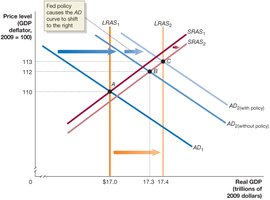
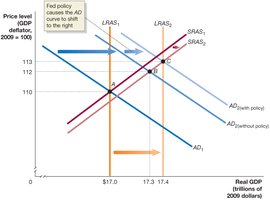
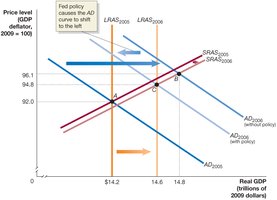
The dynamic AD-AS model incorporates annual increases in potential GDP, aggregate demand, and the price level. The Fed uses monetary policy to keep real GDP close to potential GDP and control inflation.
The Fed’s Setting of Monetary Policy Targets
Interest Rate vs. Money Supply Targeting
Monetarists advocated targeting the money supply, but the unstable relationship between money supply and real GDP/inflation led the Fed to focus on interest rates instead.
The Fed cannot target both the money supply and the interest rate simultaneously due to their interdependence.
The Taylor Rule
The Taylor Rule provides a formula for setting the federal funds rate based on inflation and output gaps:
Formula:
Inflation gap: Difference between current inflation and the Fed’s target.
Output gap: Difference between current real GDP and potential GDP.
Inflation Targeting
Some central banks announce explicit inflation targets to anchor expectations and improve accountability.
The Fed adopted a 2% average inflation target in 2012.
Arguments for: clarity, improved planning, accountability.
Arguments against: reduced flexibility, reliance on accurate forecasts, potential neglect of other goals.
Measuring Inflation
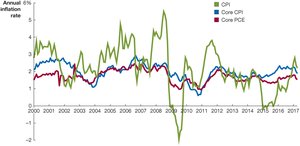
The Fed prefers the "core PCE" (Personal Consumption Expenditures index excluding food and energy) as its inflation measure due to its stability.
Fed Policies during the 2007–2009 Recession
The Housing Bubble and Financial Crisis
A bubble occurs when asset prices exceed their fundamental value, often due to herding and speculation.
The U.S. housing bubble led to excessive investment and risky lending practices (sub-prime, Alt-A, adjustable-rate mortgages).
When the bubble burst, defaults increased, mortgage-backed securities lost value, and banks suffered heavy losses.
Policy Responses
The Fed and Treasury took unprecedented actions, including lending to banks and insuring money market funds, to stabilize the financial system.
Congress passed the Troubled Asset Relief Program (TARP) to provide capital to banks.
These interventions aimed to restore confidence and achieve the Fed’s traditional goals: high employment, price stability, and financial market stability.
