 Back
BackChapter 16: Fiscal Policy – Macroeconomics Study Notes
Study Guide - Smart Notes
 Tailored notes based on your materials, expanded with key definitions, examples, and context.
Fiscal Policy: Concepts and Applications
What Is Fiscal Policy?
Fiscal policy refers to the use of government spending, transfer payments, and taxation to influence macroeconomic outcomes such as real GDP, unemployment, and inflation. It is a primary tool for managing economic fluctuations and achieving policy objectives.
Discretionary Fiscal Policy: Deliberate changes in government purchases or taxes to influence aggregate demand.
Automatic Stabilizers: Government spending and taxes that automatically increase or decrease with the business cycle (e.g., unemployment insurance).
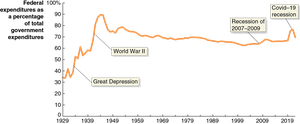
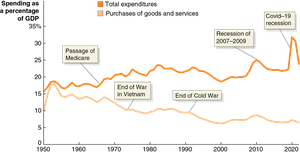
Federal Expenditures: Now over 30% of GDP, with a significant portion on transfer payments (Social Security, Medicare).
Federal Revenue: Primarily from individual income and payroll taxes, with smaller shares from corporate taxes and other sources.
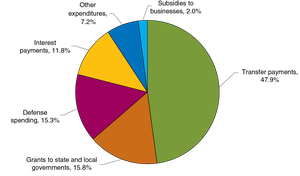
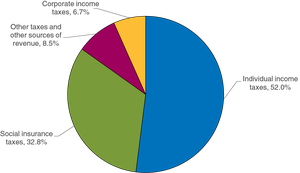
Example: During the Covid-19 recession, the U.S. government distributed $800 billion to households, supporting spending but increasing the federal deficit.
Social Security and Medicare: Fiscal Challenges
Social Security and Medicare have reduced poverty among the elderly but face long-term funding challenges due to an aging population and rising healthcare costs.
Potential solutions include increasing taxes, reducing benefits, tightening eligibility, and controlling medical costs.
The Effects of Fiscal Policy on Real GDP and the Price Level
Fiscal Policy and Aggregate Demand
Fiscal policy affects aggregate demand (AD) through changes in government purchases and taxes:
Expansionary Fiscal Policy: Increases government purchases or decreases taxes to boost AD, used when real GDP is below potential GDP.
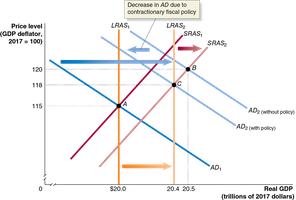
Contractionary Fiscal Policy: Decreases government purchases or increases taxes to reduce AD, used when real GDP exceeds potential GDP.
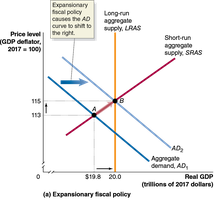
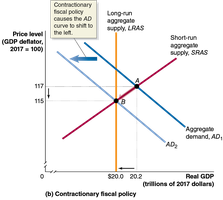
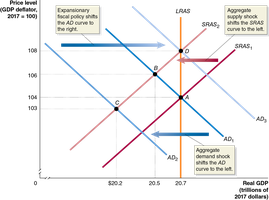
Example: The Covid-19 pandemic caused both aggregate supply and demand shocks. Expansionary fiscal policy shifted AD rightward, helping restore GDP but contributing to inflation.
Fiscal Policy in the Dynamic Aggregate Demand and Aggregate Supply Model
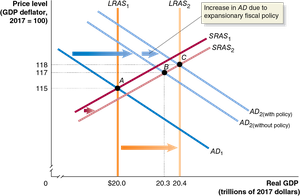
The dynamic AD-AS model incorporates changes in potential GDP and the price level over time, providing a more realistic analysis of fiscal policy effects.
Expansionary policy can restore full employment but may raise the price level.
Contractionary policy can reduce inflationary pressures when AD grows too quickly.
The Government Purchases, Tax, and Transfer Payments Multipliers
The Multiplier Effect
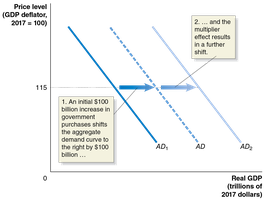
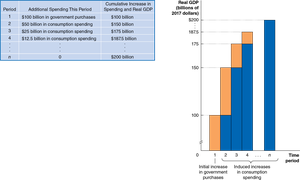
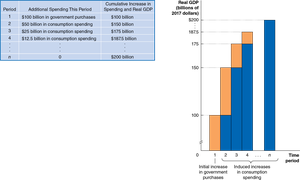
The multiplier effect describes how an initial change in autonomous expenditure (such as government purchases) leads to a larger change in real GDP due to induced increases in consumption.
Government Purchases Multiplier: Measures the total change in GDP from a change in government spending.
Tax Multiplier: Measures the total change in GDP from a change in taxes (negative value; smaller in absolute terms than the purchases multiplier).
Transfer Payments Multiplier: Positive effect on GDP as increased transfers raise disposable income and consumption.
Formula for Government Purchases Multiplier:
where MPC is the marginal propensity to consume.
Formula for Tax Multiplier:
Example: If MPC = 0.75, the government purchases multiplier is 4, and the tax multiplier is -3.
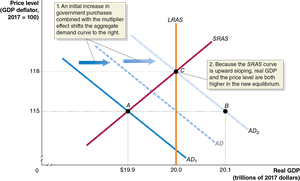
Limits to Using Fiscal Policy to Stabilize the Economy
Fiscal policy faces several limitations:
Legislative Delay: Time required for Congress to pass fiscal measures.
Implementation Delay: Time needed to execute spending projects.
Crowding Out: Increased government spending may raise interest rates, reducing private investment, consumption, and net exports.
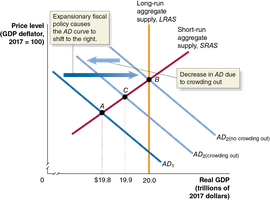
Long-Run Crowding Out: In the long run, increases in government purchases are offset by reductions in private spending, leaving real GDP unchanged but increasing the size of the government sector.
Deficits, Surpluses, and Federal Government Debt
Budget Deficits and Surpluses
Budget Deficit: Government expenditures exceed tax revenue.
Budget Surplus: Government expenditures are less than tax revenue.
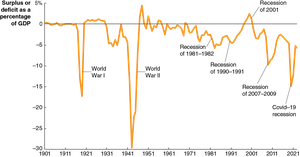
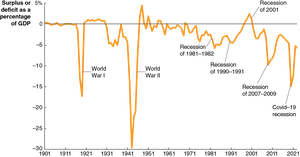
Automatic Stabilizers: Budget deficits often increase during recessions due to falling tax receipts and rising transfer payments, helping to moderate economic downturns.
Cyclically Adjusted Budget Deficit: The deficit or surplus that would exist if the economy were at potential GDP, separating the effects of the business cycle from policy decisions.
Federal Government Debt
The national debt is the total value of outstanding Treasury securities issued to finance past budget deficits.
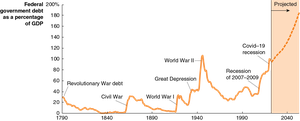
Debt increases during wars and recessions.
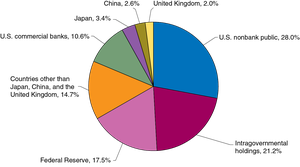
Debt is held by government trust funds, the Federal Reserve, U.S. investors, and foreign entities.
Is Government Debt a Problem?
Currently, the U.S. faces low risk of default due to low borrowing costs and manageable interest payments.
Long-term risks include crowding out of investment if debt grows faster than GDP.
Debt used for productive investment (infrastructure, education) is less problematic than debt used for current consumption.
Long-Run Fiscal Policy and Economic Growth
Supply-Side Economics
Some fiscal policies aim to increase potential GDP by improving incentives to work, save, invest, and innovate. These are known as supply-side policies.
Tax Wedge: The difference between pre-tax and post-tax returns to economic activity. Large tax wedges reduce incentives and lower real GDP.
Marginal Tax Rates: Higher marginal rates can discourage work and investment.
Tax Simplification: A simpler tax code can increase efficiency and reduce compliance costs.
Appendix: A Closer Look at the Multiplier
Equilibrium Real GDP
Equilibrium GDP is determined where total spending equals total output. The basic model includes consumption, investment, government purchases, and taxes.
General Equilibrium Condition:
where is real GDP, is consumption, is investment, and is government purchases.
Government Purchases Multiplier (with MPC):
Tax Multiplier:
Balanced Budget Multiplier: If government purchases and taxes increase by the same amount, GDP increases by that amount in the short run.
Effect of Tax Rates: Lower tax rates increase the size of the multiplier.
Open Economy Multiplier: The presence of imports reduces the multiplier, as some spending leaks abroad.
where is the tax rate and is the marginal propensity to import.
Example: With , , and , the multiplier is smaller than in a closed economy.
