 Back
BackChapter 2: Trade-offs, Comparative Advantage, and the Market System – Study Notes
Study Guide - Smart Notes
 Tailored notes based on your materials, expanded with key definitions, examples, and context.
Trade-offs, Comparative Advantage, and the Market System
Scarcity and Trade-offs
Scarcity is a fundamental concept in economics, referring to the situation where unlimited wants exceed the limited resources available to fulfill those wants. Because resources are scarce, households, firms, and governments must make choices about how best to allocate them, leading to trade-offs.
Scarcity: Unlimited wants vs. limited resources.
Trade-off: Choosing one option means forgoing another.
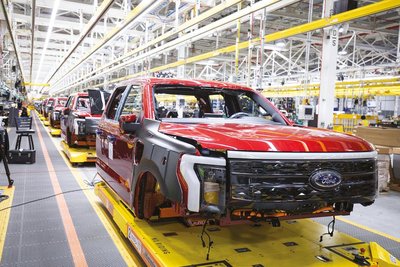
Example: Ford must decide whether to allocate resources to produce more electric vehicles (EVs) or gasoline-powered trucks.
Production Possibilities Frontier (PPF) and Opportunity Costs
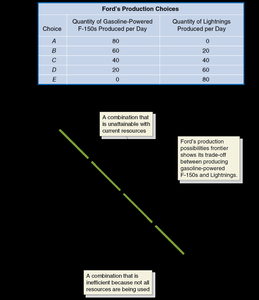
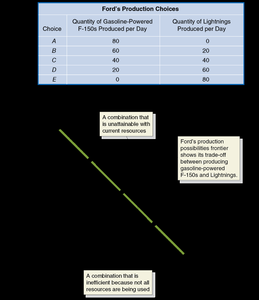
The Production Possibilities Frontier (PPF) is a curve that shows the maximum attainable combinations of two goods that can be produced with available resources and current technology. The PPF is a positive tool, illustrating what is possible, not what should be done.
PPF: Demonstrates trade-offs and opportunity costs.
Opportunity Cost: The highest-valued alternative that must be given up to engage in an activity.
Points on the PPF: Attainable and efficient.
Points below the PPF: Inefficient (not all resources used).
Points above the PPF: Unattainable with current resources.
Increasing Marginal Opportunity Costs
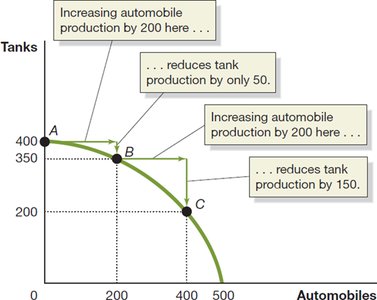
Opportunity costs are often increasing because some resources are better suited to one task than another. As more resources are devoted to an activity, the payoff to devoting additional resources diminishes.
Economic Growth and Shifts in the PPF
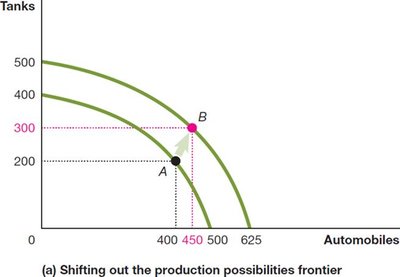
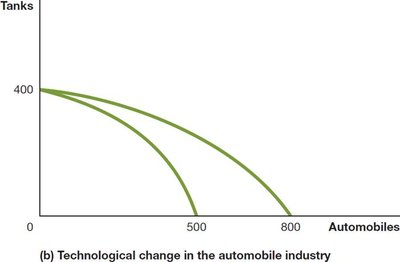
Economic growth occurs when more resources become available or when technology improves, allowing the economy to produce more goods and services. This is represented by an outward shift of the PPF.
Economic Growth: Ability to increase production.
Technological Change: Allows more output with the same resources.
PPF Example: Exam Grades
When allocating limited study time between two exams, the PPF is typically bowed outward, reflecting increasing opportunity costs. The first hour spent studying one subject is more valuable than the last hour.
Comparative Advantage and Trade
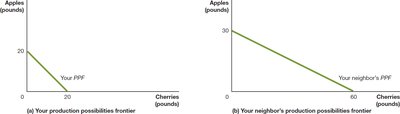
Comparative advantage is the basis for trade. It refers to the ability to produce a good or service at a lower opportunity cost than others. Even if one party has an absolute advantage in producing both goods, both parties can benefit from trade by specializing according to their comparative advantage.
Absolute Advantage: Ability to produce more of a good with the same resources.
Comparative Advantage: Ability to produce at a lower opportunity cost.
Specialization: Producing goods for which one has a comparative advantage.
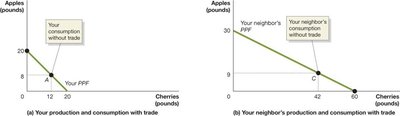
Trade: Allows both parties to consume more than they could without trade.
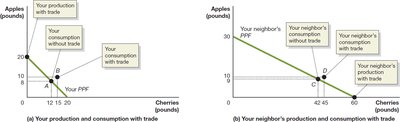
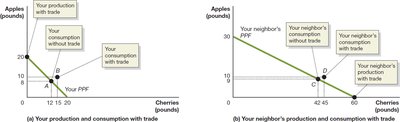
Summary Table: Gains from Trade
The following table summarizes the gains from trade between you and your neighbor:
You Apples (lbs) | You Cherries (lbs) | Your Neighbor Apples (lbs) | Your Neighbor Cherries (lbs) | |
|---|---|---|---|---|
Production and consumption without trade | 8 | 12 | 9 | 42 |
Production with trade | 20 | 0 | 0 | 60 |
Consumption with trade | 10 | 15 | 10 | 45 |
Gains from trade (increased consumption) | 2 | 3 | 1 | 3 |
Opportunity Costs Table
Opportunity Cost of Picking 1 Pound of Apples | Opportunity Cost of Picking 1 Pound of Cherries | |
|---|---|---|
You | 1 pound of cherries | 1 pound of apples |
Your Neighbor | 2 pounds of cherries | 0.5 pound of apples |
Application: Comparative Advantage in Housework
Comparative advantage can be applied to everyday situations, such as dividing household chores. Even if one person is faster at both tasks, specialization according to comparative advantage leads to greater efficiency.
The Market System
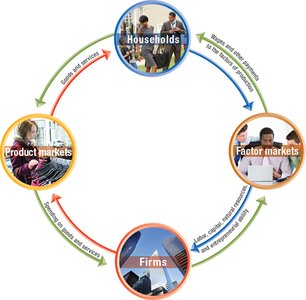
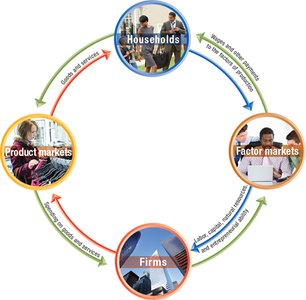
A market system is a group of buyers and sellers of a good or service, and the institution or arrangement by which they come together to trade. The modern economy consists of households and firms interacting in product and factor markets.
Households: Provide factors of production (labor, capital, natural resources, entrepreneurial ability).
Firms: Purchase factors of production and produce goods and services.
Factor Market: Where factors of production are bought and sold.
Product Market: Where goods and services are bought and sold.
The Four Factors of Production
Labor: All types of work.
Capital: Physical capital used to produce other goods.
Natural Resources: Raw materials used in production.
Entrepreneurial Ability: The skill to combine other factors to produce goods and services.
Households and Firms Table
Households | Firms | |
|---|---|---|
What they sell | Sell factors of production to firms in factor markets | Sell goods and services to households in product markets |
What they buy | Buy goods and services from firms in product markets | Buy factors of production from households in factor markets |
Circular-Flow Diagram
The circular-flow diagram illustrates how households and firms interact in product and factor markets. Households provide factors of production to firms, and firms provide goods and services to households. Money flows in the opposite direction.
The Gains From Free Markets
Free markets, with few government restrictions, have historically provided rising living standards. Adam Smith argued for free markets, noting that the "invisible hand" allows individual self-interest to collectively satisfy consumer wants.
The Market Mechanism
Flexible Prices: Allow households and firms to signal the relative worth of goods and services.
Self-interest: Drives firms to respond to consumer demand.
Example: Firms increase production of electric cars when demand rises, without government direction.
Knowledge Mobilization in Markets
Markets process vast amounts of information, much of which is local and specific. Individuals use their knowledge for personal benefit, but this helps send price signals throughout the economy, allowing rapid adaptation to changing conditions.
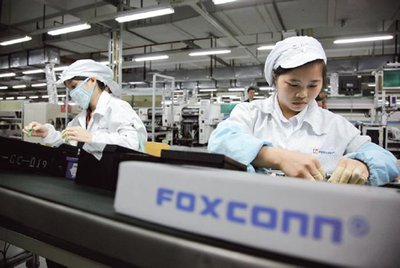
Application: Making an iPad
Production of complex goods like an iPad involves hundreds of firms, each acting in its own self-interest, yet collectively contributing to the final product without central coordination.
The Role of the Entrepreneur
Entrepreneurs operate businesses, bringing together labor, capital, and natural resources to produce goods and services. They drive innovation and economic growth, often taking significant risks.
The Legal Basis of a Successful Market System
While free markets minimize government restrictions, a sound legal environment is essential. Governments must protect private property and enforce contracts to ensure market success.
Property Rights: Exclusive rights to use, buy, or sell property.
Contract Enforcement: Critical for transactions across time.
Independent Courts: Necessary for upholding property rights and contracts.
Socialism and the Role of Government
Socialism, as described by Karl Marx, involves government control of the economy. Modern social democratic parties advocate for a larger government role, especially in sectors like health care and education, but not full socialism.


Additional info: Academic context and examples have been expanded for clarity and completeness. Tables have been recreated and summarized for study purposes.
