 Back
BackChapter 4: What Macroeconomics Is All About – Key Variables, Growth, and Fluctuations
Study Guide - Smart Notes
 Tailored notes based on your materials, expanded with key definitions, examples, and context.
Chapter 4: What Macroeconomics Is All About
Key Macroeconomic Variables
Macroeconomics studies the aggregate performance of the economy by focusing on several key variables. These variables help economists and policymakers understand the health and direction of the economy.
National Income: The total income earned by a nation's residents and businesses, including wages, profits, rents, and taxes minus subsidies.
Nominal National Income: Measured in current dollars, reflecting both changes in prices and quantities.
Real National Income: Measured in constant (base-period) dollars, reflecting only changes in quantities.
Gross Domestic Product (GDP): The most widely used measure of national income, representing the total value of goods and services produced within a country.
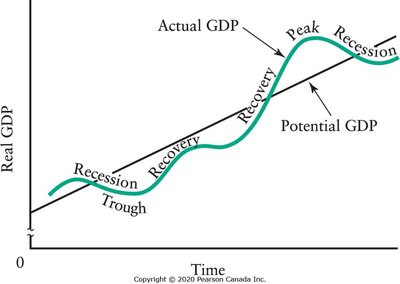
Business Cycles: Fluctuations in economic activity characterized by periods of expansion (recovery, peak) and contraction (recession, trough).
Unemployment: The number of people actively seeking work but unable to find employment.
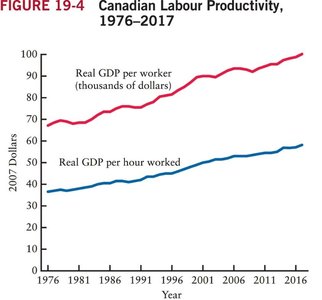
Productivity: Output per unit of input, often measured as real GDP per worker or per hour worked.
Inflation: The rate at which the general level of prices for goods and services rises.
Interest Rates: The cost of borrowing money, expressed as a percentage of the amount borrowed.
Exchange Rates: The value of one currency in terms of another.
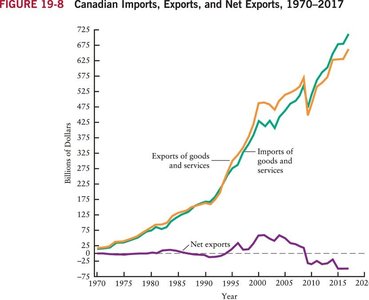
Net Exports: The difference between a country's exports and imports.
Growth Versus Fluctuations
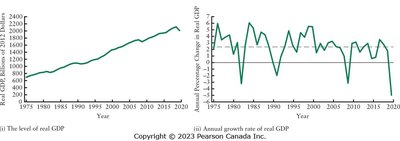
Macroeconomics distinguishes between long-run economic growth and short-run fluctuations. Long-run growth refers to the sustained upward trend in output over time, while short-run fluctuations are deviations from this trend, often associated with the business cycle.
Long-Run Growth: Driven by increases in productivity, technological advancement, and capital accumulation.
Short-Run Fluctuations: Caused by changes in aggregate demand, supply shocks, and policy interventions.
Government Policy: Can influence both long-run growth (through investment in education, infrastructure, etc.) and short-run fluctuations (through fiscal and monetary policy).
Potential Output and Output Gap
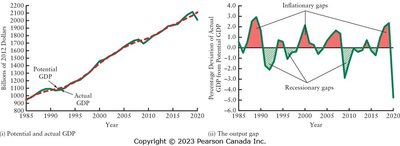
Potential output (Y*) is the level of GDP that an economy can produce at full employment. The output gap measures the difference between actual output (Y) and potential output (Y*).
Output Gap Formula:
Recessionary Gap: When actual output is less than potential output ().
Inflationary Gap: When actual output exceeds potential output ().
Employment, Unemployment, and the Labour Force
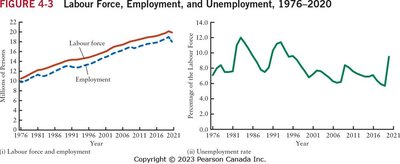
Employment and unemployment are central indicators of economic health. The labour force consists of all individuals aged 15 and over who are either employed or actively seeking employment.
Employment (E): Number of people with jobs.
Unemployment (U): Number of people without jobs but actively seeking work.
Labour Force:
Unemployment Rate Formula:
Types of Unemployment:
Frictional: Due to normal turnover in the labour market.
Structural: Due to mismatch between skills and job requirements.
Cyclical: Due to economic downturns (when real GDP is less than potential GDP).
Why Unemployment Matters
Unemployment has significant social and economic consequences, including loss of income, increased poverty, and potential long-term effects such as crime and social unrest.
Loss of Income: Affects both individuals and their dependents.
Long-Term Unemployment: Can lead to persistent negative effects ('scarring').
Social Impact: Higher rates of crime, substance abuse, and mental illness.

Okun’s Law
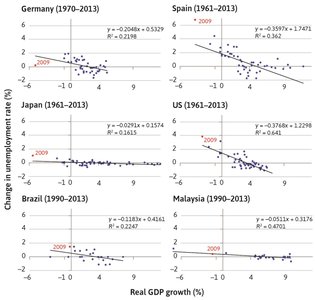
Okun’s Law describes the empirical relationship between unemployment and GDP growth. It shows that increases in GDP growth are typically associated with decreases in the unemployment rate.
Negative Correlation: Output falls → Unemployment rises → Well-being falls.
Application: Used to estimate the impact of GDP changes on unemployment.
Productivity
Productivity measures the efficiency of production and is a key driver of long-term economic growth and living standards.
Labour Productivity:
Growth in Productivity: Leads to higher material living standards.
Technological Knowledge: Considered a public good (non-rival and non-excludable).
Private Goods: Rivalrous and excludable (e.g., food, clothing).
Inflation and Price Level
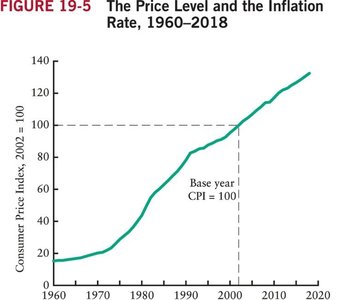
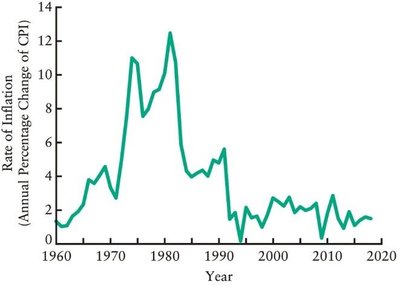
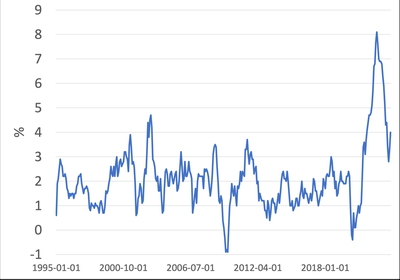
Inflation is the rate at which the general price level rises, reducing the purchasing power of money. The Consumer Price Index (CPI) is commonly used to measure inflation.
Price Level: Average level of all prices in the economy, expressed as an index.
Inflation: Rise in the price level.
Deflation: Fall in the price level.
Consumer Price Index (CPI): Measures the average price level of a basket of consumer goods.
Rate of Inflation Formula:
Example Calculation:
Why Inflation Matters
Inflation affects the real value of money and fixed incomes. Anticipated inflation allows for adjustments in wages and prices, while unanticipated inflation can cause distortions.
Purchasing Power: Inflation reduces the amount of goods and services that can be bought with a unit of money.
Anticipated vs. Unanticipated Inflation: Anticipated inflation allows for adjustments; unanticipated inflation causes unexpected changes in real values.
Bank of Canada Target: 2% (±1%) inflation rate.
Interest Rates
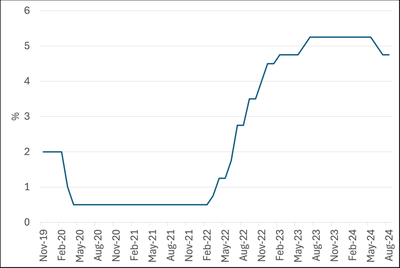
Interest rates are the cost of borrowing money and play a crucial role in the allocation of resources, investment decisions, and the flow of credit in the economy.
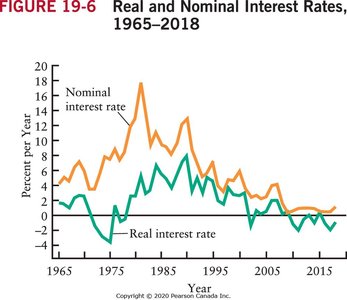
Nominal Interest Rate: The stated rate without adjustment for inflation.
Real Interest Rate: The nominal rate adjusted for inflation:
Impact: Affects borrowers (cost of loans) and savers (income from savings).
Exchange Rates and Trade Flows
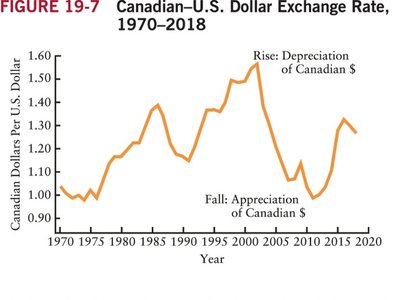
Exchange rates determine the value of one currency relative to another and influence international trade flows. Canada has a flexible exchange rate system with the US.
Exchange Rate: Number of units of domestic currency needed to buy one unit of foreign currency.
Appreciation: Increase in the value of the domestic currency.
Depreciation: Decrease in the value of the domestic currency.
Net Exports:
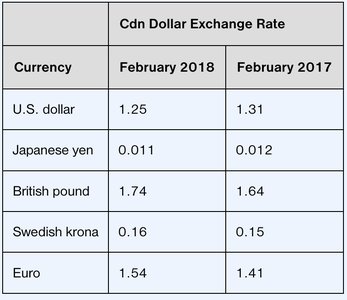
Review Question: Exchange Rate Table
The following table shows the Canadian dollar exchange rate against several currencies in February 2017 and February 2018. Use this data to analyze currency appreciation and depreciation.
Currency | February 2018 | February 2017 |
|---|---|---|
U.S. dollar | 1.25 | 1.31 |
Japanese yen | 0.011 | 0.012 |
British pound | 1.74 | 1.64 |
Swedish krona | 0.16 | 0.15 |
Euro | 1.54 | 1.41 |
Summary
This chapter provides an overview of the key macroeconomic variables, the distinction between long-run growth and short-run fluctuations, and the importance of government policy in influencing economic outcomes. Understanding these concepts is essential for analyzing the performance and challenges of modern economies.
