 Back
BackChapter 5: A Closed-Economy One-Period Macroeconomic Model - Study Guide
Study Guide - Smart Notes
 Tailored notes based on your materials, expanded with key definitions, examples, and context.
Chapter 5: A Closed-Economy One-Period Macroeconomic Model
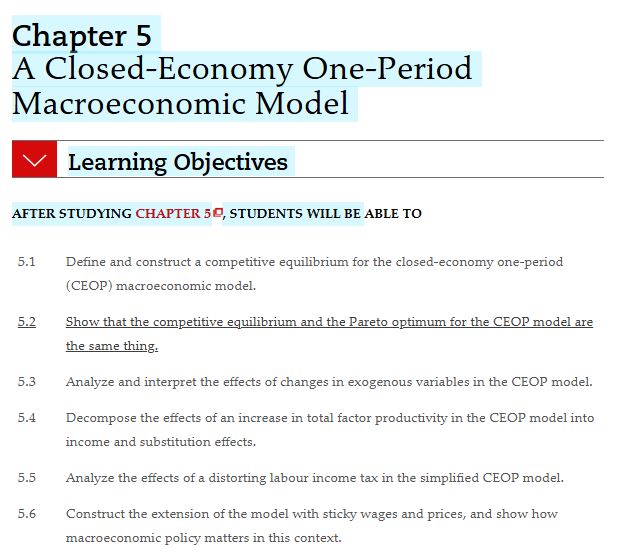
Learning Objectives
This chapter introduces the closed-economy one-period (CEOP) macroeconomic model, a foundational framework for understanding equilibrium, efficiency, and policy in macroeconomics. The following study notes cover the main learning objectives and key concepts.
Competitive Equilibrium in the CEOP Model
The competitive equilibrium in a closed-economy one-period model describes a state where all agents (consumers and firms) make optimal decisions given prices, and markets clear (supply equals demand).
Definition: A set of prices and allocations such that consumers maximize utility, firms maximize profit, and all markets clear.
Construction: Typically involves specifying consumer preferences, firm production functions, and solving for equilibrium prices and quantities.
Example: In a simple CEOP model, consumers choose labor and leisure, firms choose labor input, and the wage rate adjusts so that labor supply equals labor demand.
Pareto Optimum and Competitive Equilibrium
The Pareto optimum is an allocation where no one can be made better off without making someone else worse off. In the CEOP model, the competitive equilibrium is also Pareto optimal under standard assumptions (e.g., no externalities, perfect competition).
Key Point: The First Welfare Theorem states that competitive equilibrium allocations are Pareto efficient.
Implication: Policy interventions are only justified if there are market imperfections.
Effects of Changes in Exogenous Variables
Exogenous variables are factors determined outside the model, such as technology or government policy. Changes in these variables affect equilibrium outcomes.
Example: An increase in total factor productivity (TFP) raises output and may affect labor supply and wages.
Analysis: Comparative statics are used to study how equilibrium changes in response to exogenous shocks.
Income and Substitution Effects of Productivity Changes
When productivity increases, it affects agents' choices through two channels:
Income Effect: Higher productivity increases income, allowing consumers to afford more leisure.
Substitution Effect: Higher wages make leisure more expensive relative to work, encouraging more labor supply.
Formula: The decomposition can be shown using the Slutsky equation:
Effects of a Distorting Labour Income Tax
A distorting labor income tax reduces the incentive to work by lowering the after-tax wage.
Key Point: Taxes create a wedge between the marginal rate of substitution and the marginal product of labor.
Formula: If is the tax rate, after-tax wage is .
Implication: Labor supply and output decrease compared to the no-tax equilibrium.
Extension: Sticky Wages and Prices
Introducing sticky wages and prices means that wages and prices do not adjust instantly to clear markets, leading to possible unemployment and inefficiency.
Policy Relevance: In this context, macroeconomic policy (e.g., fiscal or monetary intervention) can affect real outcomes.
Example: If wages are fixed, a negative demand shock can cause unemployment rather than wage adjustment.
Summary Table: Key Concepts in the CEOP Model
Concept | Definition | Implication |
|---|---|---|
Competitive Equilibrium | Market-clearing prices and allocations | Pareto efficient under ideal conditions |
Pareto Optimum | No one can be made better off without making someone else worse off | Achieved in competitive equilibrium |
Exogenous Variable | Determined outside the model | Shocks affect equilibrium |
Income Effect | Change in consumption due to higher income | More leisure, less labor |
Substitution Effect | Change in consumption due to relative price change | More labor, less leisure |
Labor Income Tax | Tax on wages | Reduces labor supply |
Sticky Wages/Prices | Wages/prices do not adjust instantly | Policy can affect real outcomes |
Additional info: These notes expand on the learning objectives by providing definitions, examples, and formulas relevant to the CEOP model, ensuring a self-contained study guide for exam preparation.
