 Back
BackChapter 6: The Simplest Short-Run Macro Model – Consumption, Investment, Aggregate Expenditure, and Equilibrium
Study Guide - Smart Notes
 Tailored notes based on your materials, expanded with key definitions, examples, and context.
Desired Consumption Expenditure
Autonomous vs. Induced Expenditures
Expenditures in macroeconomics are classified based on their dependence on national income (Y):
Autonomous expenditures: Do not depend on national income. Examples include certain government spending or investment decisions made independently of current income.
Induced expenditures: Depend directly on national income. As income rises, these expenditures increase.
Disposable Income and Consumption Function
Disposable income (YD) is the income available to households after taxes:
Formula:
Where T is taxes.
The consumption function models desired consumption as a linear function of disposable income:
General form:
a: Autonomous consumption (consumption when YD = 0)
b: Marginal propensity to consume (MPC)
Example:
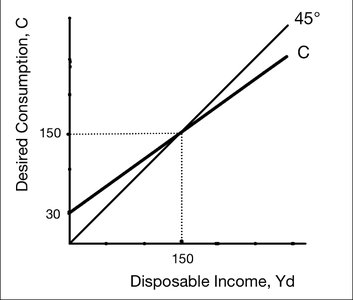
Marginal Propensity to Consume (MPC)
The MPC is the proportion of additional disposable income that consumers wish to spend:
Formula:
It is the slope of the consumption function.
Movements and Shifts in the Consumption Function
Movement along the function: Caused by changes in disposable income.
Shifts of the function: Caused by changes in wealth, interest rates, or expectations.
Savings Function
Disposable income not spent is savings:
Formula:
Marginal propensity to save (MPS):
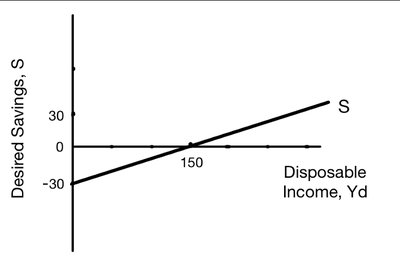
Desired Investment Expenditure
Autonomous Nature and Volatility
Investment is typically considered autonomous, meaning it does not depend on current national income. It is the most volatile component of GDP, strongly associated with short-run economic fluctuations.
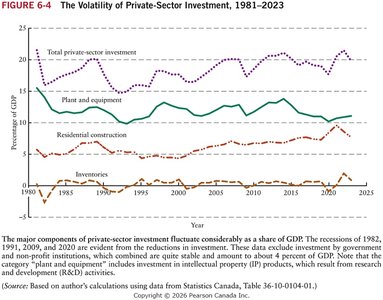
Investment Function
The investment function is usually modeled as a horizontal line, indicating independence from national income:
Formula: (where is autonomous investment)
Shifts in the investment function occur due to:
Changes in the real interest rate (opportunity cost of investment)
Changes in the level of sales (inventory and capacity considerations)
Business confidence (forward-looking expectations)
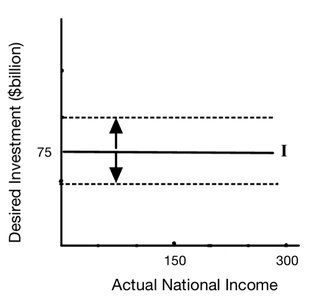
The Aggregate Expenditure Function
Definition and Assumptions
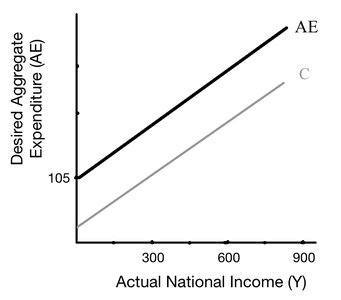
The aggregate expenditure (AE) function relates desired AE to actual national income (Y). In the simplest model:
No trade: ,
No government: ,
Constant price level
Formula:
Example: ,
Marginal Propensity to Spend (z)
The marginal propensity to spend (z) is the extra desired AE induced by an additional $1 of national income:
Formula:
In this simple model,
Equilibrium National Income
Definition and Inventory Adjustments
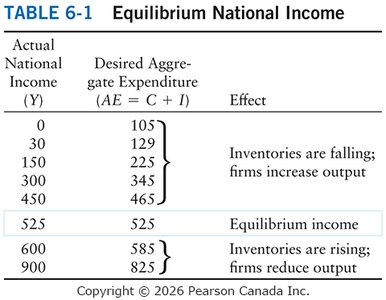
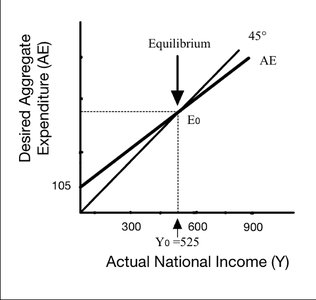
Equilibrium national income is the level where desired aggregate expenditure equals actual national income:
Condition:
If : Inventories decrease, firms increase output
If : Inventories accumulate, firms decrease output
Solving for Equilibrium
Example:
Equilibrium:
Actual National Income (Y) | Desired Aggregate Expenditure (AE = C + I) | Effect |
|---|---|---|
0 | 105 | Inventories are falling; firms increase output |
30 | 129 | Inventories are falling; firms increase output |
150 | 225 | Inventories are falling; firms increase output |
300 | 345 | Inventories are falling; firms increase output |
450 | 465 | Inventories are falling; firms increase output |
525 | 525 | Equilibrium income |
600 | 585 | Inventories are rising; firms reduce output |
900 | 825 | Inventories are rising; firms reduce output |
The Simple Multiplier
Definition and Calculation
The simple multiplier (SM) measures the change in equilibrium national income resulting from a change in desired autonomous expenditure:
Formula:
Where is the marginal propensity to spend
Change in income:
The larger the value of , the steeper the AE curve and the larger the multiplier effect.
Example Calculation
Suppose ,
If increases by 10, the change in equilibrium income is
Additional info: The multiplier effect is central to understanding how changes in autonomous spending (such as government investment or exports) can have amplified effects on national income.
