 Back
BackChapter 8: GDP—Measuring Total Production and Income (Macroeconomics Study Notes)
Study Guide - Smart Notes
 Tailored notes based on your materials, expanded with key definitions, examples, and context.
Gross Domestic Product: Measuring Total Production and Income
Introduction to Macroeconomics and GDP
Macroeconomics studies the economy as a whole, focusing on aggregate measures such as inflation, unemployment, and economic growth. One of the most important concepts in macroeconomics is Gross Domestic Product (GDP), which quantifies the total output of an economy. Understanding GDP is essential for analyzing economic performance and making policy decisions.
Key Macroeconomic Terms
Business cycle: Alternating periods of economic expansion and recession.
Expansion: Period when total production and employment are increasing.
Recession: Period when total production and employment are decreasing.
Economic growth: The ability of an economy to produce increasing quantities of goods and services over time.
Inflation rate: The percentage increase in the price level from one year to the next.
8.1 Gross Domestic Product Measures Total Production
Definition and Components of GDP
Gross Domestic Product (GDP) is defined as the market value of all final goods and services produced within a country during a specific period, typically one year. Each part of this definition is crucial for accurate measurement:
Market value: Goods and services are valued at their market prices to allow aggregation.
Final goods and services: Only goods and services purchased by final users are counted, avoiding double counting of intermediate goods.
Produced in a country: Only production within a country's borders is included, regardless of the producer's nationality.
During a period of time: Only new production within the specified period is counted; used goods are excluded.
Production and Income Approaches
GDP can be measured by either the total value of production or the total income generated in producing that output. This equivalence arises because every dollar spent on goods and services becomes income for someone else.
The Circular Flow Model and GDP Measurement
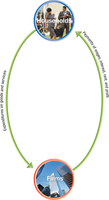
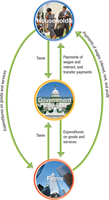
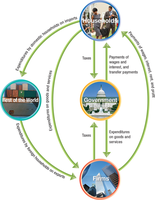
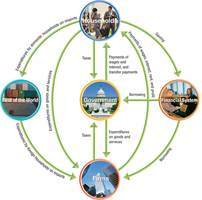
The circular flow model illustrates the movement of money, goods, and services in the economy. It shows how households, firms, government, the rest of the world, and the financial system interact to generate GDP.
Expenditure Components of GDP
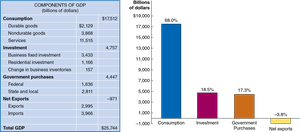
The Bureau of Economic Analysis (BEA) divides GDP into four major expenditure categories:
Consumption (C): Household spending on goods and services, excluding new houses. Subdivided into services, nondurable goods, and durable goods.
- Services: Medicare, education and haircuts
- Nondurable goods: food and clothing
- Durable goods: automobiles and furniture
Investment (I): Spending on new factories, office buildings, machinery, inventories, and new houses. Includes business fixed investment, residential investment, and changes in business inventories.
- Business fixed investment (new factories, office buildings, etc)
- Residential investment (new single-family houses)
- Changes in business inventories (goods that have been produced but not yet sold)
Government Purchases (G): Government spending on goods and services, including consumption and investment, but excluding transfer payments.
Net Exports (NX): Exports minus imports. Reflects the value of goods and services produced domestically and sold abroad, minus those produced abroad and purchased domestically.
The GDP formula is:
Value Added Approach
GDP can also be measured by summing the value added at each stage of production. Value added is the market value a firm adds to a product, ensuring no double counting occurs.
8.2 Does GDP Measure What We Want It to Measure?
Shortcomings of GDP as a Measure of Total Production
Household production: Non-market activities such as childcare and cooking are not included in GDP, even though they contribute to economic well-being.
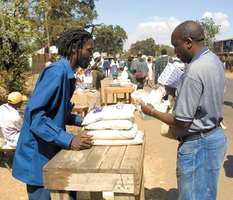
Underground economy: Economic activity concealed from the government to avoid taxes or regulations, or because it is illegal, is not captured in official GDP statistics. In developing countries, this informal sector can be very large.
Shortcomings of GDP as a Measure of Well-Being
GDP per capita is often used to compare living standards, but it does not account for:
The value of leisure
Pollution and other negative externalities
Crime and social problems
Income distribution
Improvements in these areas may actually reduce GDP but increase overall well-being.
8.3 Real GDP versus Nominal GDP
Distinguishing Real and Nominal GDP
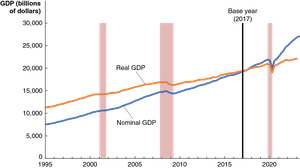
Nominal GDP measures the value of final goods and services at current-year prices, while real GDP measures value at base-year prices, removing the effects of price changes. This distinction allows economists to determine whether changes in GDP are due to changes in production or prices.
Since 1996, the BEA uses chain-weighted prices to adjust for changing relative prices over time.
- This means the "relative prices" (how much one good cost compared to another) are always shifting distorting real GDP calculations. So, we use chain-weighted prices
· Calculate real GDP growth from one year to the next using the previous year’s prices.
· Repeat this process each year, "chaining" the growth rates together.
· This approach smooths out the impact of big price changes in any one good or service
Nominal GDP and Real GDP On a Graph
· If Nominal > Real: Prices have increased (Inflation).
· If Nominal < Real: Prices have fallen (Deflation).
· If Nominal = Real: You are in the base year, or price levels haven't changed
Formula for real GDP:
GDP Deflator
The GDP deflator is a measure of the price level, calculated as:
It reflects the average price of all goods and services included in GDP and is used to measure inflation.
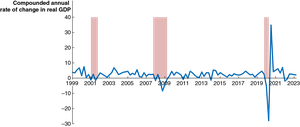
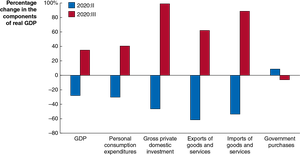
Real GDP Movements: The Covid-19 Pandemic
During the Covid-19 pandemic, real GDP experienced unprecedented swings, highlighting the importance of distinguishing between real and nominal measures.
8.4 Other Measures of Total Production and Total Income
Alternative National Income Measures
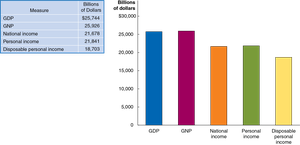
Gross National Product (GNP): production performed by citizens of a nation, including overseas production
National Income: GDP minus depreciation (consumption of fixed capital).
Personal Income: Income received by households, including transfer payments but excluding retained earnings.
Disposable Personal Income: Personal income minus personal taxes; represents the amount households can spend or save.
Division of Income
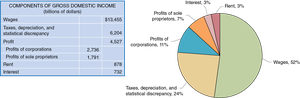
All production generates income, which is divided among wages, profits, rent, interest, and taxes. In practice, statistical discrepancies may arise due to data limitations.
GDP versus GDI: Measuring Economic Activity
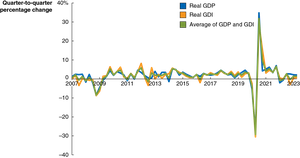
Gross Domestic Income (GDI) measures output from the income side. While GDP and GDI usually move together, they can diverge in the short run, leading some economists to prefer averaging the two for a more accurate picture of economic activity.

Additional info: These notes are based on Chapter 8 of a leading Macroeconomics textbook and are designed to provide a comprehensive yet concise overview of GDP measurement, its limitations, and related national income concepts for college-level study.
