 Back
BackComparative Advantage and the Gains from International Trade
Study Guide - Smart Notes
 Tailored notes based on your materials, expanded with key definitions, examples, and context.
International Trade: Foundations and Importance
Voluntary Trade and Economic Gains
Voluntary trade between nations is not a zero-sum game; rather, it is a positive-sum game where both parties can benefit. The gains from trade arise because countries can specialize in producing goods for which they have a comparative advantage, leading to increased overall wealth and efficiency.
Zero-sum game: One party's gain is another's loss.
Positive-sum game: Both parties can gain from voluntary exchange.
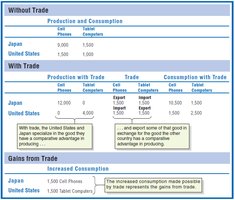
Example: The United States and Japan both benefit from trading cell phones and tablet computers, as each specializes in the good for which it has a comparative advantage.
The United States in the International Economy
The U.S. economy is increasingly integrated into the global market, with imports and exports playing a significant role in GDP. Key terms include:
Tariff: A tax imposed by a government on imports.
Imports: Goods and services bought domestically but produced in other countries.
Exports: Goods and services produced domestically but sold in other countries.
The Importance of Trade to the U.S. Economy
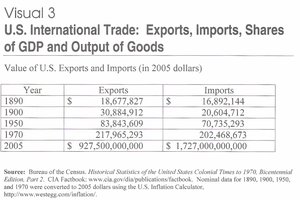
Exports and imports as a percentage of GDP have steadily increased since 1970, highlighting the growing importance of international trade to the U.S. economy.
U.S. International Trade in a World Context
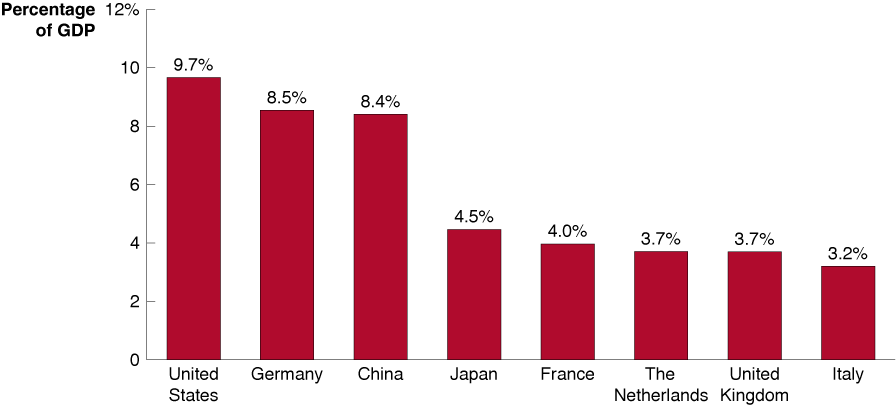
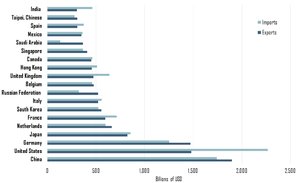
The United States is a leading exporter, accounting for a significant share of total world exports. However, international trade is still less important to the U.S. than to many other countries.
Comparative Advantage and Gains from Trade
Absolute and Comparative Advantage
Understanding comparative advantage is central to international trade theory:
Absolute advantage: The ability to produce more of a good or service than competitors using the same amount of resources.
Comparative advantage: The ability to produce a good or service at a lower opportunity cost than competitors.
Opportunity cost: The highest valued alternative that must be given up to engage in an activity.
How Countries Gain from International Trade
Trade allows countries to specialize in goods where they have a comparative advantage, increasing total consumption and economic welfare. The terms of trade refer to the ratio at which a country can trade its exports for imports from other countries.
Specialization and Trade: Economic Thinkers
Adam Smith and David Ricardo were foundational thinkers in trade theory:
Adam Smith: Advocated for specialization and trade to increase individual and national welfare.
David Ricardo: Used opportunity cost to explain the benefits of free trade and comparative advantage.

Sources of Comparative Advantage
Comparative advantage arises from several factors:
Climate and natural resources: Countries with unique resources can produce certain goods more efficiently.
Relative abundance of labor and capital: Skilled labor and capital availability affect production capabilities.
Technology: The process firms use to turn inputs into goods and services.
External economies: Cost reductions from industry concentration, such as financial firms in Manhattan.

Trade Restrictions: Tariffs and Quotas
Tariffs
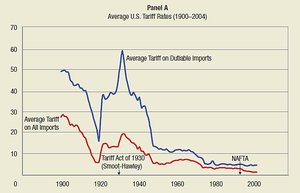
Tariffs are taxes on imports, either as a percentage of price (ad valorem) or a fixed amount per unit (unit tax). They generate government revenue and increase domestic prices.
Historical context: Tariffs were once the dominant source of U.S. federal revenue.
Effects: Tariffs raise prices, reduce imports, and protect domestic industries.
Quotas
Quotas restrict the quantity of imports, raising prices and benefiting domestic producers but not generating government revenue.
Arguments for and Against Trade Restrictions
Protectionism
Protectionism uses trade barriers to shield domestic firms from foreign competition. Common arguments include:
Saving jobs
Protecting high wages
Protecting infant industries
National security
Globalization Concerns
Critics of globalization argue that free trade can harm domestic employment, the environment, and working conditions in developing nations. However, trade often raises incomes and can improve environmental standards as countries become wealthier.

Unintended Consequences of Trade Policies
Trade restrictions can have unintended effects, such as increasing costs for other industries or displacing workers. For example, tariffs on hangers increased costs for U.S. dry cleaners, leading to job losses.

Child Labor and Trade
Banning goods made with child labor can have unintended consequences, as children in developing countries may have few alternatives to work. As incomes rise, reliance on child labor decreases.

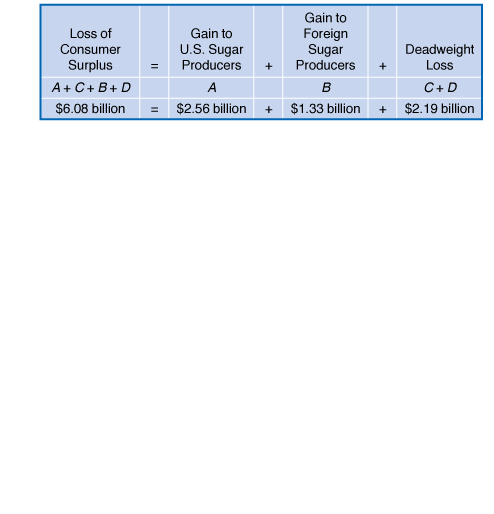
Summary Table: Effects of Trade Restrictions
Loss of Consumer Surplus | Gain to U.S. Producers | Gain to Foreign Producers | Deadweight Loss |
|---|---|---|---|
$6.08 billion | $2.56 billion | $1.33 billion | $2.19 billion |
Chapter Summary
Voluntary exchange is a positive sum game, creating gains for both parties.
Trade restrictions such as tariffs and quotas protect domestic industries but can reduce overall economic welfare.
Arguments against free trade include protection of jobs, wages, infant industries, and national defense, as well as concerns about globalization.
Trade can create winners and losers, but overall wealth is enhanced.
