 Back
BackComprehensive Study Notes: Money, Banking, and Macroeconomic Policy
Study Guide - Smart Notes
 Tailored notes based on your materials, expanded with key definitions, examples, and context.
Money, Banking, and the Federal Reserve System
Definition and Functions of Money
Money is any asset that people are generally willing to accept in exchange for goods and services or for payment of debts. It serves several critical functions in the economy:
Medium of Exchange: Money is used to facilitate transactions and eliminate the inefficiencies of barter systems.
Unit of Account: Money provides a common measure for valuing goods and services.
Store of Value: Money can be saved and retrieved in the future, retaining its value over time.
Standard of Deferred Payment: Money is used to settle debts payable in the future.
Example: U.S. dollars are used to buy groceries, pay rent, and settle loans, fulfilling all four functions of money.
Types of Money
Commodity Money: Has intrinsic value (e.g., gold, silver).
Fiat Money: Has no intrinsic value but is declared by the government to be legal tender (e.g., paper currency).
Additional info: Most modern economies use fiat money, which relies on trust in the issuing authority.
Measuring Money Supply
The money supply is measured using different aggregates:
M1: Includes currency in circulation, checking account deposits, and traveler’s checks.
M2: Includes all of M1 plus savings deposits, small-denomination time deposits, and money market mutual funds.
Formula:
The Banking System
Role of Banks
Banks act as financial intermediaries, accepting deposits and making loans. They play a crucial role in the creation of money through the process of fractional reserve banking.
Accept Deposits: Banks provide a safe place for individuals and businesses to store money.
Make Loans: Banks lend out a portion of deposits to borrowers, earning interest.
Fractional Reserve Banking: Banks keep only a fraction of deposits as reserves and lend out the rest.
Reserve Ratio Formula:
Money Multiplier Formula:
Example: If the required reserve ratio is 10%, the money multiplier is .
Bank Balance Sheets
A bank’s balance sheet lists its assets (loans, reserves) and liabilities (deposits). The difference between assets and liabilities is the bank’s capital.
The Federal Reserve System
Structure and Functions
The Federal Reserve (the Fed) is the central bank of the United States. It regulates the banking system and controls the money supply to achieve macroeconomic objectives.
Board of Governors: Seven members appointed by the President.
Federal Open Market Committee (FOMC): Sets monetary policy, including open market operations.
12 Regional Federal Reserve Banks: Serve as the operating arms of the Fed.
Tools of Monetary Policy
The Fed uses several tools to influence the money supply and interest rates:
Open Market Operations: Buying and selling government securities to influence reserves in the banking system.
Discount Rate: The interest rate the Fed charges banks for short-term loans.
Reserve Requirements: The fraction of deposits banks are required to hold as reserves.
Example: To increase the money supply, the Fed buys government securities, injecting reserves into the banking system.
Monetary Policy and Macroeconomic Objectives
Goals of Monetary Policy
The main goals of monetary policy are:
Price Stability: Controlling inflation to maintain the purchasing power of money.
High Employment: Promoting conditions that achieve the natural rate of unemployment.
Economic Growth: Supporting conditions for sustainable increases in real GDP.
Stability of Financial Markets: Ensuring the smooth functioning of the financial system.
Expansionary vs. Contractionary Policy
Expansionary Monetary Policy: Increases the money supply and lowers interest rates to stimulate economic activity.
Contractionary Monetary Policy: Decreases the money supply and raises interest rates to reduce inflation.
Example: During a recession, the Fed may lower the federal funds rate to encourage borrowing and investment.
Aggregate Demand and Aggregate Supply Analysis
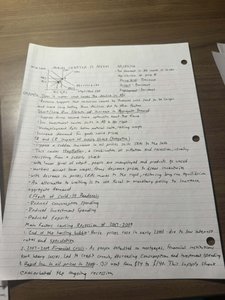
Aggregate Demand (AD)
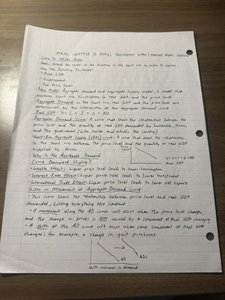
Aggregate demand represents the total quantity of goods and services demanded across all levels of an economy at a given price level.
Components: Consumption, investment, government spending, and net exports.
AD Curve: Downward sloping due to the wealth effect, interest rate effect, and international trade effect.
Aggregate Supply (AS)
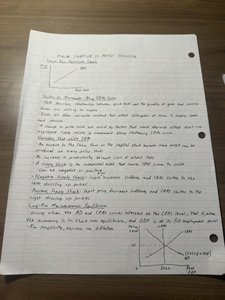
Aggregate supply shows the total quantity of goods and services that firms are willing and able to produce at different price levels.
Short-Run Aggregate Supply (SRAS): Upward sloping due to sticky wages and prices.
Long-Run Aggregate Supply (LRAS): Vertical at the potential level of output (full employment GDP).
Macroeconomic Equilibrium
Equilibrium occurs where AD intersects AS. Changes in AD or AS can lead to inflation, unemployment, or economic growth.
Monetary Policy Transmission Mechanism
How Monetary Policy Affects the Economy
Monetary policy influences aggregate demand through changes in interest rates, which affect consumption and investment decisions.
Lower Interest Rates: Increase borrowing and spending, shifting AD to the right.
Higher Interest Rates: Decrease borrowing and spending, shifting AD to the left.
Summary Table: Tools of Monetary Policy
Tool | Description | Effect on Money Supply |
|---|---|---|
Open Market Operations | Buying/selling government securities | Buy = Increase, Sell = Decrease |
Discount Rate | Interest rate on loans to banks | Lower = Increase, Higher = Decrease |
Reserve Requirements | Fraction of deposits banks must hold | Lower = Increase, Higher = Decrease |
Additional info:
These notes cover key concepts from chapters on money, banking, the Federal Reserve, monetary policy, and aggregate demand/supply analysis, directly relevant to macroeconomics at the college level.
