Back
BackCourse Books and Goals for Macroeconomics
Study Guide - Smart Notes
 Tailored notes based on your materials, expanded with key definitions, examples, and context.
Course Books and Reference Materials
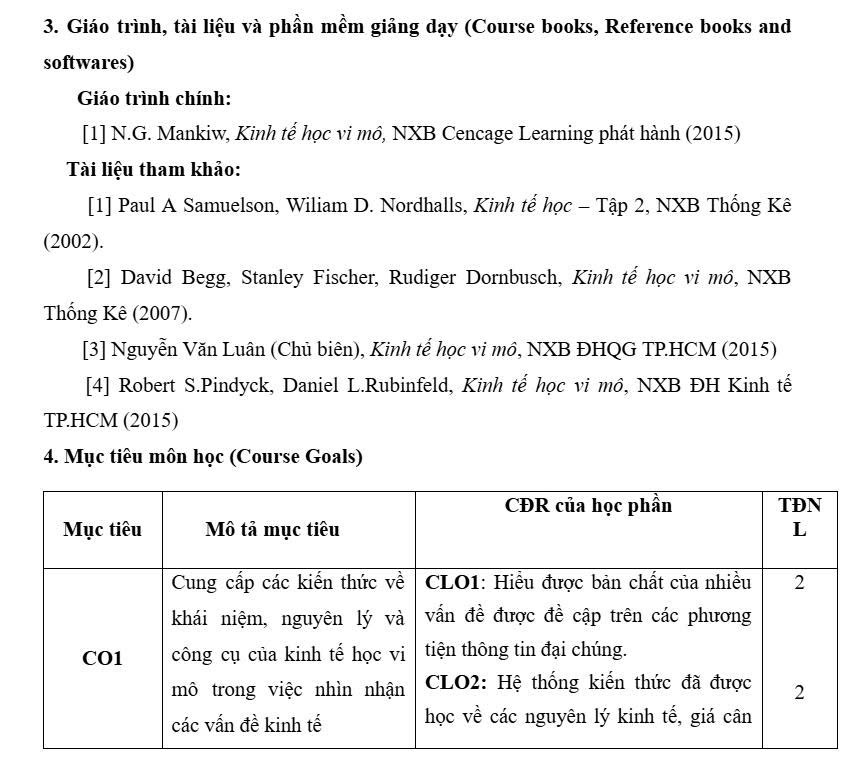
Main Textbook
The primary textbook for this course is Kinh tế học vi mô by N.G. Mankiw, published by Cencage Learning in 2015. This book is widely recognized for its clear explanations of microeconomic principles and models, making it a foundational resource for students.
Reference Books
Kinh tế học – Tập 2 by Paul A. Samuelson and William D. Nordhalls, published by Thống Ké (2002). This book provides additional context and depth to economic theory.
Kinh tế học vi mô by David Begg, Stanley Fischer, and Rudiger Dornbusch, published by Thống Ké (2007). It offers alternative perspectives and examples in microeconomics.
Kinh tế học vi mô edited by Nguyễn Văn Luân, published by ĐHQG TP.HCM (2015). This text is tailored for Vietnamese students and includes localized examples.
Kinh tế học vi mô by Robert S. Pindyck and Daniel L. Rubinfeld, published by ĐH Kinh tế TP.HCM (2015). This book is known for its application of microeconomic concepts to real-world scenarios.
Course Goals
Overview of Learning Objectives
The course aims to provide students with a comprehensive understanding of microeconomic concepts, principles, and analytical tools. These objectives are structured to ensure students can apply economic reasoning to real-world issues and develop a systematic knowledge base.
Mục tiêu | Mô tả mục tiêu | CDR của học phần | TĐNL |
|---|---|---|---|
CO1 | Cung cấp các kiến thức về khái niệm, nguyên lý và công cụ của kinh tế học vi mô trong việc nhìn nhận các vấn đề kinh tế | CLO1: Hiểu được bản chất của nhiều vấn đề được đề cập trên các phương tiện thông tin đại chúng. CLO2: Hệ thống kiến thức đã được học về các nguyên lý kinh tế, giá cả | 2 |
Key Points
Concepts and Principles: Students will learn fundamental economic concepts such as scarcity, opportunity cost, and market equilibrium.
Analytical Tools: The course introduces tools like supply and demand analysis, elasticity, and consumer/producer surplus.
Application: Emphasis is placed on applying economic reasoning to analyze and interpret real-world economic issues.
Example
For instance, students may use supply and demand models to explain price changes in the market or analyze the impact of government policies on economic outcomes.