 Back
Credit Market and Interest Rates: Principles of Macroeconomics Study Notes
Study Guide - Smart Notes
 Tailored notes based on your materials, expanded with key definitions, examples, and context.
Credit Market Fundamentals
Wealth, Saving, Capital Gains, and Capital Losses
The concepts of wealth, saving, capital gains, and capital losses are central to understanding the credit market in macroeconomics. Net wealth (or net worth) is the total value of all assets owned by an individual, including both real and financial assets, minus liabilities. Saving is the portion of after-tax income not spent on consumption or interest payments. Saving increases net wealth, while changes in asset values lead to capital gains (when asset values rise) or capital losses (when asset values fall).
Net Wealth: Value of assets minus liabilities.
Saving: Increases net wealth; is after-tax income not spent.
Capital Gains: Increase in asset value.
Capital Losses: Decrease in asset value.
Example: If you save $500 from your income, your net wealth increases by $500.
Interest Payments and Interest Rates
Definitions and Economic Roles
Interest payment is the fee charged for using borrowed capital, while the interest rate is the ratio of the interest payment to the amount borrowed, expressed as a percentage. For borrowers, interest is the cost of consuming goods and services earlier; for lenders, it is compensation for delaying consumption.
Interest Payment: Fee for borrowing money.
Interest Rate:
Example: Borrow \frac{100}{1000} \times 100\% = 10\%$ per year.
Present Value
Concept and Calculation
The present value concept reflects the idea that a dollar received in the future is worth less than a dollar today, due to the positive interest rate. Present value calculations help determine how much money today is equivalent to a future sum.
Formula: , where is the interest rate.
Example: \frac{1}{1.05} = 0.9524$ today.
Interest Rate Variations and Determinants
Factors Affecting Interest Rates
Interest rates differ across loans due to riskiness, collateral, and expectations about future price levels. Riskier loans have higher rates, and secured loans (with collateral) have lower rates than unsecured loans.
Risk: Higher risk leads to higher interest rates.
Collateral: Secured loans (e.g., mortgages) have lower rates.
Expectations: Anticipated inflation affects nominal rates.
Example: Individuals with low credit scores pay higher rates.
Nominal vs. Real Interest Rate
Definitions and Fisher Equation
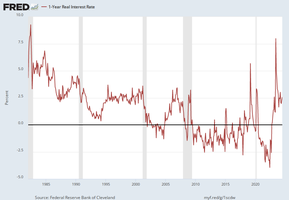
The nominal interest rate is the stated rate on loan contracts, while the real interest rate adjusts for inflation, representing the true cost in terms of goods and services. The Fisher equation relates these rates:
Nominal Interest Rate (): Dollar price of loanable funds.
Real Interest Rate (): Adjusted for inflation.
Fisher Equation: where is expected inflation.
Example: If expected inflation is 2% and real rate is 3%, nominal rate is 5%.

Effects of Interest Rate on Consumption and Investment
Consumption and Investment Functions
Lower real interest rates encourage more consumption and investment, as the opportunity cost of borrowing decreases and expected profitability rises.
Consumption:
Investment:
Example: Lower mortgage rates increase home purchases.
Credit Market Structure
Definition and Participants
The credit market (or loanable funds market) coordinates borrowing and lending among firms, governments, and households. Financial intermediaries, such as banks, dominate trading. The credit market excludes the stock market and determines both short-term and long-term interest rates.
Participants: Firms, government, households, banks.
Excludes: Stock market.
Determines: Interest rates for loans.
Demand and Supply of Loanable Funds
Market Dynamics
Demand for loanable funds depends on the real interest rate and other influences, such as business opportunities and consumer time preferences. Supply depends on the real interest rate and lending plans.
Demand: Quantity demanded vs. real interest rate.
Supply: Quantity supplied vs. real interest rate.
Other Influences: Business opportunities, consumer impatience.
Financial Assets: Stocks and Bonds
Classification and Economic Role
Financial assets are claims on physical capital. Stocks (equity) confer ownership rights and are not part of the credit market. Bonds (debt) are part of the credit market and confer no ownership rights. Financial investment (buying assets) differs from economic investment (creating new capital).
Stocks: Direct claims, ownership rights.
Bonds: Indirect claims, debt contracts.
Example: Buying a bond funds a firm's investment project.
Bonds as Financial Assets
Bond Structure and Types
A bond is a debt security obligating the issuer to repay the principal at maturity and make periodic coupon payments. Bonds are used by firms and governments to fund projects or deficits.
Principal: Amount repaid at maturity.
Coupon Payment: Periodic interest payment.
Types: Corporate (investment-grade, junk), government (Treasury, municipal, inflation-indexed).
Bond Prices: Inverse relationship with interest rates.
Types of Financial Risks
Risk Classifications
Financial risks affect lenders and borrowers in the credit market. Key types include:
Credit Risk: Risk of borrower default.
Market Risk: Risk from changing market conditions.
Liquidity Risk: Risk of selling illiquid assets below book value.
Credit Market in the News
Federal Reserve Rate Hikes
Changes in the Federal Reserve's benchmark interest rate affect borrowing costs and savings returns. A rate hike increases costs for borrowers (e.g., mortgages, credit cards) but benefits savers with higher interest earnings.
Example: Fed raises target rate to 3.75%-4.00% in September 2026.
Effect: More expensive loans, higher savings returns.
Additional info: The credit market is a central topic in macroeconomics, influencing aggregate demand, investment, and economic growth. Understanding interest rates, present value, and financial risks is essential for analyzing macroeconomic policy and market outcomes.
