 Back
BackDemand and Supply Applications: Price System, Market Constraints, Tariffs, and Market Efficiency
Study Guide - Smart Notes
 Tailored notes based on your materials, expanded with key definitions, examples, and context.
Demand and Supply Applications
The Price System: Rationing and Allocating Resources
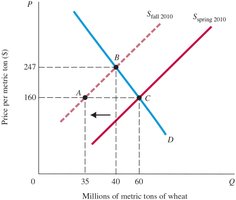
The price system is a fundamental mechanism in market economies, determining how resources are allocated and goods are rationed. When the quantity demanded exceeds the quantity supplied, prices adjust to clear the market.
Price Rationing: The process by which prices rise in response to shortages, ensuring that only those willing to pay the higher price obtain the good.
Market Clearing: Occurs when the price adjusts so that quantity supplied equals quantity demanded.
Example: A supply shock, such as fires in Russia affecting wheat supply, shifts the supply curve left, increasing equilibrium price and reducing equilibrium quantity.
Constraints on the Market and Alternative Rationing Mechanisms
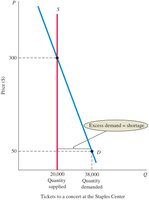
Sometimes, governments or firms intervene to prevent price rationing, using alternative mechanisms to distribute goods. These interventions often aim for fairness but can lead to unintended consequences and inefficiencies.
Price Ceiling: A government-imposed maximum price for a good, often leading to shortages.
Queuing: Distribution by waiting in line, a nonprice rationing mechanism.
Favored Customers: Special treatment for certain buyers during shortages.
Ration Coupons: Tickets entitling holders to purchase limited quantities.
Black Market: Illegal trading at market-determined prices when official prices are restricted.
Example: The 1974 U.S. gasoline price ceiling led to shortages and alternative rationing systems.
Real-World Example: Used Car Prices During the COVID-19 Pandemic
Supply chain disruptions, such as reduced semiconductor chip production, decreased new car supply and increased prices. Consumers substituted used cars, raising their prices as well.

Rationing Mechanisms for Tickets and Goods
Attempts to bypass the price system often result in queuing, favored customers, or black markets. These alternatives may be less efficient and less fair than price rationing.

Prices and the Allocation of Resources
Price changes in output markets affect profits, which attract capital and labor. Higher wages incentivize skill acquisition. The interaction of supply, demand, and prices determines resource allocation and production combinations.
Price Floor
A price floor is a minimum allowable price, often set by governments. The minimum wage is a common example, representing a price floor for labor.
Price Floor: Minimum price below which exchange is not permitted.
Minimum Wage: Government-set price floor for labor.
Supply and Demand Analysis: Tariffs (Tax)
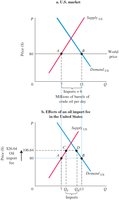
Tariffs are taxes on imported goods. Supply and demand analysis helps understand their effects on domestic markets, prices, and quantities.
Tariff Impact: Increases domestic prices, reduces quantity demanded, and increases domestic production, lowering imports.
Example: A 33.33% tariff on crude oil raises U.S. prices, decreases demand, and increases domestic supply.
Supply and Demand and Market Efficiency
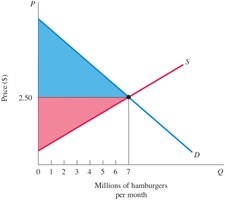
Market efficiency is illustrated by consumer and producer surplus. Competitive markets maximize the sum of these surpluses, while interventions can cause deadweight loss.
Consumer Surplus
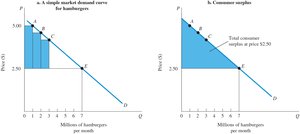
Consumer surplus is the difference between what consumers are willing to pay and the market price.
Formula:
Example: If the market price for hamburgers is $2.50, but some consumers are willing to pay $5.00, their surplus is $2.50 per hamburger.
Producer Surplus
Producer surplus is the difference between the market price and the minimum price at which producers are willing to sell.
Formula:
Example: If producers are willing to supply hamburgers at $0.75 but receive $2.50, their surplus is $1.75 per hamburger.
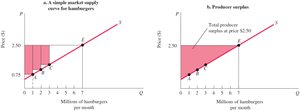
Competitive Markets and Total Surplus
At equilibrium, the sum of consumer and producer surplus is maximized. Any deviation from equilibrium reduces total surplus, resulting in deadweight loss.
Deadweight Loss
Deadweight loss is the reduction in total surplus due to underproduction or overproduction. It represents inefficiency in the market.
Formula:
Causes: Monopoly power, taxes, subsidies, externalities, price floors, and price ceilings.
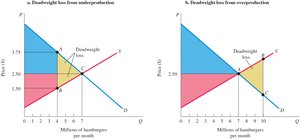
Potential Causes of Deadweight Loss
Market failures can arise from monopoly power, taxes, subsidies, external costs, and artificial price controls, leading to inefficiency and deadweight loss.
Monopoly Power: Incentivizes underproduction and overpricing.
Taxes/Subsidies: Distort consumer and producer choices.
External Costs: Pollution and congestion may cause over- or underproduction.
Price Controls: Artificial floors and ceilings can create inefficiencies.
Key Terms and Concepts
Black Market: Illegal trading at market-determined prices.
Consumer Surplus: Difference between willingness to pay and market price.
Deadweight Loss: Loss of total surplus from inefficiency.
Favored Customers: Special treatment during shortages.
Minimum Wage: Price floor for labor.
Price Ceiling: Maximum allowable price.
Price Floor: Minimum allowable price.
Price Rationing: Allocation of goods via price adjustment.
Producer Surplus: Difference between market price and cost of production.
Queuing: Waiting in line as a rationing mechanism.
Ration Coupons: Tickets for limited purchases.
Additional info: These concepts are foundational for understanding market operations and efficiency in both microeconomics and macroeconomics. They serve as building blocks for further study of market behavior and policy interventions.
