 Back
BackDifficult Cases for the Market and the Role of Government
Study Guide - Smart Notes
 Tailored notes based on your materials, expanded with key definitions, examples, and context.
Economic Efficiency and Market Outcomes
What is Economic Efficiency?
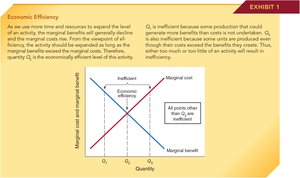
Economic efficiency occurs when resources are allocated in a way that maximizes total net benefits to society. This is achieved when the marginal benefit (MB) of an activity equals its marginal cost (MC). If MB exceeds MC, more of the activity should be undertaken; if MC exceeds MB, less should be done.
Marginal Benefit (MB): The additional benefit received from consuming or producing one more unit of a good or service.
Marginal Cost (MC): The additional cost incurred from consuming or producing one more unit of a good or service.
Efficient Output (Q2): The level of output where MB = MC.
Inefficiency: Occurs when output is either below or above Q2, meaning resources are not being used optimally.
Example: If a factory produces fewer goods than the efficient level, some potential benefits are lost. If it produces more, the extra cost outweighs the benefit.
The Principle of Imperfect Solutions
If It’s Worth Doing, It’s Worth Doing Imperfectly
In both personal and governmental decision-making, striving for perfection is often not cost-effective. The costs of achieving perfect outcomes usually outweigh the additional benefits. Therefore, it is rational to accept some imperfections if the cost of eliminating them is too high.
Key Point: Perfection is rarely attainable or worth the cost in economics or public policy.
Application: Regulatory policies should balance benefits and costs, accepting some level of imperfection.
The Economic Role of Government
Major Functions of Government
Government plays two primary roles in the economy: the protective function and the productive function.
Protective Function: Enforcing property rights, contracts, and laws to maintain order and protect citizens from violence, theft, and fraud.
Productive Function: Providing goods and services that markets may not supply efficiently, such as public goods and infrastructure.
Potential Shortcomings of the Market
Four Reasons the Invisible Hand May Fail
While markets are generally efficient, there are four main cases where they may fail to allocate resources optimally:
Lack of Competition
Externalities
Public Goods
Poor Information
Lack of Competition
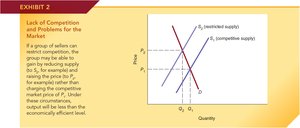
When competition is limited, sellers may restrict output and raise prices, leading to inefficiency. In a competitive market, output is higher and prices are lower. When supply is restricted, output falls and prices rise above the efficient level.
Example: A monopoly restricts supply to increase profits, resulting in higher prices and lower output than in a competitive market.
Externalities
Externalities occur when the actions of individuals or firms have effects on third parties that are not reflected in market prices. These can be negative (external costs) or positive (external benefits).
External Costs (Negative Externalities)
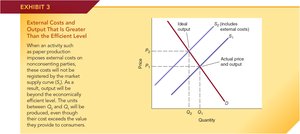
When external costs are present, such as pollution, the market supply curve understates the true cost of production. This leads to overproduction and inefficiency, as more units are produced than is socially optimal.
Example: A factory emits pollution, imposing health costs on nearby residents that are not included in the price of its products.
External Benefits (Positive Externalities)
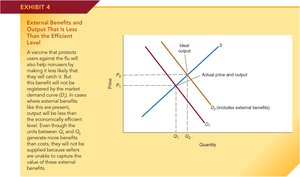
When external benefits are present, such as with vaccinations, the market demand curve understates the true benefit to society. This leads to underproduction, as fewer units are produced than is socially optimal.
Example: Vaccinations not only protect the individual but also reduce disease spread, benefiting others.
Public Goods
Public goods are non-rivalrous and non-excludable, meaning one person's consumption does not reduce availability for others, and people cannot be prevented from using them. Because of the free rider problem, markets may underprovide public goods.
Free Rider: Someone who benefits from a good without paying for it.
Example: National defense protects all citizens, regardless of whether they pay taxes.
Poor Information
Markets may fail when buyers or sellers lack sufficient information to make informed decisions. Market responses include consumer information publications, brand names, franchises, and warranties to reduce information problems.
Example: Consumer Reports provides unbiased product reviews to help buyers make better choices.
Market and Government Failure
Market Failure
Market failure occurs when the allocation of goods and services by a free market is not efficient, often due to the reasons discussed above (externalities, public goods, lack of competition, poor information).
Government Failure
Government failure happens when government intervention in the economy causes an inefficient allocation of resources, often due to bureaucracy, lack of information, or political incentives.
Markets Versus Government
Both markets and governments can fail. The challenge is to identify when government intervention can improve outcomes and when it may make things worse.
Key Diagrams and Exhibits
Summary of Key Graphs
Economic Efficiency: MB = MC at the efficient output level.
Lack of Competition: Restricted supply leads to higher prices and lower output.
External Costs: Overproduction when external costs are not included.
External Benefits: Underproduction when external benefits are not included.
Formulas and Equations
Marginal Benefit (MB):
Marginal Cost (MC):
Efficiency Condition:
