 Back
BackEconomic Development and Growth: Institutions, Geography, and the Transportation-Communication Revolution
Study Guide - Smart Notes
 Tailored notes based on your materials, expanded with key definitions, examples, and context.
The Economics of Development
Introduction to Economic Development
Economic development refers to the process by which the economic well-being and quality of life of a nation, region, or local community are improved. This process is multi-dimensional, involving not only increases in income and output but also improvements in institutions, technology, and living standards. The evolution of political and economic institutions plays a central role in shaping the environment for sustained economic growth.
Institutions: The rules, laws, and organizations that structure economic, political, and social interactions.
Key Influences: History, climate, geography, demography, and technology all impact economic development.
Historical Patterns of Economic Growth
Economic Record of the Last 1,000 Years
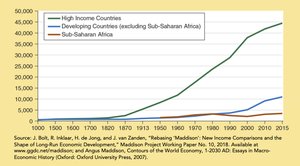
For most of human history, per capita GDP remained at or near subsistence levels. Significant and sustained economic growth began with the Industrial Revolution in the early 1800s, primarily in Western Europe, North America, Oceania, and Japan. In contrast, much of the rest of the world experienced stagnation until the late 20th century, when many developing countries began to see rapid growth.
Pre-1800: Minimal growth in per capita income.
Post-Industrial Revolution: Rapid growth in high-income regions; slower progress elsewhere until recent decades.
Theories of Economic Development
Malthusian Theory of Development
The Malthusian theory posits that population growth will outpace agricultural production, leading to stagnation in living standards. Historically, this was true until technological advances and institutional changes allowed for sustained growth.
Key Point: Economic growth was limited by resource constraints and population growth until the Industrial Revolution.
Colonialism, European Settlements, and Institutions
The legacy of colonialism significantly influenced the development of institutions in former colonies. Where European settlers established permanent settlements, inclusive institutions often developed. In contrast, regions with harsh climates and high disease burdens saw the emergence of extractive institutions, which hindered long-term growth.
Extractive Institutions: Systems with minimal legal protections, allowing elites to seize resources.
Impact: Persistent underdevelopment in many regions, especially Sub-Saharan Africa and parts of Latin America.
Neoclassical Production Function Theory
This theory explains output as a function of capital, labor, and technology. While it describes how growth occurs, it does not explain why some countries invest more in capital and technology than others.
Production Function: where is output, is capital, is labor, and is technology.
Limitation: Does not address the root causes of growth, such as institutional quality.
Geography and Development
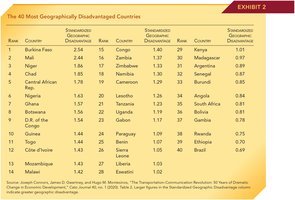
Geographic factors, such as climate, access to the sea, and disease prevalence, can significantly affect a country's development prospects. Countries with geographic disadvantages often face higher transportation costs, limited market access, and greater health challenges.
Geographically Disadvantaged Countries: Nations with significant barriers to trade and development due to their location and environment.
The Transportation-Communication Revolution
Reductions in Transportation and Communication Costs
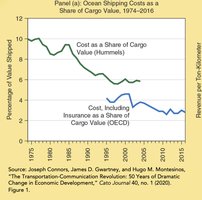
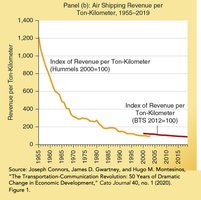
Over the past half-century, the costs of transporting goods and communicating information have fallen dramatically. This has facilitated greater international trade, the spread of technology, and economic growth, especially in countries with fewer geographic disadvantages.
Ocean Shipping: Costs as a share of cargo value have declined by more than 50% since 1974.
Air Freight: Revenue per ton-kilometer fell by 78% from 1970 to 2019, and by 94% since 1955.
Impact on International Trade
Lower transportation and communication costs have led to a substantial increase in the volume of international trade. This expansion has been especially pronounced in developing countries with fewer geographic disadvantages, generating mutual gains from specialization and large-scale production.
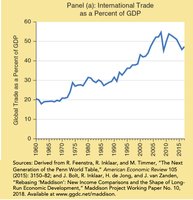
Global Trade: International trade as a share of world GDP rose from 20% in 1960 to about 50% in 2005–2017.
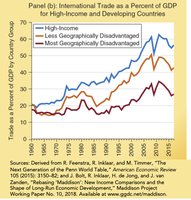
Country Differences: High-income and less geographically disadvantaged countries have seen greater increases in trade-to-GDP ratios compared to the most disadvantaged countries.
Gains from Entrepreneurship and Technology Transfer
Entrepreneurs in developing countries can adopt successful technologies and business practices from advanced economies at relatively low cost. The reduction in transportation and communication costs accelerates this process, fostering innovation and productivity growth.
Improvements in Economic Institutions
Greater interaction with the global economy can create incentives for countries to adopt sound economic institutions, further supporting development and growth.
Demographic Changes and the Virtuous Cycle of Development
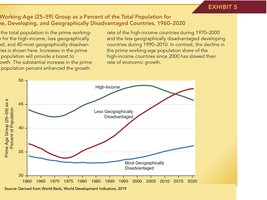
As economies grow and incomes rise, the opportunity cost of having children increases, leading to lower birth rates and a higher share of the population in the prime working age group (25–59). This demographic shift boosts labor productivity and economic growth.
Prime-Age Population: An increasing share of the population in the prime working age enhances productivity and growth.
Recent Trends in Economic Growth and Poverty Reduction
Growth of High-Income and Developing Countries
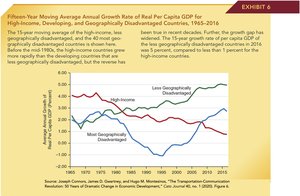
In recent decades, less geographically disadvantaged developing countries have experienced higher growth rates than high-income countries. The most geographically disadvantaged countries have also begun to see improvements since 2000.
15-Year Moving Average Growth Rate: In 2016, less geographically disadvantaged countries had a 5% growth rate, compared to less than 1% for high-income countries.
Best and Worst Growth Records
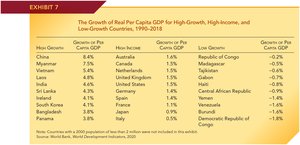
Countries vary widely in their economic growth performance. High-growth countries include China, Myanmar, and India, while some countries, particularly those with significant geographic or institutional challenges, have experienced negative growth.
High-Growth | Growth per Capita GDP | High-Income | Growth per Capita GDP | Low-Growth | Growth per Capita GDP |
|---|---|---|---|---|---|
China | 8.4% | Australia | 1.8% | Republic of Congo | -1.7% |
Myanmar | 6.8% | Canada | 1.6% | Madagascar | -1.6% |
India | 4.8% | Netherlands | 1.5% | Haiti | -1.5% |
Lao | 4.7% | United Kingdom | 1.5% | Central African Republic | -1.4% |
Sri Lanka | 4.1% | United States | 1.5% | Burundi | -1.4% |
Vietnam | 4.1% | Germany | 1.3% | Democratic Republic of Congo | -1.0% |
Bangladesh | 3.8% | Japan | 0.9% | ||
Ethiopia | 3.7% | Italy | 0.5% |
Reduction in Worldwide Poverty
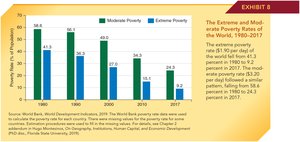
There has been a dramatic reduction in both extreme and moderate poverty rates worldwide over the past four decades. Extreme poverty fell from 41.3% in 1980 to 9.2% in 2017, while moderate poverty dropped from 58.6% to 24.3% over the same period.
Extreme Poverty: Living on less than $1.90 per day (2011 PPP).
Moderate Poverty: Living on less than $3.20 per day (2011 PPP).
Lessons and Future Prospects
Lessons from Two Centuries of Economic Development
Technological progress and reductions in transportation and communication costs have been crucial for economic development, especially for countries with fewer geographic disadvantages. However, the adoption of sound institutions remains essential for sustaining progress.
Institutions and Policies: The political process determines whether sound institutions are adopted, and there is no guarantee of continued progress.
Can Economic Progress Be Maintained?
Despite advances in understanding the institutional framework supportive of growth, there is no assurance that all countries will continue to adopt and maintain sound policies. Political and institutional challenges remain significant obstacles to sustained development.
