 Back
BackEconomic Efficiency, Government Price Controls, and Market Outcomes
Study Guide - Smart Notes
 Tailored notes based on your materials, expanded with key definitions, examples, and context.
Economic Efficiency and Government Price Controls
Introduction
This chapter explores how government interventions such as price ceilings and price floors affect market efficiency, consumer and producer surplus, and the overall allocation of resources. It also examines the consequences of these policies, including deadweight loss, black markets, and the distribution of gains and losses among market participants.
Efficient Markets
Requirements for Market Efficiency
Accurate Information: All buyers and sellers have access to relevant information about prices and products.
Property Rights: Ownership rights are clearly defined and protected by law.
Contract Enforcement: Legal systems ensure that contracts are honored.
No Externalities: There are no external costs or benefits affecting third parties outside the market transaction.
Competitive Markets: Many buyers and sellers interact, ensuring no single participant can control the market price.
When these conditions are met, markets allocate resources efficiently through the price mechanism, directing goods and services to their most valued uses.
Consumer and Producer Surplus
Definitions and Measurement
Consumer Surplus: The difference between the maximum price a consumer is willing to pay and the actual price paid. It represents the net benefit to consumers from market transactions.
Producer Surplus: The difference between the actual price received by producers and the minimum price they are willing to accept. It measures the net benefit to producers.
Economic Surplus: The sum of consumer and producer surplus, representing the total net benefit to society from market transactions.
Consumer and producer surplus are key measures of the gains from trade in a market. Economic efficiency is achieved when the sum of these surpluses is maximized.
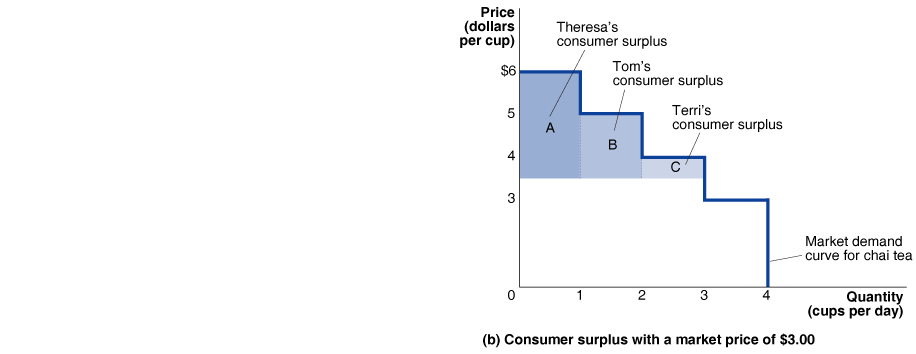
Example: The graph above shows consumer surplus in the market for chai tea. The shaded areas represent the surplus received by individual consumers when the market price is $3.00 per cup.
Disequilibrium Pricing: Price Ceilings and Price Floors
Government-Imposed Price Controls
Price Ceiling: A legal maximum price set below the equilibrium price. Example: Rent control.
Price Floor: A legal minimum price set above the equilibrium price. Example: Minimum wage, agricultural price supports.
Price controls disrupt the natural equilibrium of supply and demand, leading to shortages or surpluses and reducing economic efficiency.
Price Ceilings: Effects and Examples
Rent Control
Rent control laws set a maximum price landlords can charge for apartments.
Intended to make housing more affordable, but can lead to shortages and benefit higher-income individuals who secure rent-controlled units.

Example: In cities with rent control, the quantity of apartments demanded increases while the quantity supplied decreases, resulting in a shortage of available housing.
Effects of Price Ceilings:
Increase quantity demanded
Decrease quantity supplied
Create a market shortage
Lead to deadweight loss (reduction in economic surplus)
Increase consumer surplus at the expense of producer surplus
Price Floors: Effects and Examples
Minimum Wage and Agricultural Price Supports
Price floors set a minimum price above equilibrium, increasing quantity supplied and decreasing quantity demanded, resulting in a surplus.
Minimum wage laws are a common example, intended to raise incomes for low-skilled workers but may reduce employment opportunities.
Agricultural price supports guarantee farmers a minimum price, often leading to excess supply.
Effects of Price Floors:
Increase quantity supplied
Decrease quantity demanded
Create a market surplus
Lead to deadweight loss (reduction in economic surplus)
Increase producer surplus at the expense of consumer surplus
Additional info: A government-imposed price floor may also result in a wrong mix of output, increased tax burden, altered income distribution, political favoritism, and government failure if it does not improve economic outcomes.
Deadweight Loss and Market Inefficiency
Definition and Causes
Deadweight Loss: The reduction in economic surplus that occurs when a market is not in competitive equilibrium due to price controls or other interventions.
Both price ceilings and price floors create deadweight loss by preventing mutually beneficial trades from occurring.
Black Markets and Unintended Consequences
Law of Unintended Consequences
Government price controls can lead to the emergence of black markets, where goods are traded illegally at prices above the legal maximum or below the legal minimum.
Black market prices for apartments, for example, may exceed the equilibrium price, further reducing efficiency and fairness.
Additional info: The existence of black markets illustrates how well-intentioned policies can have adverse effects, such as increased illegal activity and reduced market transparency.
Winners, Losers, and Economic Analysis
Distributional Effects of Price Controls
Price controls create winners (those who benefit from lower prices or higher incomes) and losers (those who face shortages, surpluses, or reduced income).
There is always a loss of economic efficiency due to deadweight loss.
Positive analysis examines the effects of these policies, while normative analysis considers whether the outcomes are desirable.
Additional info: Whether the gains to winners outweigh the losses to losers and the decline in efficiency is a matter of judgment and not strictly an economic question.
