 Back
BackEconomic Efficiency, Government Price Setting, and Taxes: Core Concepts and Applications
Study Guide - Smart Notes
 Tailored notes based on your materials, expanded with key definitions, examples, and context.
Economic Efficiency, Government Price Setting, and Taxes
4.1 Consumer Surplus and Producer Surplus
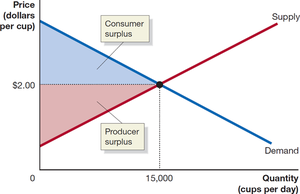
In market transactions, both consumers and producers can gain benefits, measured as consumer surplus and producer surplus. These concepts help economists evaluate the welfare effects of market outcomes.
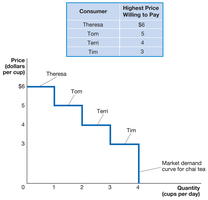
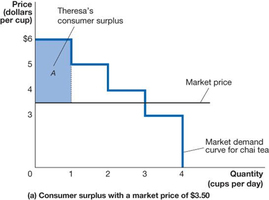
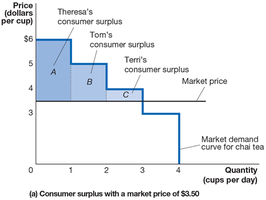
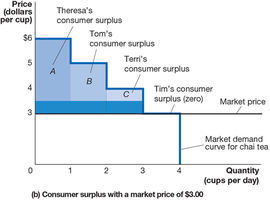
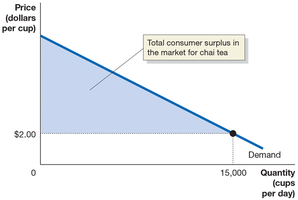
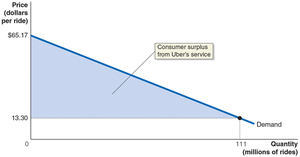
Consumer Surplus: The difference between the highest price a consumer is willing to pay for a good or service and the actual price paid. It represents the net benefit to consumers from participating in the market.
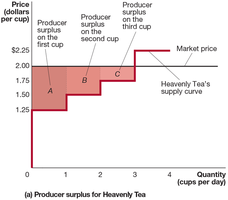
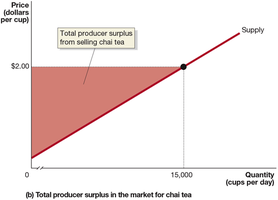
Producer Surplus: The difference between the lowest price a firm would accept for a good or service (usually the marginal cost) and the price it actually receives. It measures the net benefit to producers.
Marginal Benefit: The additional benefit to a consumer from consuming one more unit of a good or service.
Marginal Cost: The change in a firm’s total cost from producing one more unit of a good or service.
Example: If a consumer is willing to pay $6 for a cup of chai tea but pays only $3.50, the consumer surplus is $2.50.
4.2 The Efficiency of Competitive Markets
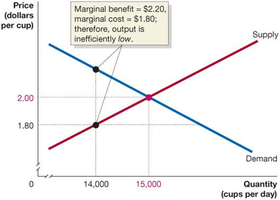
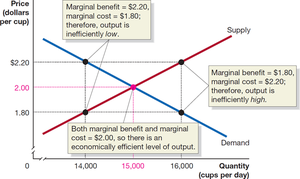
Economic efficiency in markets is achieved when resources are allocated to maximize the sum of consumer and producer surplus, known as economic surplus. This occurs at the competitive equilibrium, where the marginal benefit to consumers equals the marginal cost to producers.
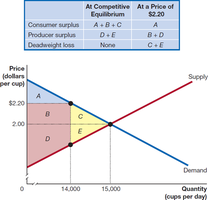
Economic Surplus: The sum of consumer surplus and producer surplus.
Deadweight Loss: The reduction in economic surplus resulting from a market not being in competitive equilibrium.
Economic Efficiency: A market outcome in which the marginal benefit to consumers of the last unit produced equals its marginal cost of production, and the sum of consumer and producer surplus is maximized.
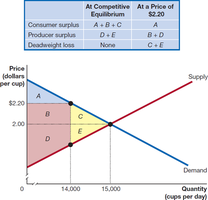
4.3 Government Intervention in the Market: Price Floors and Price Ceilings
Governments may intervene in markets by imposing price floors (minimum prices) or price ceilings (maximum prices). These interventions can lead to surpluses, shortages, and deadweight loss, reducing economic efficiency.
Price Ceiling: A legally determined maximum price that sellers may charge (e.g., rent controls).
Price Floor: A legally determined minimum price that sellers may receive (e.g., minimum wage, agricultural price supports).
Price controls can benefit some groups (e.g., renters with lower rents) but harm others (e.g., landlords, those unable to find apartments).
Deadweight loss arises because fewer transactions occur than would be efficient.
Example: A price floor in the wheat market above equilibrium price leads to a surplus of wheat and deadweight loss.
4.4 The Economic Effect of Taxes
Taxes are a primary means for governments to raise revenue, but they also affect market outcomes by shifting supply or demand curves, changing equilibrium prices and quantities, and creating deadweight loss.
Per-Unit Tax: A tax assessed as a fixed dollar amount per unit sold (e.g., excise tax on gasoline).
Tax Incidence: The actual division of the burden of a tax between buyers and sellers, determined by the relative elasticities of demand and supply, not by legal assignment.
Excess Burden: The deadweight loss from a tax.
A tax is more efficient if it raises more revenue with less deadweight loss.
Example: A $1-per-pack tax on cigarettes shifts the supply curve up, raises the price for consumers, lowers the price received by producers, and generates tax revenue for the government, but also creates deadweight loss.
Appendix: Quantitative Demand and Supply Analysis
Quantitative analysis involves using demand and supply equations to calculate equilibrium price and quantity, as well as the effects of government interventions such as price controls.
Set demand equal to supply to solve for equilibrium.
Calculate consumer and producer surplus using the area of triangles and rectangles under the demand and above the supply curves.
Assess the impact of price ceilings or floors by recalculating quantities and surpluses, and identifying deadweight loss.
Policy | Consumer Surplus | Producer Surplus | Deadweight Loss |
|---|---|---|---|
Equilibrium | High | High | None |
Price Ceiling | Varies (some gain, some lose) | Lower | Present |
Price Floor | Lower | Varies (some gain, some lose) | Present |
Tax | Lower | Lower | Present |
Key Equations:
Equilibrium:
Consumer Surplus (triangle area):
Producer Surplus (triangle area):
Deadweight Loss: Area between demand and supply curves for units not traded due to intervention
Additional info: These notes synthesize the main concepts, definitions, and applications from Chapter 4, providing a comprehensive yet concise study guide for macroeconomics students.
