 Back
Economic Growth: Concepts, Models, and Drivers in Macroeconomics
Study Guide - Smart Notes
 Tailored notes based on your materials, expanded with key definitions, examples, and context.
Economic Growth
Introduction to Economic Growth
Economic growth refers to the sustained increase in a nation’s real GDP or real GDP per capita over time. It is a central topic in macroeconomics, as it determines improvements in living standards and the expansion of production possibilities. Growth trends are analyzed both in the short run (business cycles) and the long run (potential GDP).
Real GDP: The value of all final goods and services produced within a country, adjusted for inflation.
Potential GDP: The maximum output an economy can produce when operating at full capacity, smoothing out business cycle fluctuations.
Growth Rate: The annual percentage change in real GDP or real GDP per capita.
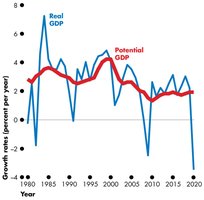
Additional info: Potential GDP growth is less volatile than real GDP, reflecting the underlying expansion of productive capacity.
Long-Term Growth Trends in the US
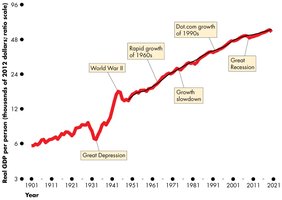
Over the past century, the United States has experienced average per capita growth of about 2% per year. Even moderate growth rates, when sustained, lead to significant increases in income and living standards over time.
Ratio Scale (Log Scale): Used to visualize exponential growth, making it easier to see proportional changes.
Rule of 70: The number of years required for a variable to double is approximately 70 divided by its annual growth rate.
Example: At 2% growth, income doubles in 35 years; at 7% growth, it doubles in 10 years.
Comparing US and International Growth
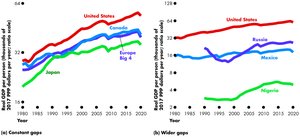
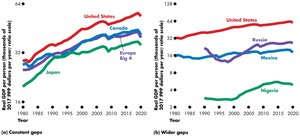
Growth rates and levels of real GDP per capita vary across countries. Advanced economies like the US, Canada, Japan, and Europe have experienced steady growth, while emerging markets show more variability.
Convergence: Poorer countries are expected to grow faster than richer ones due to diminishing marginal returns, but this is not always observed.
Growth Gaps: Differences in growth rates can lead to widening or narrowing gaps in income per capita between countries.
Production Functions and Growth Models
The Cobb-Douglas Production Function
The aggregate production function describes how inputs like labor and capital are transformed into output. The Cobb-Douglas form is widely used in macroeconomics:
Formula:
Y: Output (GDP)
A: Total Factor Productivity (TFP)
K: Capital stock
N: Labor input
\alpha: Capital share parameter (0 < \alpha < 1)
Additional info: TFP captures the efficiency with which capital and labor are used.
Diminishing Marginal Returns
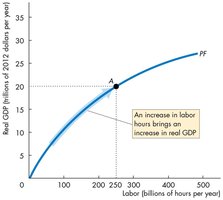
As more labor or capital is added, holding other inputs constant, the additional output produced from each extra unit decreases. This is known as diminishing marginal returns.
Concave Production Function: The output curve flattens as more labor is added.
Implication: Increasing labor or capital alone cannot sustain high growth indefinitely.
Labor Market and Growth
Labor Market Equilibrium
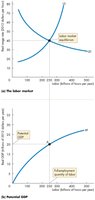
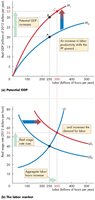
The amount of labor used in production is determined by the equilibrium between labor demand and labor supply.
Labor Demand: Downward sloping due to diminishing marginal returns.
Labor Supply: Upward sloping; higher real wages encourage more work.
Equilibrium: Where labor demand equals labor supply, determining employment and real wage.
Sources of Growth in GDP
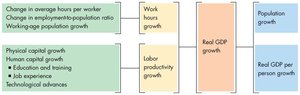
Growth in GDP can be attributed to increases in labor supply and improvements in labor productivity.
Labor Supply Growth: More hours worked, higher employment/population ratio, population growth.
Labor Productivity Growth: Investment in physical capital, human capital, and technological innovation.
Growth in the Supply of Labor
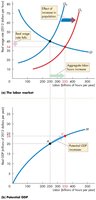
Increasing the supply of labor raises total output but may lower real wages. There are natural limits to labor supply, such as time constraints and maximum employment ratios. Population growth increases GDP but not necessarily GDP per capita.
Growth in Labor Productivity
Higher labor productivity increases labor demand and real wages. Productivity improvements stem from investments in physical capital, human capital, and technological innovation.
Drivers of Economic Growth
Investment in Physical Capital
Physical capital investment (machinery, infrastructure) increases labor productivity and output. However, due to diminishing returns, the impact of additional capital decreases as the capital stock grows. Sustained growth requires more than just capital accumulation.
Gross Investment: Total new capital added.
Depreciation: Capital lost due to wear and tear.
Solow Model: Capital accumulation alone cannot sustain long-run growth without technological progress.
Investment in Human Capital
Human capital investment (education, training, experience) enhances workers’ skills and knowledge, raising productivity. There are limits to productivity gains from human capital alone.
Education: Formal schooling and skill acquisition.
On-the-job Training: Learning through work experience.
Technological Change
Technological innovation is a major driver of long-run growth. It increases total factor productivity (TFP), allowing more output from the same inputs. Technological progress has accelerated since the industrial revolution and remains crucial for sustained growth.
TFP: Captures the effects of technology, efficiency, and innovation.
Main Engine of Growth: TFP is essential for increasing GDP per capita in the long run.
Theories of Economic Growth
Malthusian Theory (Pre-Industrial Revolution)
Malthus argued that pre-industrial economies were trapped in poverty. Any increase in living standards led to population growth, which eventually reduced per capita income back to subsistence levels.
Poverty Trap: Population growth offsets gains in output, keeping per capita income constant.
Demographic Revolution: After the industrial revolution, birth rates fell, allowing sustained per capita growth.
Neoclassical Growth Theory (Post-Industrial Revolution)
Modern growth theory recognizes that sustained per capita growth is possible when population growth is moderate. Capital accumulation has limits, and long-run growth depends on increases in TFP.
Solow Model: Capital accumulation alone leads to diminishing returns; TFP is key for sustained growth.
Example: Communist countries grew rapidly with capital investment but stagnated without technological progress.
Capital, Convergence, and TFP
Diminishing returns suggest poor countries should grow faster, leading to income convergence. However, not all poor countries grow quickly; differences in TFP explain much of the variation.
Convergence: Fast growth in emerging markets, but not universal.
TFP: Varies widely among countries and is influenced by many factors.
What Determines TFP?
Total Factor Productivity is influenced by a range of institutional, social, and economic factors.
Peace and Security: Stability encourages investment and growth.
Institutions: Accountability, transparency, predictability, and economic freedoms foster innovation and productivity.
Regulation: Effective regulation supports industry growth without excessive costs.
Market Systems: Competition and provision of public goods (infrastructure, education, health) support TFP growth.
Natural Resources: Can be a blessing or a curse, depending on management and economic structure.
Example: The World Bank’s Doing Business Ranking attempted to measure institutional quality but was discontinued due to political pressures.
Additional info: TFP is multidimensional and complex, with no simple solution to the problem of economic growth.
