 Back
BackEconomic Growth, the Financial System, and Business Cycles: Study Notes
Study Guide - Smart Notes
 Tailored notes based on your materials, expanded with key definitions, examples, and context.
Chapter 10: Economic Growth, the Financial System, and Business Cycles
Introduction
This chapter explores the determinants and measurement of long-run economic growth, the role of the financial system in supporting investment and growth, and the nature and consequences of business cycles. Understanding these concepts is essential for analyzing how economies expand over time and how they respond to short-term fluctuations.
Long-Run Economic Growth
Definition and Importance
Long-run economic growth refers to the process by which rising productivity increases the average standard of living
This growth improves the average standard of living, allowing individuals to consume more goods and services.
It is distinct from short-run fluctuations, which are the focus of the business cycle.
Business cycle: the alternating periods of economic expansion and economic recession
Real GDP per capita is the most common measure for this average standard of living, adjusting for population and inflation.
Example: Since 1900, real GDP per capita in the United States has increased more than nine-fold, reflecting significant improvements in living standards.
Economic Prosperity and Health
Richer nations can allocate more resources to health, leading to longer lifespans and higher productivity.
Economic growth is associated with increased leisure time, as higher productivity allows for more discretionary and leisure hours.
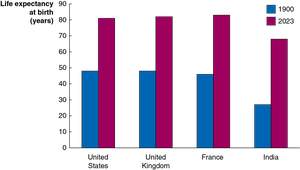
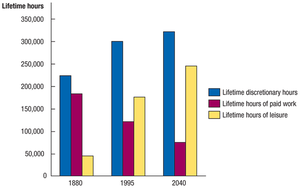
Example: Over the past century, both lifespans and leisure time have increased in developed economies.
Calculating Growth Rates
The growth rate of an economic variable (e.g., real GDP) is the percentage change from one year to the next.
For multi-year periods, the average annual growth rate can be calculated by averaging yearly rates or using the formula for compound growth:
For longer periods, solve for in:
Final Value = Current Real GDP
Initial Value= Previous Real GDP
T= the # of time periods between the previous and current periods
The Rule of 70 estimates the number of years for an economic variable to double:
Example: If the growth rate is 5%, the variable will double in 70/5 = 14 years
We can consume and produce (in an hour) more than 9 times as many goods and services now than in the 1900s
Determinants of Long-Run Growth
Labor productivity—the quantity of goods and services that can be produced by one worker or by one hour of work
Key factors influencing productivity growth:
Increases in capital per hour worked: More physical and human capital boosts productivity.
Capital is the physical assets and intellectual property that are used to produce other goods and services
Human capital- the accumulated knowledge and skills workers possesses
Physical capital- machinery
Technological change: Innovations and improved methods of production (capital) increase output per worker.
The role of entrepreneurs is critical in pioneering new ways to bring together factors of production to produce better or lower-cost products
Factors of production: labor, capital, land and entrepreneurship
Property rights: Secure property rights and effective legal systems encourage investment and innovation.
Governments can aid growth by establishing independent court systems to enforce contracts between private individuals
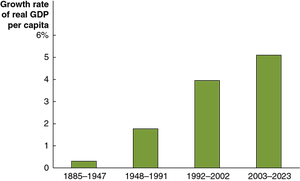
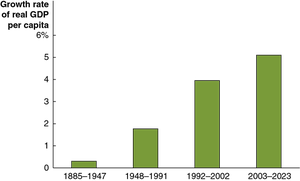
Case Study: India’s Economic Growth
India’s growth accelerated after market-based reforms in 1991, but sustaining growth requires continued improvements in infrastructure, education, health, and governance.
Potential GDP
Potential GDP is the level of real GDP (adjusted for inflation, output) attained when all firms are operating at capacity.
Capacity: refers to "normal" hours and a "normal" sized workforce
It grows with increases when the labor force expands, when a nation acquires more capital stock, and when new technologies are created.
The growth in the potential GDP in the u.S has been steady at about 3.1%
Actual GDP can fall below potential during recessions, creating an output gap (widens). So, Potential GDP = Actual Real GDP before a recession
Saving, Investment, and the Financial System
The Role of the Financial System
Firms can finance some of their own expansion through retained earnings, reinvesting profits back into the firm. But often firms want to obtain more funds for expansion than are available, they obtain these funds via the financial system.
The financial system channels funds from savers to borrowers, facilitating investment and economic growth.
Financial markets are markets where financial securities, such as stocks and bonds, are bought and sold.
Financial security: A document (sometimes electronic) stating the terms under which funds pass from the buyer of the security to the seller.
Stock: A financial security representing partial ownership of a firm.
Bond: A financial security promising to repay a fixed amount of funds. A bond is essentially a loan from a household to a firm.
Financial intermediaries are firms, such as banks, mutual funds, pension funds, and insurance companies, that borrow funds from savers and lend them to borrowers.
Services the Financial System Provides
Risk sharing: Diversification reduces individual risk.
Liquidity: Assets can be quickly converted to cash.
Information: Prices reflect aggregated information about future prospects.
Macroeconomics of Savings and Investment
In equilibrium, the total value of saving in the economy must equal the total value of investment (S=I)
We express GDP of a nation (Y) in an open economy as
Y= C + I +G +NX
In a closed economy, GDP () is the sum of consumption (), investment (), and government purchases ():
In a closed economy, NX=0
Rearranged for investment:
Savings
Payments for factors of production= wages
Total savings aka. National Savings
Thus, in equilibrium, savings equals investment.
T > G +TR (budget surplus)
T < G + TR (budget deficit)
The Market for Loanable Funds
A convenient way to model these different markets is as a single market: the market for loanable funds, a (conceptual) interaction of borrowers and lenders that determines the market interest rate and the quantity of loanable funds exchanged
Firms demand loanable funds for investment; households supply them through saving.
Government deficits reduce the supply of loanable funds, raising interest rates and crowding out private investment.
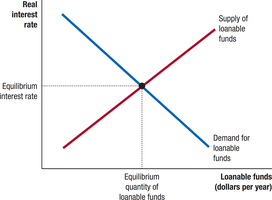
Remember: NX = 0 and S=I in a closed economy
The price of loanable funds in this case is the real interest rate
Shifts in the Loanable Funds Market
Increase in demand (e.g., due to technological change) raises both the equilibrium interest rate and quantity of funds loaned.
Government budget deficits decrease the supply of loanable funds, raising interest rates and reducing investment (crowding out).
The government is spending more than they earn
In practice, the effect of gov. budget deficits and surpluses on the equilibrium interest rate is relatively small
This effect is small b/c interest rates are influenced by global markets, so even few hundred billion dollars is a relatively minor amount
Summary Table: Loanable Funds Model
The Business Cycle
Phases of the Business Cycle
The business cycle consists of alternating periods of economic expansion (rising real GDP) and recession (falling real GDP).
Turning points are called peaks (end of expansion) and troughs (end of recession).
Identifying Recessions
Common media definition: Two consecutive quarters of declining real GDP.
National Bureau of Economic Research (NBER) definition: A significant decline in activity spread across the economy, lasting more than a few months, visible in industrial production, employment, real income, and trade.
Two quarters = two periods of three months each (so, six months total).
Typical Features of the Business Cycle
Near the end of expansions: Rising interest rates and wages, falling profits.
During recessions: Firms cut investment and employment, households reduce consumption, leading to further declines.
Recovery: Firms and households resume investment and spending, employment recovers.
Inflation and the Business Cycle
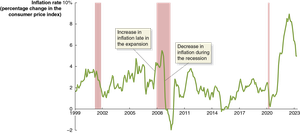
Inflation rate: measures the change in the price level from one year to the next
Inflation tends to rise late in expansions and fall during recessions.
During recessions, demand is low relative to supply, leading to slower price increases or deflation.
Unemployment and the Business Cycle
Unemployment rises during recessions as firms reduce production and lay off workers.
Unemployment often continues to rise even after a recession ends.
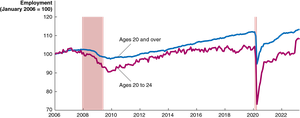
Impact on Younger Workers
Younger workers are often more severely affected by recessions, with higher unemployment rates and slower employment recovery.
Why Economists Cannot Predict Recessions
Business cycles are not uniform
Leading economic indicators are unreliable.
Recessions are often triggered by unpredictable events.
Fluctuations in Real GDP
Annual fluctuations in real GDP were larger before 1950; since then, cycles have become milder—a period known as the Great Moderation.
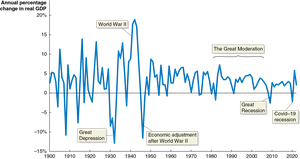
Explaining the Great Moderation
Greater importance of services (less affected by recessions than manufacturing).
Establishment of unemployment insurance and transfer programs, which stabilize consumption.
Active government stabilization policies to manage the business cycle.
Increased stability of the financial system.
Additional info: These notes synthesize and expand upon the provided slides and textbook content, ensuring a comprehensive and academically rigorous overview suitable for exam preparation.
