 Back
BackEconomic Growth, the Financial System, and Business Cycles: Chapter 10 Study Notes
Study Guide - Smart Notes
 Tailored notes based on your materials, expanded with key definitions, examples, and context.
Economic Growth, the Financial System, and Business Cycles
10.1 Long-Run Economic Growth
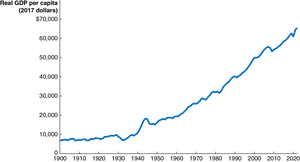
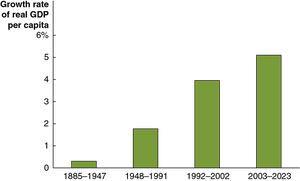
Long-run economic growth refers to the sustained increase in real GDP per capita, which raises the average standard of living. This growth is distinct from short-run fluctuations, known as the business cycle. The most common measure of living standards is real GDP per capita, which adjusts for changes in the price level.
Definition: Real GDP per capita is the total production in the economy per person, adjusted for inflation.
Contrast: Long-run growth is a gradual upward trend, while the business cycle consists of expansions and recessions.
Example: Since 1900, real GDP per capita in the United States has increased more than nine-fold, allowing the average American to purchase far more goods and services.
Economic Prosperity and Health
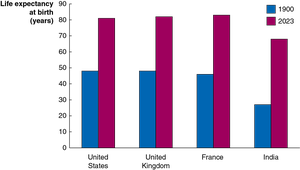
Economic prosperity is closely linked to health outcomes. Wealthier nations can allocate more resources to healthcare, and healthier citizens contribute to higher productivity. In addition to GDP, increased lifespans and leisure time are important indicators of prosperity.
Health: Higher real GDP per capita enables better healthcare and longer lifespans.
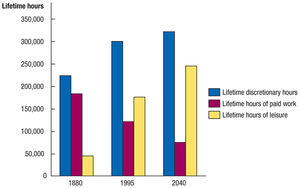
Leisure: As productivity and lifespans increase, people spend more time on leisure and less on work.
Prediction: Nobel laureate Robert Fogel predicts continued improvements in leisure and health.
Calculating Growth Rates
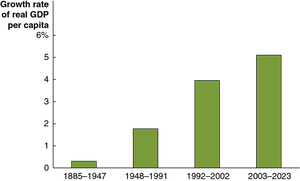
The growth rate of an economic variable, such as real GDP, is the percentage change from one year to the next. For multi-year periods, average annual growth rates are used. For longer periods, the growth rate can be calculated using the formula:
Annual Growth Rate:
Rule of 70: The number of years for a variable to double is approximately .
What Determines the Rate of Long-Run Growth?
Long-run growth in real GDP per capita depends primarily on increases in labor productivity, which is the quantity of goods and services produced by one worker or one hour of work.
Labor Productivity: Higher productivity means more output per worker.
Key Factors:
Increases in capital per hour worked (physical and human capital)
Technological change (new methods and innovations)
Secure property rights (legal framework for markets)
Entrepreneurs: Play a critical role in introducing new technologies and organizing production efficiently.
Apply the Concept: Can India Sustain Its Rapid Growth?
India's economic growth accelerated after market-based reforms in 1991, doubling its real GDP per capita growth rate. Sustaining this growth requires improvements in infrastructure, education, health, and regulatory reforms.
Key Policies: Reducing corruption, modernizing infrastructure, and maintaining rule of law.
Potential GDP
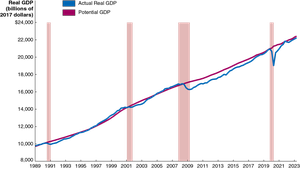
Potential GDP is the level of real GDP achieved when all firms operate at normal capacity. It increases with a larger labor force, more capital, and technological advances. Actual GDP can fall below potential during recessions, creating a gap.
Steady Growth: U.S. potential GDP has grown at about 3.1% annually.
Recessions: Widen the gap between potential and actual GDP.
10.2 Saving, Investment, and the Financial System
The Role of the Financial System
The financial system facilitates long-run economic growth by channeling funds from savers to borrowers. Firms often need more funds than they can generate internally, so they rely on financial markets and intermediaries.
Financial Markets: Where securities like stocks and bonds are traded.
Financial Intermediaries: Institutions such as banks, mutual funds, and insurance companies that connect savers and borrowers.
Services Provided:
Risk sharing
Liquidity
Information aggregation
The Macroeconomics of Savings and Investment
In a closed economy, total savings must equal total investment. GDP () is the sum of consumption (), investment (), government purchases (), and net exports (). For a closed economy ():
Savings are divided into private (households) and public (government) savings:
Private Savings:
Public Savings:
Total Savings:
Thus, savings equals investment in a closed economy.
The Market for Loanable Funds
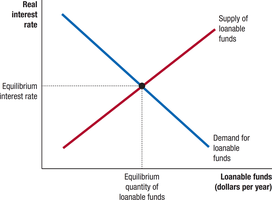
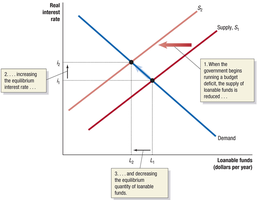
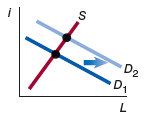
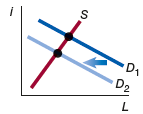
The market for loanable funds models the interaction between borrowers and lenders, determining the equilibrium interest rate and quantity of funds exchanged. Households supply funds, firms demand them, and government actions affect the supply.
Equilibrium: The real interest rate adjusts to balance supply and demand for loanable funds.
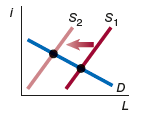
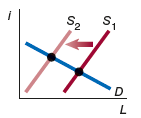
Government Deficits: Reduce the supply of funds, raising interest rates and crowding out private investment.
Summary of the Loanable Funds Model
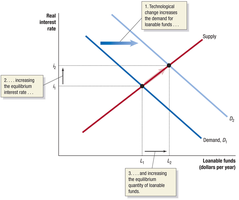
The loanable funds model summarizes how changes in demand and supply affect equilibrium interest rates and investment.
Event | Effect on Interest Rate | Effect on Investment |
|---|---|---|
Increase in demand for loanable funds | Interest rate rises | Investment rises |
Government budget deficit | Interest rate rises | Investment falls (crowding out) |
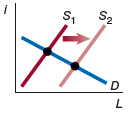
Government budget surplus | Interest rate falls | Investment rises |
Global capital flows | Interest rate effect is small | Investment effect is small |
10.3 The Business Cycle
Phases of the Business Cycle
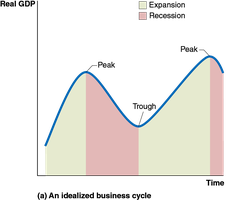
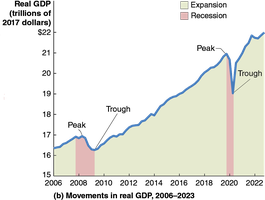
The business cycle consists of alternating periods of economic expansion and recession. Expansions are periods of rising real GDP, while recessions are periods of falling real GDP. Peaks and troughs mark the transitions between these phases.
Expansion: Rising output and employment
Recession: Falling output and employment
Peak: Transition from expansion to recession
Trough: Transition from recession to expansion
Identifying Recessions
Recessions are typically defined as two consecutive quarters of declining real GDP, but economists rely on broader criteria, including declines in industrial production, employment, real income, and trade.
Features of the Business Cycle
Common features include rising interest rates and wages near the end of expansions, falling profits, reduced investment and consumption during recessions, and eventual recovery as firms and households resume spending.
Effect of the Business Cycle on Inflation
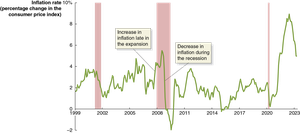
Inflation rates tend to rise during expansions and fall during recessions. High demand during expansions pushes prices up, while low demand during recessions slows price increases or causes deflation.
Effect of the Business Cycle on Unemployment
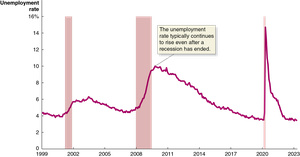
Unemployment rises during recessions as firms cut production and lay off workers. It often continues to rise even after a recession ends, before gradually declining during expansions.
Impact on Younger Workers
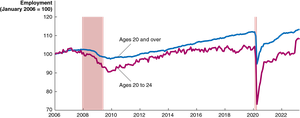
Younger workers are disproportionately affected by recessions, experiencing higher unemployment rates and slower recovery compared to older workers.
Why Can’t Economists Predict Recessions?
Recessions are difficult to predict due to the non-uniform nature of business cycles, unreliable leading indicators, and unpredictable triggering events.

Fluctuations in Real GDP
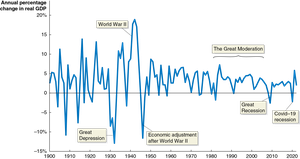
Annual fluctuations in real GDP were larger before 1950. Since the mid-1980s, business cycles have become milder, a period known as the Great Moderation.
Explaining the Great Moderation
The Great Moderation is attributed to several factors:
Increasing importance of services (less affected by recessions)
Establishment of unemployment insurance and transfer programs
Active government stabilization policies
Greater stability in the financial system
These factors suggest the U.S. economy may return to stability after severe recessions.
