 Back
Backchapter 10
Study Guide - Smart Notes
 Tailored notes based on your materials, expanded with key definitions, examples, and context.
Chapter 10: Economic Growth, the Financial System, and Business Cycles
10.1 Long-Run Economic Growth
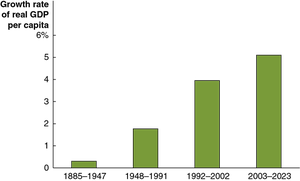
Long-run economic growth refers to the sustained upward trend in the economy's output over time, measured by increases in real GDP per capita. This growth is crucial for improving the average standard of living and is distinct from short-run fluctuations known as the business cycle.
Long-Run Economic Growth: The process by which rising productivity increases the average standard of living.
Real GDP per Capita: The amount of production in the economy per person, adjusted for changes in the price level. It is the most common measure of the standard of living.
Business Cycle: Alternating periods of economic expansion and recession.
Example: Since 1900, real GDP per capita in the United States has increased more than nine-fold, allowing the average American to consume far more goods and services than in the past.
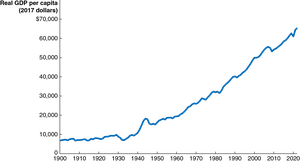
Economic Prosperity and Health
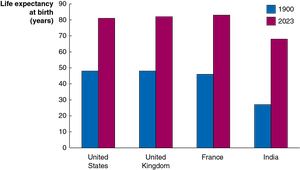
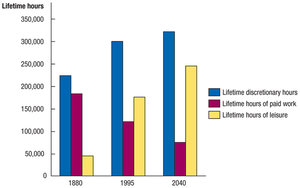
Economic prosperity enables nations to allocate more resources to health, leading to longer lifespans and greater productivity. As productivity and incomes rise, people can also enjoy more leisure time.
Health and Productivity: Richer nations can invest more in healthcare, resulting in healthier, more productive citizens.
Leisure: Increased productivity allows for more leisure time as less time is needed for work.
Example: Nobel laureate Robert Fogel predicts continued improvements in both lifespan and leisure time as economies grow.
Calculating Growth Rates
The growth rate of an economic variable, such as real GDP, is the percentage change from one year to the next. For multi-year periods, the average annual growth rate can be calculated, and for longer periods, the Rule of 70 provides a shortcut for estimating doubling time.
Growth Rate Formula:
Rule of 70: The number of years for a variable to double is approximately .
Determinants of Long-Run Growth
Long-run growth in real GDP per capita depends primarily on increases in labor productivity, which is influenced by capital, technology, and institutional factors.
Labor Productivity: The quantity of goods and services produced by one worker or one hour of work.
Key Factors:
Capital per Hour Worked: More physical and human capital increases productivity.
Technological Change: Innovations and improved methods of production boost output.
Property Rights: Secure property rights and effective legal systems encourage investment and innovation.
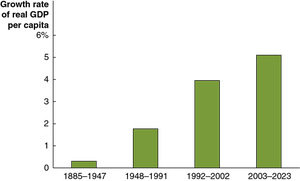
Example: The rapid economic growth in India since the 1990s is attributed to market-based reforms, infrastructure improvements, and regulatory changes.
Potential GDP
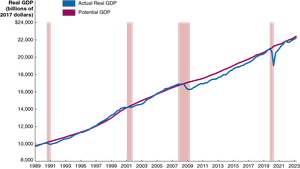
Potential GDP is the level of real GDP attained when all firms are operating at capacity, with normal hours and workforce. It grows with increases in the labor force, capital stock, and technological progress.
Potential GDP: Indicates the economy's productive capacity under normal conditions.
Actual vs. Potential GDP: Recessions create a gap between actual and potential GDP.
10.2 Saving, Investment, and the Financial System
The financial system channels funds from savers to borrowers, facilitating investment and economic growth. It includes financial markets and intermediaries, which provide risk sharing, liquidity, and information.
Financial Markets: Where securities like stocks and bonds are bought and sold.
Financial Intermediaries: Institutions such as banks and mutual funds that connect savers and borrowers.
Services Provided:
Risk Sharing: Diversification reduces risk for investors.
Liquidity: Assets can be quickly converted to cash.
Information: Prices reflect aggregated information about future returns.
The Macroeconomics of Savings and Investment
In a closed economy, total saving equals total investment. This relationship is derived from the national income identity:
National Income Identity:
Closed Economy (NX = 0):
Solving for Investment:
Private Saving:
Public Saving:
Total Saving:
The Market for Loanable Funds
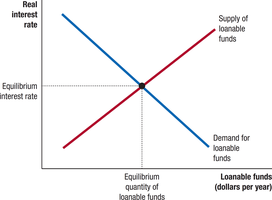
The market for loanable funds models the interaction between borrowers and lenders, determining the equilibrium real interest rate and the quantity of funds exchanged.
Borrowers: Firms seeking funds for investment.
Lenders: Households supplying savings.
Equilibrium: The real interest rate adjusts to equate saving and investment.
Shifts in the Loanable Funds Market
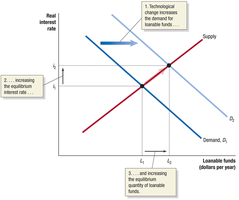
Increase in Demand: Technological change increases investment profitability, raising demand for loanable funds, the real interest rate, and the quantity loaned.
Budget Deficit (Crowding Out): Government deficits reduce the supply of loanable funds, raising interest rates and reducing private investment.
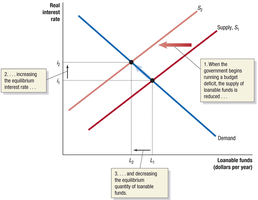
Summary Table: Loanable Funds Model
The following table summarizes the effects of various changes in the loanable funds market:
Event | Effect on Interest Rate | Effect on Investment |
|---|---|---|
Increase in demand for loanable funds | Interest rate rises | Investment rises |
Increase in supply of loanable funds | Interest rate falls | Investment rises |
Government budget deficit | Interest rate rises | Investment falls (crowding out) |
Government budget surplus | Interest rate falls | Investment rises |
Additional info: Table inferred from context and images 12–16. |
10.3 The Business Cycle
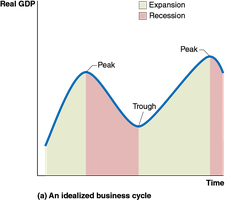
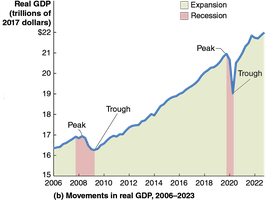
The business cycle refers to the recurring pattern of economic expansions and recessions. Real GDP does not grow at a constant rate but fluctuates over time.
Expansion: Periods when real GDP is rising.
Recession: Periods when real GDP is falling.
Peak: The highest point before a recession begins.
Trough: The lowest point before an expansion begins.
Identifying Recessions
Media Definition: Two consecutive quarters of declining real GDP.
Official Definition (NBER): A significant decline in activity spread across the economy, lasting more than a few months, visible in industrial production, employment, real income, and wholesale-retail trade.
Features of the Business Cycle
Near the end of expansions, interest rates and wages rise, but firm profits fall.
During recessions, investment and consumption decline, leading to layoffs and further reductions in spending.
Recovery begins as firms and households anticipate future growth and increase spending.
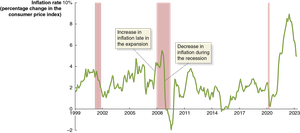
Business Cycle Effects on Inflation and Unemployment
Inflation: Tends to rise during expansions and fall during recessions.
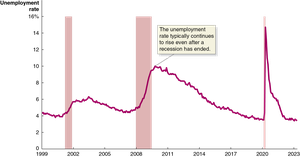
Unemployment: Rises during recessions, often continuing to increase even after the recession ends.
Impact on Different Groups
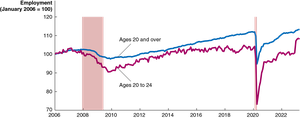
Younger workers are often more severely affected by recessions, with higher unemployment rates and slower employment recovery.
Predicting Recessions
Economists struggle to predict recessions due to the non-uniform nature of business cycles, unreliable leading indicators, and unpredictable triggering events.
Historical Fluctuations and the Great Moderation
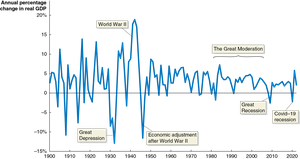
Annual fluctuations in real GDP were larger before 1950; since the mid-1980s, business cycles have been milder—a period known as the Great Moderation.
Factors contributing to stability include the shift toward services, government stabilization policies, and a more stable financial system.
Summary Table: Factors Affecting Business Cycle Stability
Factor | Effect on Stability |
|---|---|
Shift to services | Reduces volatility |
Unemployment insurance and transfer programs | Supports consumption during recessions |
Active government policies | Lengthens expansions, shortens recessions |
Stable financial system | Prevents severe downturns |
Additional info: Some tables and figures were logically reconstructed based on the context and referenced images. All equations are provided in LaTeX format as required.
