 Back
BackFederal Funds Market and Monetary Policy: Panel A and Panel B Analysis
Study Guide - Smart Notes
 Tailored notes based on your materials, expanded with key definitions, examples, and context.
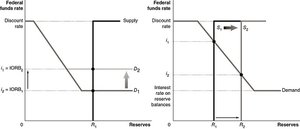
Q27. Refer to Figure 15-2. Which of the following statements is correct?
Background
Topic: Monetary Policy and Federal Funds Market
This question tests your understanding of how shifts in demand and supply in the federal funds market relate to expansionary and contractionary monetary policy. The federal funds rate is a key interest rate targeted by the Federal Reserve to influence economic activity.
Key Terms and Concepts:
Expansionary Monetary Policy: Actions by the Fed to lower interest rates and increase the money supply, typically to stimulate economic activity.
Contractionary Monetary Policy: Actions by the Fed to raise interest rates and decrease the money supply, typically to slow down economic activity.
Federal Funds Rate: The interest rate at which depository institutions lend reserve balances to other depository institutions overnight.
Demand and Supply Shifts: In Panel A, demand for reserves shifts up; in Panel B, supply of reserves shifts right.
Step-by-Step Guidance
Examine Panel A: The demand curve for reserves shifts upward from D1 to D2. This typically happens when the Fed is tightening policy, making reserves more expensive, which is associated with contractionary monetary policy.
Examine Panel B: The supply curve for reserves shifts right from S1 to S2. This usually occurs when the Fed is increasing the supply of reserves, which is associated with expansionary monetary policy.
Recall that expansionary policy involves increasing reserves (shifting supply right), while contractionary policy involves increasing demand for reserves (shifting demand up).
Match the descriptions to the answer choices, focusing on which panel represents which policy.
Try solving on your own before revealing the answer!
Final Answer: Panel A represents the Fed engaging in contractionary monetary policy and Panel B represents the Fed engaging in expansionary monetary policy.
Panel A shows a shift up in demand, which is contractionary. Panel B shows a shift right in supply, which is expansionary.
